Mars Impact Fund Puts $13M Into Cocoa Health, Mint Livelihoods, 4-H and Rabies Work

Six new Mars Impact Fund partnerships put more than $13 million into farmer health and income, youth science careers, and last-mile rabies work—on top of an $85 million 2025–2027 envelope.

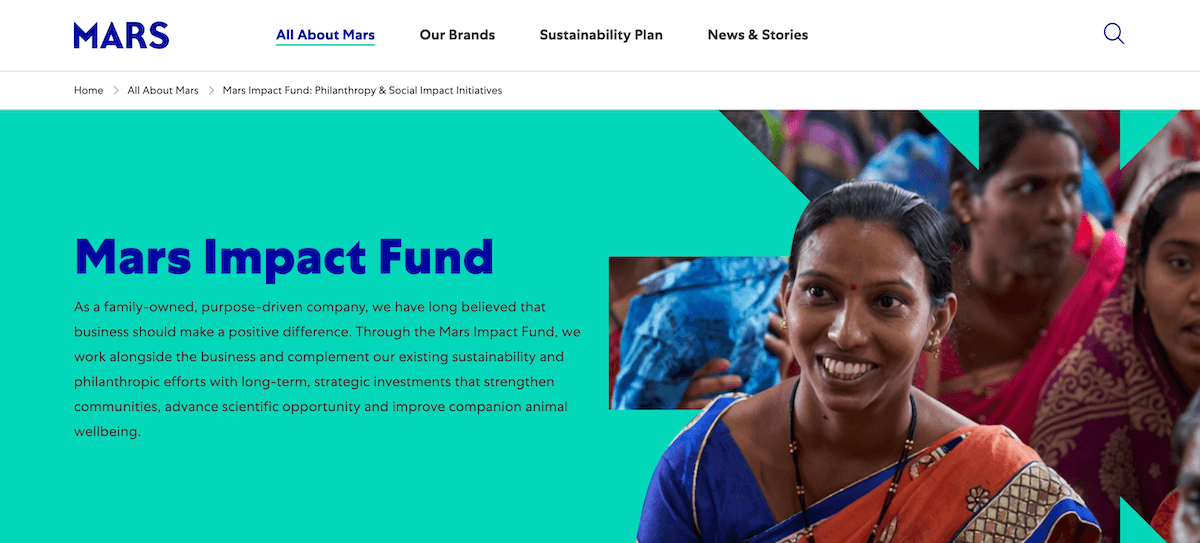
Mars, Incorporated wordmark used for Mars Impact Fund coverage

Photo credit: Mars, Incorporated

Key takeaways

  • The September 2026 round is more than $13M across six multi-year NGO partnerships in Côte d’Ivoire, India, the U.S. and Thailand.
  • The largest disclosed livelihood/health stacks sit on Mars cocoa (Elucid + Gavi) and mint (Tanager, with Pratham and PANI planned).
  • 4-H ($3M) and WVS rabies work in Thailand ($3M) fill the science-pipeline and companion-animal pillars.
  • The Fund launched in February 2026 with $85M for 2025–2027 and does not take unsolicited applications.

Mars is not running a typical open grant window. The Mars Impact Fund, launched in February 2026 as the company’s enterprise philanthropic arm, announced on 1 September 2026 that it is putting more than $13 million into six named partnerships. The money follows the Fund’s three published pillars, sourcing-community resilience, scientist pipelines, and companion-animal wellbeing, rather than a scatter of unrelated CSR cheques.

Causeartist is indexing the Fund as a corporate grantmaker, not a venture vehicle. The useful question for operators and other funders is how this round sits on Mars’s cocoa and mint supply chains, and what it signals about invitation-only corporate philanthropy at this scale.

What was announced

Mars, Incorporated said the new grants go to Elucid, Tanager, Pratham Education Foundation, People’s Action for National Integration (PANI), National 4-H Council and Worldwide Veterinary Service (WVS). Geography runs Côte d’Ivoire, India, the United States and Thailand. Executive director Michelle Grogg framed the round as multi-year partnerships meant to last, not a single-year press cycle.

Disclosed amounts in this package include about $2.07 million over three years for Elucid (plus roughly $2 million in Gavi matching funds), $5.6 million toward mint-farming communities in India via Tanager and planned education/nutrition work, $3 million for National 4-H Council, and $3 million for WVS in Thailand. That arithmetic is why the headline is “more than $13 million” rather than a single cheque.

Sourcing communities: cocoa health and mint income

The Côte d’Ivoire work is the clearest health-systems bet. Elucid is meant to help up to 12,750 cocoa-farming households enroll in national health insurance and cover gaps the public scheme leaves, while putting money into clinic quality, mobile clinics and maternal and child health. Gavi’s match is aimed at vaccination and disease prevention for at least 200,000 community members. For a company whose chocolate brands depend on West African cocoa, paying for rural care is both philanthropy and a resilience hedge.

In India the Fund is stacking livelihood and social infrastructure around mint. Tanager is slated to help 20,000 mint-farming families add potato, mustard and rice income. Planned work with Pratham would reach 3,000 children in Barabanki, Uttar Pradesh, on early childhood and school readiness; PANI would take on child undernutrition and WASH in rural schools. Mars says this sits next to Shubh Mint, which has already worked with more than 24,000 farmers and reports more than doubling mint incomes while cutting production costs by about 20%. Read that as: the Impact Fund is grafting health and education onto a commodity program that already exists, not inventing a mint strategy from scratch.

Scientist pipelines and last-mile rabies

Enjoying this? Get the next one.

We send one email a week with the best impact reads, interviews, and tools.

Free. Unsubscribe anytime.

In the U.S., $3 million to National 4-H Council is the Fund’s domestic science-talent line. Mars says the work could engage up to 200,000 young people around food, agriculture and veterinary careers, with innovation grants, digital career tools, leadership events, and 60 full scholarships to Ignite by 4-H. That maps to the second pillar the company published at launch: thicken the bench of people who might one day work in food science, agronomy or vet care, the same talent Mars’s pet hospitals and R&D actually hire.

The companion-animal grant is a $3 million WVS partnership on rabies elimination in Thailand. The pitch is last-mile: free-roaming and hard-to-reach dogs, stronger outbreak surveillance, and training capacity including WVS’s International Training Centre in Chiang Mai, alongside the Thai government’s campaign. Mars is explicit that this is a One Health play, people and animals, rather than a shelter-adoption grant of the kind PEDIGREE Foundation already makes in North America.

How this sits in the 2026 portfolio

This is not the Fund’s first cheque. At launch it committed $85 million for 2025–2027 and said it expects to deploy at least $50 million a year from 2028. Earlier 2026 awards include $1 million to World Central Kitchen for Venezuela earthquake meals, €1.5 million to the Lindau Nobel Laureate Meetings for early-career fellowships, $3 million to Save the Children in Indonesian cocoa communities, and $726,000 to Humane World for Animals for veterinary access in India and Mexico.

Two operating rules matter for anyone hoping to work with the Fund. First, it is not an impact-investing LP: there is no public check-size for equity. Second, the website is blunt that the team develops programs with partners and is not accepting unsolicited applications. The Causeartist Mars Impact Fund profile lists it as a corporate grantmaker for that reason.

Figures and partner names in this article are drawn from Mars’s 1 September 2026 announcement and earlier 2026 Fund press releases. Independent evaluation of outcomes is not yet public; household, vaccination and youth-reach numbers above are program targets as stated by Mars, not Causeartist-verified results.

Sources

  1. Mars Impact Fund awards more than $13M in new grants — PR Newswire / Mars, Incorporated (2026)
  2. Mars launches $85M Mars Impact Fund — Mars, Incorporated (2026)
  3. Mars Impact Fund — priorities and partners — Mars, Incorporated

FAQ

How much did the Mars Impact Fund award in September 2026?

Mars said more than $13 million across six partnerships: Elucid, Tanager, Pratham Education Foundation, PANI, National 4-H Council, and Worldwide Veterinary Service.

What are the Mars Impact Fund’s three pillars?

Sourcing-community resilience, growing scientist pipelines in food, agriculture and pet care, and improving companion-animal wellbeing. Disaster response is an additional operating role.

Can nonprofits apply to the Mars Impact Fund?

Not through an open portal. Mars says the team develops programs with partners and is not accepting unsolicited applications.

Support
 

Share:

Related Articles

View all articles

Get weekly impact insights

Founder stories, funding news, and tools — curated for impact builders.

Join 25,000+ Causeartists

Free. Unsubscribe anytime.