Triomics Raises $22M for AI Cancer Data Platform

The oncology AI company is working with Memorial Sloan Kettering, MD Anderson, and Yale Cancer Center to turn complex clinical records into actionable intelligence inside clinical workflows.

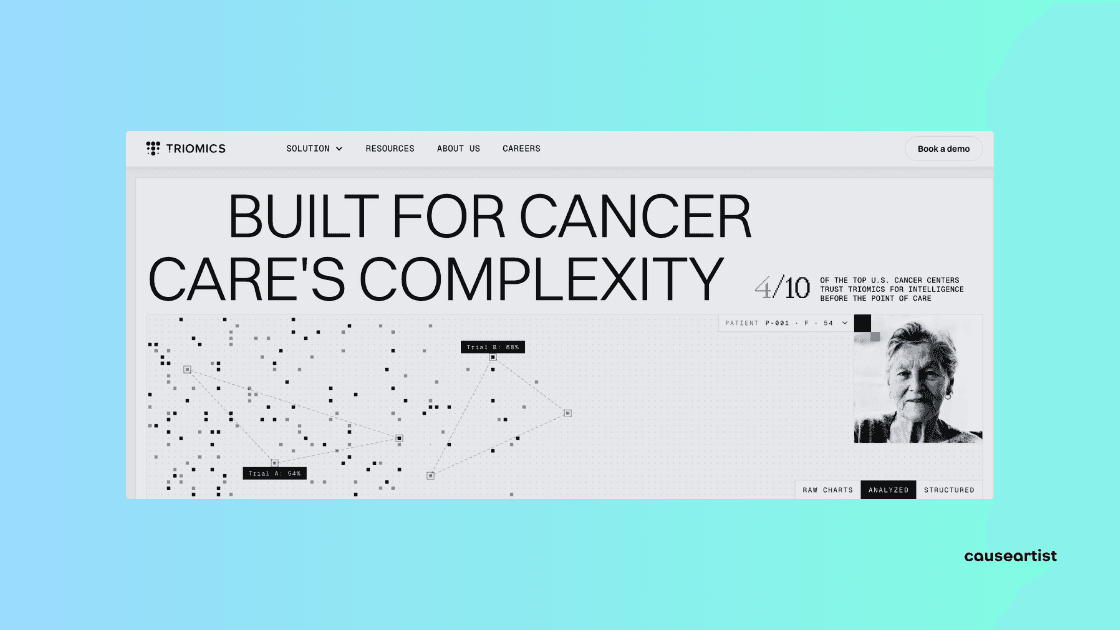
Triomics oncology AI platform — helping cancer centers match patients to clinical trials and reduce manual chart review burden

Photo credit: Triomics

Key takeaways

  • Triomics raised $22 million in Series B financing led by Battery Ventures, bringing total funding to more than $36 million.
  • The platform is deployed at Memorial Sloan Kettering, MD Anderson, Yale Cancer Center, Mount Sinai Tisch Cancer Center, and Texas Oncology.
  • Published results show a 40% increase in trial matches, 30%+ increase in trial enrollments, and 67% reduction in chart review time.
  • Every output from the Triomics platform is source-backed and verifiable inside the clinician's existing workflow — not a standalone summarization layer.
  • The same AI infrastructure powers multiple workflows (trial matching, chart prep, registry abstraction) without redundant integrations, which is the core platform leverage argument.
  • Yale New Haven Health System is using Triomics to pursue autonomous cancer registry abstraction — a currently manual, high-burden reporting obligation.
  • Triomics also serves life sciences organizations on clinical trial operations, positioning it at the intersection of provider workflow and research infrastructure.

The problem in oncology data is not scarcity. A single patient's record can span hundreds of clinic notes, pathology reports, radiology results, biomarker data, prior treatment histories, and constantly evolving clinical trial criteria. The problem is that the workflows required to make that information usable have remained almost entirely manual.

Triomics is building the infrastructure to change that. The New York-based oncology AI company has raised $22 million in Series B financing led by Battery Ventures, with participation from existing investors Nexus Venture Partners, Lightspeed, and Y Combinator, alongside strategic backers Oncology Ventures and Precision Health Informatics, a wholly-owned subsidiary of Texas Oncology. Total funding raised to date now exceeds $36 million.

What Triomics Actually Builds

Founded in 2021 by Sarim Khan and Hrituraj Singh, Triomics builds AI agents that read the full longitudinal patient record and convert unstructured clinical information into structured, source-backed, verifiable outputs delivered directly into existing clinical and operational workflows.

That last part matters. The platform is not a summarization layer sitting outside the workflow. Every output is traceable to its source and accessible inside the tools clinicians already use. The practical applications include proactive clinical trial matching, pre-visit chart review and preparation, and oncology data abstraction for registry reporting, quality improvement, and operational use.

The company is already deployed at some of the most demanding environments in oncology: Memorial Sloan Kettering Cancer Center, MD Anderson, Yale Cancer Center and its partner Smilow Cancer Hospital, Mount Sinai Tisch Cancer Center, and Texas Oncology, one of the largest community oncology networks in the country.

The Results So Far

Enjoying this? Get the next one.

We send one email a week with the best impact reads, interviews, and tools.

Free. Unsubscribe anytime.

Published outcomes show users of the Triomics platform have increased clinical trial matches by 40% and trial enrollments by more than 30%, while reducing chart review times by 67%. The platform has received peer-review validation in Nature Digital Medicine and was presented at ASCO. Those are not common benchmarks for enterprise health AI at this stage.

Yale New Haven Health System is using Triomics for both clinical trial matching and cancer registry abstraction, a process that is currently labor-intensive, subjective, and difficult to complete on required timelines. Their stated goal is autonomous chart abstraction that human registrars can rapidly review and finalize, rather than produce from scratch.

Why This Is Worth Watching

Clinical trial enrollment is one of the most persistent bottlenecks in oncology research. A large share of eligible patients are never identified, and a significant portion of trials fail to meet enrollment targets. The gap between eligible and enrolled is not primarily a scientific problem. It is a workflow and information problem.

Triomics is addressing that gap at the infrastructure level rather than building a feature on top of existing EHR systems. The same AI infrastructure that powers trial matching also powers chart prep and registry abstraction, which means the platform creates compounding value without requiring redundant integrations for each new use case. That architecture is one of the more defensible positions in health AI, where single-use point solutions often struggle to justify sustained enterprise relationships.

Beyond provider workflows, Triomics is building a network that connects cancer centers with life sciences organizations on clinical trial operations. That positions the company at an intersection that carries significant long-term value: deep workflow integration on the provider side combined with operational leverage on the research and pharma side.

The Funding and What It Funds

The $22 million Series C will be used to accelerate adoption across health systems and oncology networks, expand the AI engineering and forward-deployed teams, and advance the company's AI agent infrastructure for clinical care and research.

Battery Ventures principal Brandon Gleklen, who is joining the Triomics board, framed the investment around platform leverage: the same underlying AI infrastructure powering multiple distinct workflows inside a high-caliber customer base, without redundant integrations. That combination is unusual at this stage of company development.

Sources

  1. Triomics Raises $22 Million Series B to Accelerate Oncology AI Adoption — Triomics (2026)
  2. Peer-reviewed validation of Triomics platform — Nature Digital Medicine (2026)

FAQ

What does Triomics do?

Triomics builds AI agents that read full longitudinal patient records and convert unstructured clinical information into structured, source-backed outputs delivered inside existing clinical workflows. Use cases include clinical trial matching, pre-visit chart preparation, and oncology data abstraction for registry and quality reporting.

How much has Triomics raised?

Triomics has raised more than $36 million in total. The most recent round was a $22 million Series B led by Battery Ventures, closed in May 2026.

Which cancer centers use Triomics?

Triomics is deployed at Memorial Sloan Kettering Cancer Center, MD Anderson, Yale Cancer Center and Smilow Cancer Hospital, Mount Sinai Tisch Cancer Center, and Texas Oncology, among others.

What outcomes has Triomics demonstrated?

Published results show Triomics users have increased clinical trial matches by 40%, improved trial enrollment by more than 30%, and reduced chart review times by 67%. The platform has been validated in Nature Digital Medicine and presented at ASCO.

How is Triomics different from other health AI tools?

Unlike lightweight summarization tools, Triomics outputs are source-backed and verifiable inside the clinician's workflow. The same AI infrastructure powers multiple distinct workflows without requiring redundant integrations for each use case.

Who invested in Triomics' Series B?

Battery Ventures led the round. Existing investors Nexus Venture Partners, Lightspeed, and Y Combinator participated, along with strategic backers Oncology Ventures and Precision Health Informatics, a subsidiary of Texas Oncology.

Support
 

Share:

Related Articles

View all articles

Get weekly impact insights

Founder stories, funding news, and tools — curated for impact builders.

Join 25,000+ Causeartists

Free. Unsubscribe anytime.