
New Belgium Brewing Company
Brewing world-class beer while putting people and planet at the heart of business.
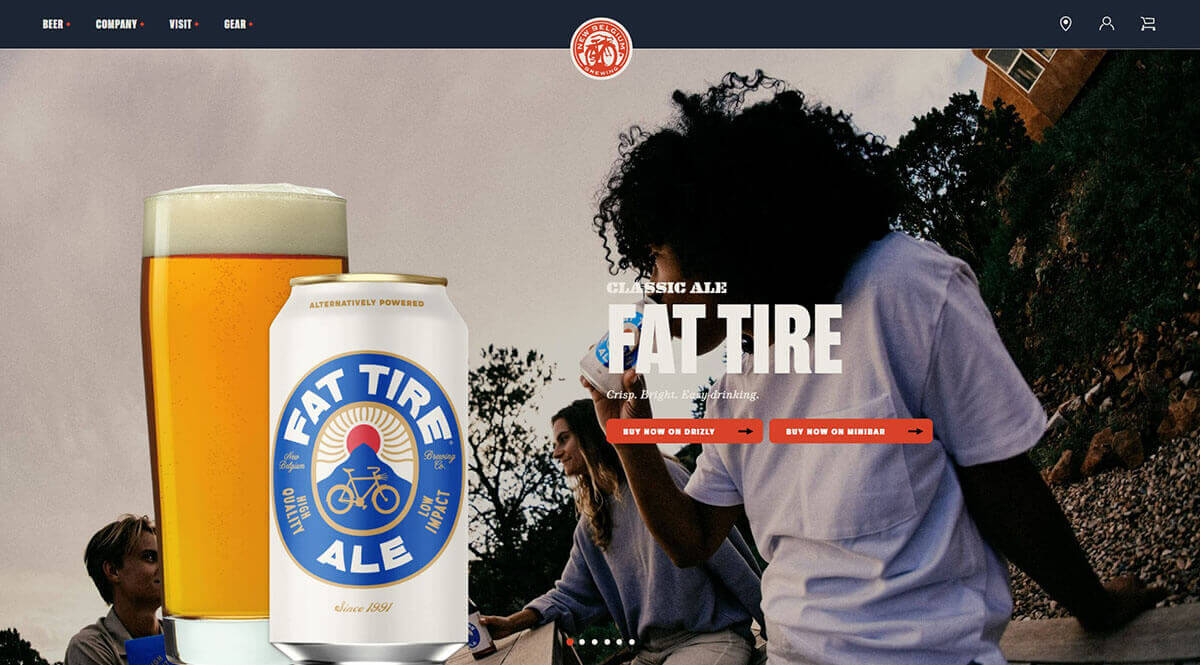
Photo credit: New Belgium Brewing Company / newbelgium.com official homepage artwork
Browse related lists
Related on Causeartist
- Founder
- Kim Jordan and Jeff Lebesch

Retail locations
New Belgium Brewing Company, Inc. is a Fort Collins, Colorado-based brewer founded in 1991 by Kim Jordan and Jeff Lebesch after a 1988 bicycle trip through Belgium inspired Lebesch to make Belgian-style beer at home. Early beers included Fat Tire Ale and Abbey, first sold at the Colorado Brewers' Festival in June 1991. The company now makes and markets a national portfolio led by Voodoo Ranger and Fat Tire and operates breweries in Fort Collins, Colorado; Asheville, North Carolina; Daleville, Virginia; and Comstock, Michigan. Its public hospitality locations include Fort Collins, Asheville, and Bell's locations in Kalamazoo, Michigan.
The legal company is broader than the New Belgium consumer brand but should not be conflated with every name in its portfolio. Bell's Brewery was founded separately in 1985 by Larry Bell. Lion Little World Beverages acquired Bell's in a transaction announced in 2021 and completed in 2022, after which Bell's operations and brands such as Two Hearted and Oberon joined New Belgium's operating portfolio. Bell's history, founder, and brand identity therefore remain distinct even though New Belgium's 2025 report covers the combined operating facilities and calls the business the largest U.S. craft brewer by volume.
New Belgium was partly employee-owned from 2000 and became 100% employee-owned through an employee stock ownership plan in 2012. That ownership is historical, not current. Lion Little World Beverages agreed to acquire the business in 2019, employees approved the transaction, and the acquisition closed in early 2020, ending employee ownership. New Belgium's 2025 report identifies the legal entity as a Colorado Public Benefit Corporation and a wholly owned indirect subsidiary of Japan-listed Kirin Holdings Company, Limited. It says a corporate reorganization effective October 1, 2025 moved New Belgium to report directly within Kirin's global subsidiary structure; Lion Little World Beverages is therefore described here as the historical acquirer rather than New Belgium's current reporting parent.
The company calls its approach Human Powered Business: commercial brewing paired with employee programs, environmental management, advocacy, and community giving. New Belgium's site says it has been a Certified B Corporation since 2013. It also reports current 1% for the Planet membership and Colorado Public Benefit Corporation status. Certification scope matters: B Corp applies to the assessed enterprise, the public-benefit designation is a legal form rather than third-party impact verification, and New Belgium says its 1% for the Planet set-aside applies to Fat Tire and Mountain Time sales rather than all company sales.
Key benefits
Measured brewery footprint
New Belgium publishes Scope 1-3 emissions, water intensity, renewable electricity, materials, and waste data across its operating facilities, with explicit baselines and target years.
Operational climate projects
Fermentation-CO2 recovery, steam electrification, onsite renewables, water-efficiency work, and high waste diversion address direct brewery impacts while supply-chain work targets the much larger Scope 3 footprint.
Scalable community giving
The Dollar per Barrel model links beer volume to nonprofit funding, supplemented by coworker-directed grants, matching gifts, paid volunteer incentives, and long-running bicycle and watershed partnerships.
Accountability structures
Colorado Public Benefit Corporation status, B Corp certification, annual impact reporting, and facility environmental-management certification create formal checkpoints, while disclosed assurance and scope limits keep the claims bounded.

Latest News and Funding Rounds
New Belgium's environmental model combines operational efficiency with supply-chain intervention. Its 2030 goals are a 55% reduction in Scope 1 and 2 emissions and a 30% reduction in Scope 3 emissions from a 2019 baseline, plus 100% renewable electricity. The company says these goals align with Kirin Holdings' Science Based Targets initiative targets. Projects include fermentation-carbon-dioxide recovery, partial steam electrification, solar, biogas and geothermal generation, water-efficiency work, lower-impact packaging, waste diversion, watershed partnerships, and purchasing regeneratively grown malt. These initiatives can reduce impacts, but targets, installed capacity, purchased renewable electricity, and modeled supply-chain benefits are not the same as measured company-wide emissions reductions.
The social model directs one dollar per barrel sold to nonprofit support through the Dollar per Barrel Giving Fund and gives coworkers influence through site committees, matching gifts, paid volunteer incentives, and grassroots grants. Focus areas include climate and environment, thriving communities, bicycle advocacy, water stewardship, governance, and identity, equality and rights. New Belgium also offers Poured for All inclusion training to hospitality businesses and supports responsible-consumption education. Grant totals and volunteer hours are inputs and outputs; they do not independently establish long-term community outcomes.
New Belgium's 2025 Human Powered Business Report is the principal source for current performance data. It covers the combined operating footprint, including Bell's-associated Michigan facilities, and reports with reference to GRI Standards, but the company explicitly states that the report was not externally assured. The figures below should therefore be read as company-reported unless a certification body is specifically named. B Corp certification provides independent assessment against B Lab's framework, but it does not independently assure every metric in the annual report or make the company's products impact-free.
Company-reported 2025 climate results: total Scope 1-3 emissions were 285,663 metric tonnes CO2e—18,065 Scope 1, 17,406 market-based Scope 2, and 250,192 Scope 3. New Belgium reported a 14% year-over-year reduction in Scope 1 emissions, while increased transportation during the Asheville brewery's Hurricane Helene recovery offset some operational gains. Renewable electricity supplied 7% of consumed electrical power, including 2,385 MWh generated onsite. The company-wide 2030 goals—55% lower Scope 1 and 2, 30% lower Scope 3 from 2019, and 100% renewable electricity—remain targets, not results.
Company-reported 2025 resource results: Fort Collins used 3.7 volumes of water per volume of output, a 3% year-over-year improvement and about 25% of the way toward its 3.4:1 target for 2027. Overall manufacturing-waste diversion was 98.83%. New Belgium sourced 1,558 metric tonnes of ReGenMalt, representing 3% of total malt. Supplier-specific practice claims and intended soil, biodiversity, water, or emissions benefits are not quantified here as achieved company outcomes.
Company-reported 2025 social results: $1,715,195 in community investment went to more than 307 U.S. 501(c)(3) organizations; cumulative Dollar per Barrel giving exceeded $36.2 million over three decades. Coworkers recorded 7,214 volunteer hours, and $311,544 in grassroots grants supported bicycle advocacy and water-stewardship programs. The company reported 1,357 coworkers at year-end and an 81% engagement score with 82% survey participation. These are spending, participation, workforce, and survey measures rather than independently evaluated beneficiary outcomes.
Certification and reporting caveats: New Belgium's current site says it has been a Certified B Corp since 2013 and displays a 136.5 B Impact score without dating that graphic; this profile does not treat that undated score as a current assessment-period result. New Belgium also reports ISO 14001:2015 certification for New Belgium-owned production facilities, but the directory has no ISO 14001 relation to assign. The 2025 report was not externally assured, and historical carbon-neutral certification for Fat Tire is product-specific, so no company-wide carbon-neutral certification relation is created.
Frequently asked questions
- What does New Belgium Brewing Company do?
- New Belgium Brewing Company, Inc. is a Fort Collins, Colorado-based brewer founded in 1991 by Kim Jordan and Jeff Lebesch after a 1988 bicycle trip through Belgium inspired Lebesch to make Belgian-style beer at home. Early beers included Fat Tire Ale and Abbey, first sold at the Colorado Brewers' Festival in June 1991. The company now makes and markets a national portfolio led by Voodoo Ranger…
- Where is New Belgium Brewing Company based?
- New Belgium Brewing Company is based in Colorado, United States.
- What sector does New Belgium Brewing Company operate in?
- New Belgium Brewing Company operates in the Community Development sector.
- Who founded New Belgium Brewing Company?
- Kim Jordan and Jeff Lebesch
At a glance
Locations
Certifications