
New Belgium Brewing: Impact Business Case Study
How New Belgium grew from a Fort Collins basement into a 100% employee-owned B Corp, voted to sell to Lion/Kirin, and now reports 2025 climate, giving, and culture metrics as a Kirin subsidiary.
Photo credit: New Belgium Brewing Company / modified by Causeartist
Key takeaways
- Kim Jordan and Jeff Lebesch founded New Belgium in Fort Collins in 1991 after a 1988 bike trip through Belgium; Fat Tire and Abbey were the first beers.
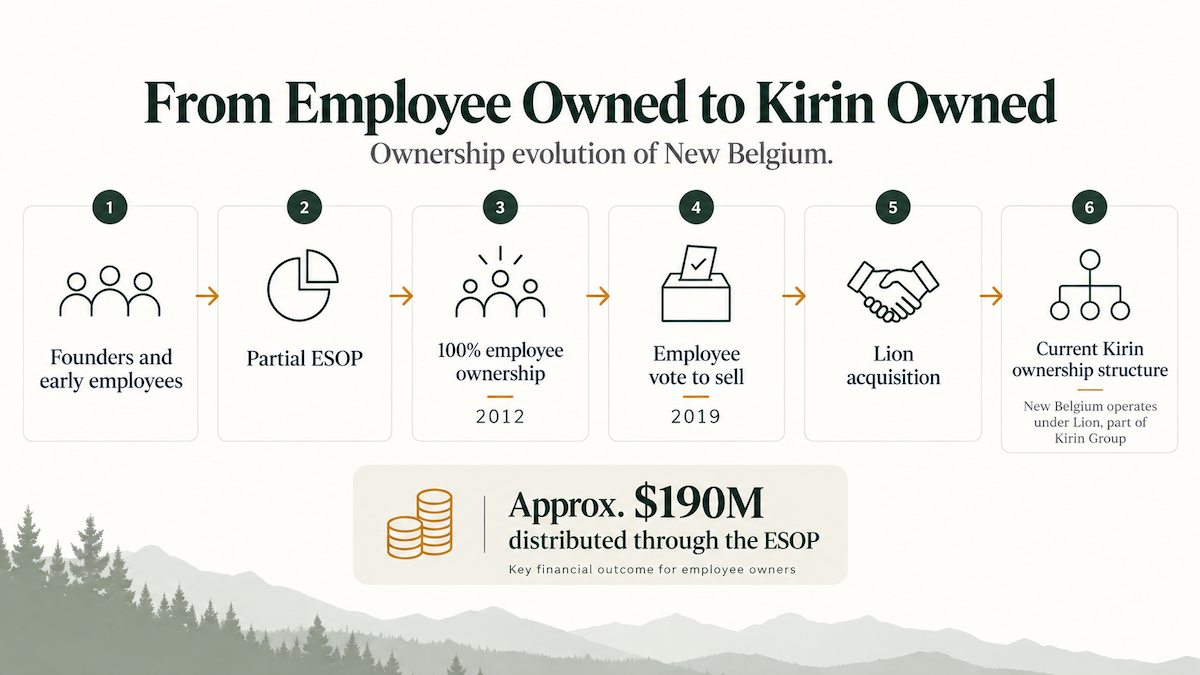
- An ESOP began in 2000; in December 2012 the plan bought remaining family shares, making 457 coworkers 100% owners. New Belgium became a certified B Corporation in 2013.
- Employees voted in 2019–2020 to sell to Lion Little World Beverages (Kirin). The ESOP had paid about $190 million to current and former workers over 19 years; employee ownership ended.
- As of 1 October 2025, New Belgium reports directly within Kirin Holdings' global subsidiary structure as a Colorado Public Benefit Corporation, not as a current Lion operating parent.
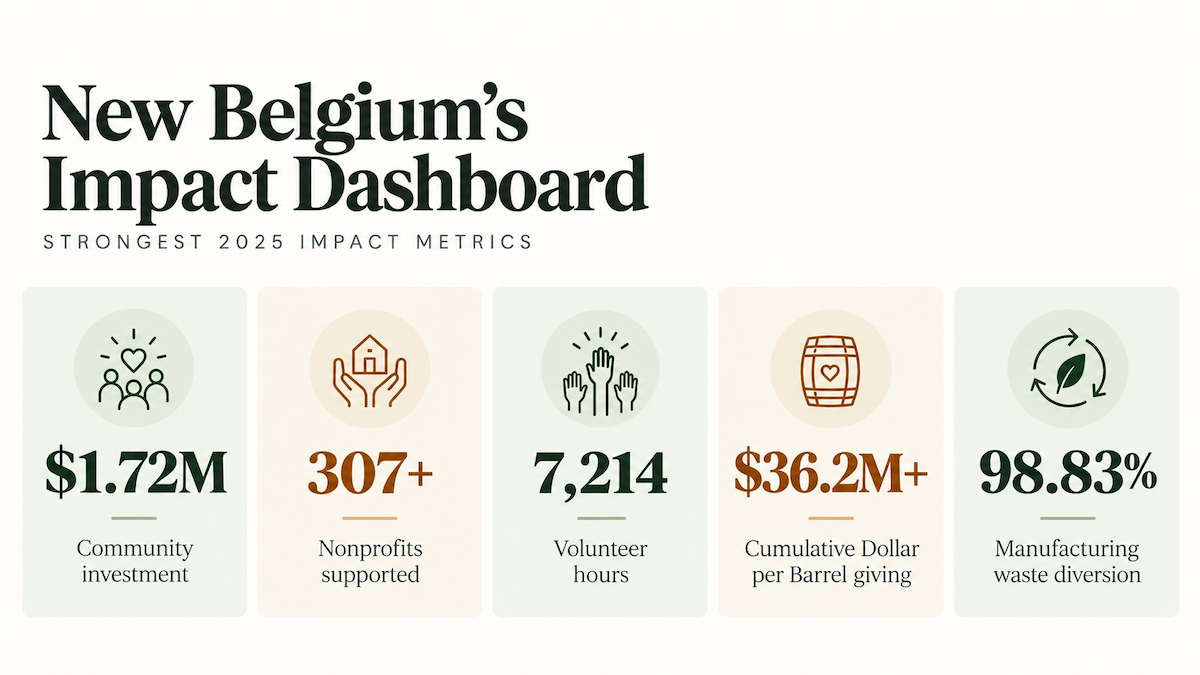
- The 2025 Human Powered Business Report is company-reported and not externally assured: 285,663 tCO2e across Scopes 1–3, $1.7 million in community investment, and more than $36.2 million in cumulative Dollar-per-Barrel giving.
New Belgium Brewing began with an unusual premise: that a brewery could be built around employees, community, and environmental responsibility as much as beer.
Founded by Kim Jordan and Jeff Lebesch in a Fort Collins basement in 1991, the company grew from a homebrewing project inspired by a bicycle trip through Belgium into one of the most recognizable craft breweries in the United States.
Along the way, New Belgium introduced employee ownership, open book management, a dedicated sustainability team, B Corp certification, and the now iconic tradition of giving coworkers a cruiser bike on their first anniversary.
For years, New Belgium stood out as one of the country’s most prominent 100% employee owned companies and one of the earliest major beverage brands to embrace the B Corp model.
Then came the liquidity event.
In 2019, New Belgium’s employee owners voted to sell the company to Lion Little World Beverages, part of Australia’s Lion and ultimately owned by Japan’s Kirin Holdings. The company retained many of the cultural and sustainability practices that had defined it, including its B Corp certification. Employee ownership, however, ended with the sale. In October 2025, another reorganization moved New Belgium more directly into Kirin Holdings’ global corporate structure.
The business itself continued to evolve. Voodoo Ranger emerged as a major growth engine. Fat Tire became increasingly associated with climate advocacy and the company’s 1% for the Planet commitment. In 2022, Bell’s Brewery joined the portfolio while continuing to operate as a distinct brand.
That makes New Belgium a particularly useful case study for impact driven companies approaching scale, succession, or acquisition.
The central question is not whether the company remained exactly what it was in the 1990s. It is what happens to an impact model when ownership changes. If employee ownership disappears, but environmental commitments, certification, culture, and certain operating practices remain, which parts of the original mission were structural, and which were durable enough to survive the transaction?
Company Background & History
Founding story
New Belgium Brewing traces its origins to a 1988 bicycle trip through Belgium, where cofounder Jeff Lebesch developed a fascination with the country’s brewing traditions. When he returned to Colorado, he began experimenting with Belgian style beers at home. By 1991, he and Kim Jordan had turned that interest into a small brewery operating out of their Fort Collins basement.
From the beginning, the company was built around more than beer. Jordan, whose background was in social work, helped shape a set of core values focused on employees, community, and environmental responsibility. Those principles were not added later as a branding exercise. They were part of the operating philosophy from the start.
New Belgium introduced Fat Tire and Abbey at the Colorado Brewers’ Festival in June 1991. Jordan handled much of the early business herself, including bottling, sales, distribution, bookkeeping, and eventually company leadership as the brewery expanded beyond Colorado.
Fat Tire helped make the company accessible to a broader audience at a time when the American craft beer market was still relatively small and heavily associated with stronger, more bitter styles. Abbey also helped establish New Belgium’s brewing credibility, winning a gold medal at the 1993 Great American Beer Festival when Belgian inspired beers were still a relatively uncommon category in the United States.
Growth came quickly. By 1995, New Belgium had outgrown its original operation and moved into a larger Fort Collins brewery that would become its longtime headquarters.
As the company scaled, many of its early values became embedded in formal traditions and management practices. Employees received greater visibility into company finances through open book management.
Beginning in 1999, coworkers received an Electra cruiser bicycle on their first anniversary. Tour de Fat turned the company’s connection to cycling into a traveling community event that combined bikes, music, and beer.
These practices helped establish a culture that became nearly as distinctive as the products themselves, and they laid the foundation for New Belgium’s later experiments with employee ownership, sustainability, and impact driven business.
Timeline of major milestones
1991: Founding; Fat Tire and Abbey.
1998: Coworkers vote to forgo profit-sharing to become an early wind-powered brewery—an industry first New Belgium still cites.
2000: ESOP created; partial employee ownership with Jordan family control.
2003: In-house sustainability department; later B Corp, 1% for the Planet, solar, on-site wastewater.
2008–2009: Early brewery 1% for the Planet membership; large private Colorado solar array; first published beer carbon-footprint study (2008).
December 2012: 100% employee-owned; 457 coworkers; ESOP buys remaining family shares.
2013: Certified B Corporation.
2016: Asheville, North Carolina brewery opens.
2019–2020: Coworkers vote for Lion acquisition; ESOP ends; Fat Tire certified carbon neutral (2020, PAS 2060).
2022: Bell’s Brewery joins via Lion; Voodoo Ranger Juice Force becomes a breakout IPA.
2023: Daleville, Virginia brewery acquired from Constellation; about 60 workers offered comparable or better pay.
2024–2025: Hurricane Helene hits Asheville; 2025 Human Powered Business Report publishes combined-facility climate, water, waste, and giving data; 1 October 2025 Kirin reporting change.
Leadership, ownership, and structure
Jordan’s tenure as CEO provides the clearest through line across New Belgium’s independent years. Under her leadership, the company developed a reputation for combining strong growth with employee ownership, transparent management, and environmental commitments.
That model reached its fullest expression in 2012, when New Belgium completed a transaction that made the company 100% employee owned through its ESOP. At the time, the move was presented as a way for coworkers to share more directly in the company’s future and maintain greater control over its direction.
Seven years later, that structure faced a different kind of decision.
In 2019, Lion Little World Beverages made an all cash offer to acquire New Belgium. Because the company was owned through an ESOP, the transaction required a formal participant directed process involving the plan trustee.
Employee owners ultimately approved the sale. Steve Fechheimer was serving as CEO when the deal was announced, while Jordan publicly argued that Lion could provide the scale and resources needed to continue New Belgium’s environmental work and B Corp commitments.
The transaction highlighted one of the central tensions in employee ownership. An ESOP can distribute substantial wealth to workers, but it does not guarantee permanent employee control.
A 2025 Rutgers CLEO teaching case on New Belgium examines that tension directly, using the company to explore how even strongly employee centered businesses can face powerful financial incentives to sell.
The timeline is notable. New Belgium celebrated becoming 100% employee owned in early 2013, following the ESOP transaction that closed on December 28, 2012. By 2019, the company had agreed to be acquired. Full employee ownership lasted roughly seven years.
During the broader life of the ESOP, New Belgium reported that approximately $190 million had already been distributed to employees before the sale. That figure captures both sides of the model. Employee ownership created meaningful financial value for workers, while also giving those same workers a significant economic reason to support an eventual liquidity event.
Today, New Belgium operates under a different ownership structure but continues to frame its culture through what it calls its Human Powered Business model. The company describes that approach around several core ideas: doing right by people, making world class beer, inspiring social and environmental change, and maintaining a strong internal culture.
New Belgium’s 2025 reporting identifies New Belgium Brewing Company, Inc. as a Colorado Public Benefit Corporation and a wholly owned indirect subsidiary of Kirin. Lion Little World Beverages remains important to the company’s acquisition history, but it is no longer the most direct way to describe New Belgium’s current corporate reporting structure.
Bell’s Brewery, acquired into the broader operating portfolio in 2022, also remains a distinct brand with its own history dating back to Larry Bell’s founding of the company in 1985. New Belgium’s reporting now covers the combined operating footprint, but the brands continue to maintain separate identities.
Industry & Market Analysis
Industry Landscape
The U.S. craft beer market has changed significantly from the growth environment that helped New Belgium become a national brand. After years of rapid expansion, the category has matured and overall volume growth has slowed.
Within that environment, consumer demand has increasingly concentrated around a smaller number of styles, particularly IPA, while categories such as amber ales and Belgian inspired beers have become more associated with legacy craft brands than with the fastest growing parts of the market.
New Belgium’s portfolio reflects that shift. Fat Tire remains closely tied to the company’s history and identity, while Voodoo Ranger has become the more important growth platform, particularly within the IPA segment. That gives New Belgium a portfolio that combines heritage with products designed for current category demand.
Consolidation has also reshaped the competitive landscape. Large beverage companies including Constellation Brands, Heineken, Molson Coors, and Kirin have acquired established craft breweries as the category has matured.
For brands that move from independent ownership into multinational portfolios, third party certifications and formal impact commitments can take on greater importance.
Programs such as B Corp and 1% for the Planet provide external frameworks that can help preserve elements of a company’s environmental or social positioning after ownership changes.
Target Customers
New Belgium’s customer base now extends well beyond longtime Fat Tire drinkers.
Voodoo Ranger is positioned toward consumers seeking bold, higher alcohol IPA products, which aligns the company with one of the strongest segments of the modern craft beer market. Fat Tire and Mountain Time play a different role, carrying more of the company’s heritage, environmental messaging, and sustainability positioning.
The addition of Bell’s broadens the portfolio further. Brands such as Two Hearted Ale and Oberon bring strong recognition and customer loyalty, particularly in the Midwest, while remaining distinct from New Belgium’s own product identity.
New Belgium also continues to market something broader than beer. Cycling, outdoor culture, Tour de Fat, and the company’s “born on a bike” origin story have helped create a recognizable lifestyle around the brand. That positioning can appeal to consumers who value environmental responsibility, community involvement, and outdoor recreation, even if they have little awareness of New Belgium’s current ownership structure.
Demand Drivers
Several forces continue to shape demand for New Belgium’s portfolio.
The most important is the continued strength of IPA within craft beer, particularly for Voodoo Ranger. Brand identity is another driver. New Belgium’s longstanding association with cycling, outdoor recreation, environmental responsibility, and progressive workplace practices gives it a differentiated position in a crowded market.
The company also benefits from residual trust built through decades of sustainability programs, employee ownership, B Corp certification, and public environmental commitments. Those attributes can still influence consumer perception even though the ownership structure has changed.
At the same time, New Belgium faces pressures that extend beyond consumer preferences. The broader beer category is experiencing volume pressure, while brewing remains highly exposed to water availability, agricultural inputs, energy use, and climate related disruption.
New Belgium’s own sustainability reporting shows that the majority of its emissions sit within the supply chain, making ingredients, packaging, transportation, and supplier practices important parts of its climate strategy.
Physical climate risk is also becoming operational. Hurricane Helene’s impact on New Belgium’s Asheville operations demonstrated how extreme weather can affect production, employees, infrastructure, and local communities at the same time. For a company with a major footprint in climate sensitive regions, resilience is becoming as relevant as emissions reduction.
Competitive Landscape
Key competitors and adjacent brands
Sierra Nevada, Deschutes, other remaining independents: Similar heritage; different ownership stories.
Bell’s (now in the same operating portfolio): Two Hearted and Oberon; combined volume scale after the Lion-era combination. Treat Bell’s as a sibling brand, not as New Belgium’s origin story.
Mega-craft and Big Beer craft lines: Distribution muscle without B Corp accountability.
Patagonia Provisions and other mission CPG: Not beer peers, but the same “can mission survive a parent” question. See also Causeartist’s Patagonia case study.
SWOT analysis
Strengths: B Corp and public-benefit continuity, published 2025 climate inventory, giving infrastructure, Voodoo Ranger velocity, four U.S. production footprints, coworker culture rituals.
Weaknesses: No longer worker-owned; carbon-neutral claims depend partly on offsets; Fat Tire is no longer the growth brand; 1% for the Planet applies to selected SKUs, not all sales.
Opportunities: Regenerative malt, on-site CO2 recovery and electrified steam, Bell’s combination, Tour de Fat as civic media, Kirin SBTi-aligned 2030 targets if they are actually delivered.
Threats: Craft stagnation, parent-company controversy, B Corp standard tightening, climate disruption to breweries and barley, and the risk that IPA growth shrinks the 1% SKU share.
Business Model & Revenue Streams
How New Belgium Makes Money
New Belgium generates revenue primarily through the sale of packaged and draft beer distributed across retail, hospitality, and on premise channels. Its taprooms in Fort Collins and Asheville add direct to consumer revenue and serve as important brand experiences, while e-commerce supports merchandise and other direct sales.
Because Kirin does not report a standalone New Belgium profit and loss statement, the company’s exact revenue mix is not publicly available. What is clear is that the portfolio has shifted over time. Fat Tire was once the defining commercial engine of the business, while Voodoo Ranger has become increasingly important as consumer demand has moved toward IPA.
That portfolio shift also has implications for how New Belgium’s impact commitments are measured. Its 1% for the Planet participation applies to sales from specific brands, including Fat Tire and Mountain Time, rather than to the company’s entire portfolio. As a result, growth in Voodoo Ranger does not automatically produce proportional growth in 1% for the Planet contributions.
The distinction matters because New Belgium also supports environmental organizations through separate giving mechanisms tied to production volume. These programs can move differently over time depending on which brands are growing, how much beer is produced, and how the company allocates environmental giving across the portfolio.
Product and Value Proposition
New Belgium’s business model combines national distribution, recognizable consumer brands, production scale, and direct brand engagement.
The Fort Collins and Asheville taprooms provide higher margin direct sales while giving customers a physical connection to the company’s culture and history. The opening of additional production capacity in Daleville, Virginia, in 2023 strengthened the operational side of the model by expanding brewing and distribution capabilities.
The acquisition of Bell’s also materially increased the scale of the broader business. At the time of the transaction, Lion positioned the combination of New Belgium and Bell’s as creating one of the largest and fastest growing craft brewing businesses in the United States. That description came from the parent company and is best treated as transaction commentary rather than an independently audited market ranking.
The combined portfolio now spans several distinct consumer propositions. Voodoo Ranger competes in the IPA category, Fat Tire carries much of New Belgium’s heritage and sustainability positioning, and Bell’s brands such as Two Hearted and Oberon add established regional loyalty and additional category depth.
New Belgium also uses brewing credibility as part of its value proposition. The company states that the combined New Belgium and Bell’s portfolio has earned 51 Great American Beer Festival medals and that New Belgium operates the largest sour beer program in the United States. These are company reported claims and should be presented as such unless independently verified.
Taken together, the model is built around scale, portfolio breadth, distribution reach, and brand equity, with impact commitments layered across selected brands and operating practices rather than applied uniformly across every dollar of revenue.
Go-to-Market & Marketing Strategy
New Belgium’s marketing strategy has historically been built around culture, community, and experience as much as product.
The company’s “Born on a Bike” story gives it a distinctive origin narrative that connects the brand to cycling, outdoor recreation, and Fort Collins. Tour de Fat extends that story into the real world through large community events that combine bikes, costumes, music, and nonprofit fundraising.
Rather than functioning as a traditional sponsorship or advertising campaign, the event gives consumers a physical experience of the brand’s values.
The anniversary bike tradition works in a similar way inside the company. Giving coworkers a cruiser bicycle after their first year is primarily a cultural practice, but it also reinforces the brand externally. Employees riding New Belgium branded bikes become visible symbols of the company’s identity, turning an internal benefit into a form of organic brand storytelling.
Voodoo Ranger operates in a different marketing register. Its positioning is built around personality, humor, and the higher alcohol IPA category rather than New Belgium’s original social and environmental narrative. That creates an important portfolio challenge. The company has to support a growth brand with broad commercial appeal while keeping Fat Tire, Tour de Fat, and the broader New Belgium identity relevant rather than allowing them to become purely heritage assets.
Tour de Fat is particularly important in this context. It may look like a lifestyle event, but strategically it helps New Belgium maintain a connection to the places and communities that shaped the company. Consumers do not simply encounter a beer advertisement. They associate New Belgium with cycling culture, public space, local nonprofits, and a recognizable sense of place.
That makes continued investment in culture an important signal under multinational ownership. When cultural programs survive periods of operational pressure, they indicate that the company still views them as part of the brand rather than discretionary legacy spending.
New Belgium’s historical use of open book management also supported the brand from the inside out. During the employee ownership years, workers across brewing, packaging, and other functions were given visibility into the economics of the business and were expected to understand how the company performed financially.
That transparency mattered when the company eventually considered a sale. Employee owners were not being asked to evaluate the future of a business they understood only through culture and mission. They had also been exposed to the financial realities of operating it.
For impact driven companies, that is an important distinction. Employee ownership without financial literacy creates only partial participation. New Belgium paired ownership with access to the numbers, giving employees a stronger basis for understanding both the value of the business and the tradeoffs involved in selling it.
Impact Strategy
Enjoying this? Get the next one.
We send one email each Monday with what just published on Causeartist.
Free. Unsubscribe anytime.
Sources
- Born on a Bike. The Rest is History — New Belgium Brewing
- We are Human Powered — New Belgium Brewing
- Our Commitment to Climate — New Belgium Brewing
- 2025 Human Powered Business Report — New Belgium Brewing
- New Belgium Brewing Becomes 100% Employee-Owned Company — GlobeNewswire
- New Belgium sale: Kirin's empire to buy Fort Collins' craft brewery — The Coloradoan
- We the Owners: New Belgium case (CLEO / Rutgers) — Rutgers CLEO
- Fat Tire Amber Ale Becomes America’s First Certified Carbon Neutral Beer — CraftBeer.com
- Kirin Group companies — Kirin Holdings
- New Belgium Brewing Co. Inc B Corp profile — B Lab
FAQ
Is New Belgium still employee-owned?
No. The brewery was partially employee-owned from 2000 and 100% employee-owned from late 2012 until coworkers voted to accept Lion Little World Beverages’ all-cash acquisition, which closed in early 2020. Federal ESOP rules required a worker vote. Culture programs such as anniversary bikes remain; equity ownership does not. New Belgium’s 2025 report identifies the company as a wholly owned indirect subsidiary of Kirin Holdings, with a 1 October 2025 reorganization moving it to report directly inside Kirin’s global subsidiary structure.
Is New Belgium still a certified B Corp?
Yes. The company says it has been a Certified B Corporation since 2013 and still describes itself as a Colorado Public Benefit Corporation and B Corp in current Human Powered Business materials. Lion publicly committed to supporting that path at acquisition. Recertification cycles are the ongoing test. An undated 136.5 B Impact score graphic on the company site should not be treated as a dated current-period result.
What was New Belgium’s ESOP, and what did workers receive?
An Employee Stock Ownership Plan let coworkers accumulate shares. In 2012 the ESOP bought Kim Jordan’s remaining controlling stake, taking workers from about 41.5% to 100% ownership. At the 2019 sale, the company said the ESOP had distributed about $190 million to current and former employees over 19 years. The sale converted remaining equity to cash and ended the ESOP. That is both a wealth event and the end of worker ownership.
Is Fat Tire still a carbon-neutral beer?
In 2020 Fat Tire became the first nationally distributed U.S. beer certified carbon neutral under PAS 2060, using operational reductions plus offsets. New Belgium later certified Mountain Time Lager as well and published a toolkit for other brewers. Those certifications are product-specific, not company-wide, and they rely in part on offsets. The company’s 2030 aim to make all of its beers carbon neutral remains a target. The 2025 report’s measured Scope 1–3 inventory is the current operational evidence, and it was not externally assured.
How much does New Belgium give, and is it still 1% for the Planet?
New Belgium was an early brewery member of 1% for the Planet. It reports setting aside 1% of Fat Tire and Mountain Time sales, not all company revenue, and donating $1 per barrel sold through a community fund. The 2025 report cites $1,715,195 in community investment to more than 307 U.S. 501(c)(3) organizations and more than $36.2 million in cumulative Dollar-per-Barrel giving. Those programs continued after the Lion deal.
More Case Studies
Browse all
Photo credit: Who Gives A Crap, modified by Causeartist
Photo credit: Oatly, modified by Causeartist


Photo credit: Blueland, modified by Causeartist

Get the Monday roundup
New companies, funders, stories, podcasts, and case studies — one email a week.
Join 25,000+ Causeartists
Free. Unsubscribe anytime.