
Ecosia: Impact Business Case Study
How Ecosia turned everyday internet searches into a source of funding for global reforestation, renewable energy, and environmental restoration, while building an ownership structure designed to protect its mission.

Photo credit: Ecosia, modified by Causeartist
Key takeaways
- Ecosia is a search engine and browser founded in 2009 in Germany by Christian Kroll, and it has been steward-owned since 2018, with financial equity held by the Purpose Foundation.
- Ecosia earns money mainly from clicks on ads delivered by Microsoft Advertising and from a portion of purchases made through affiliate links, and it says it earns a few cents per ad click.
- In its published October 2026 financial report, Ecosia recorded total income of €4,273,454, with €1,166,765 on the trees line and €1,004,048 on green investments, alongside operational costs, taxes, search index and marketing.
- Ecosia financed 3,459,287 trees in October 2026, but a tree only counts as planted by Ecosia once a second field monitoring, three years after planting, confirms it is alive.
- Ecosia defines profit as what remains after operational costs, investments and taxes, and says 100% of that profit goes into climate action through tree planting, renewable energy investment or reinvestment in Ecosia.
Most people use a search engine several times a day without thinking about what happens behind the scenes. Every search creates an opportunity for advertising revenue, and most of that revenue ultimately benefits the companies and shareholders who own the platforms.
Ecosia was built around a different idea.
Founded in Germany in 2009 by Christian Kroll, Ecosia is a search engine and browser that uses the profits from its business to finance climate action. Rather than distributing those profits to shareholders, the company directs them toward tree planting, renewable energy investments, and growing its own operations.
The concept is straightforward: people continue doing something they already do every day, searching the internet, while the economic value generated by that activity helps finance environmental projects.
But Ecosia's story goes beyond planting trees.
Over more than 15 years, the company has developed a business model that combines digital advertising, environmental investment, financial transparency, and an ownership structure designed to keep its mission intact.
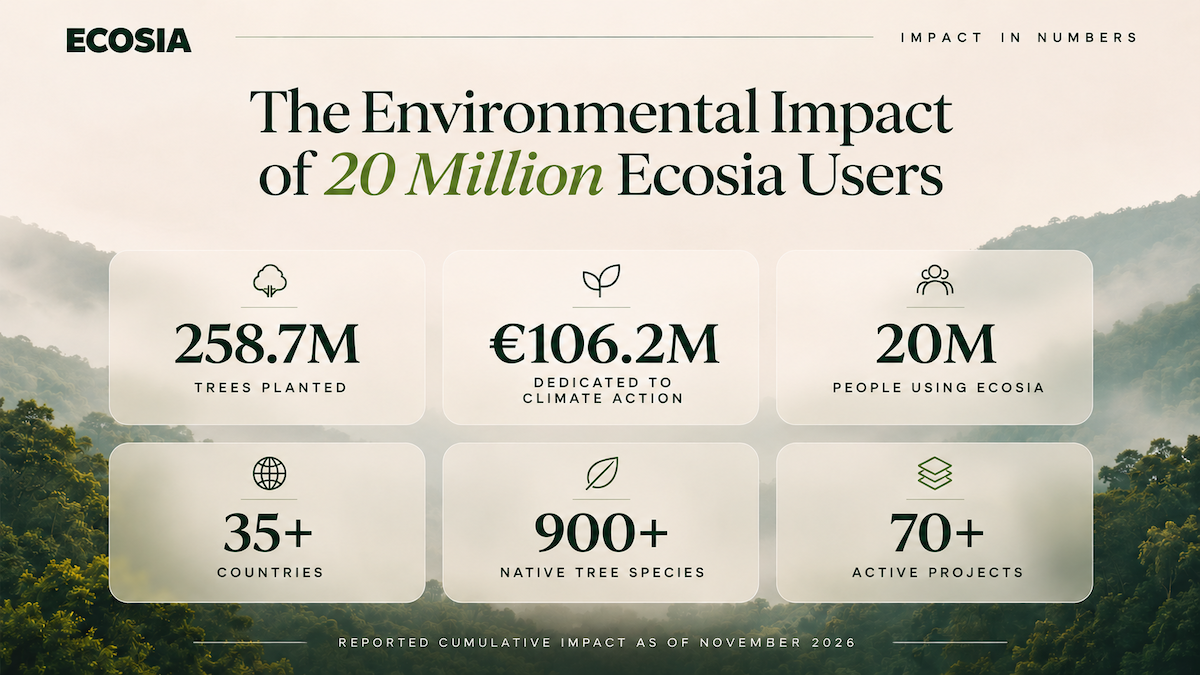
By November 21, 2026, Ecosia reported more than 258 million trees planted, 20 million users, and more than €106 million dedicated to climate action.
Its experience offers an interesting example of how a technology company can operate commercially while making environmental outcomes central to its purpose.
Company Background and History
Ecosia was founded in 2009 by German entrepreneur Christian Kroll, who wanted to explore whether the economics of internet search could support environmental conservation.
The opportunity came from understanding how search engines generate revenue.
Search engines provide a free service to users while businesses pay to advertise alongside relevant search results. Each time someone clicks an advertisement, the search platform can generate revenue.
Kroll recognized that a portion of this advertising revenue could be redirected toward environmental restoration.
Instead of developing a traditional nonprofit funded by donations, he created a commercial technology business that would generate its own revenue and use its profits to support ecological projects.

Photo: Christian Kroll, founder of Ecosia
That distinction became central to Ecosia's identity.
Users would not need to donate money, purchase a product, or change their daily routines dramatically. They could simply choose Ecosia as their search engine.
As the user base grew, the company could generate more advertising revenue and finance additional environmental work.
Building a company that cannot abandon its mission
One of the most consequential decisions in Ecosia's history came in 2018, when the company transitioned to a steward-owned structure.
Working with the Purpose Foundation, Christian Kroll and the company's early investors gave up their rights to sell the business for personal financial gain.
The company's financial equity is held by the Purpose Foundation, and its ownership arrangements prevent profits from being distributed to shareholders.
This decision was designed to protect Ecosia's environmental mission over the long term.
For many mission-driven companies, maintaining a commitment to social or environmental outcomes becomes more complicated as the business grows. New investors, acquisitions, and changes in leadership can create pressure to prioritize financial returns.
Ecosia's ownership structure addresses that risk directly.
Rather than relying exclusively on the intentions of its founder, the company has embedded its purpose into its governance.
It is an important distinction for entrepreneurs exploring how to protect a company's mission beyond its founding team.
Ecosia at a glance
Category | Details |
|---|---|
Company | Ecosia |
Founded | 2009 |
Founder | Christian Kroll |
Headquarters | Germany |
Industry | Search technology, digital advertising |
Business model | Advertising and affiliate revenue |
Ownership | Steward-owned since 2018 |
Legal entity | Ecosia GmbH |
Primary impact areas | Reforestation, biodiversity, renewable energy |
Website |
Industry and Market Analysis
Ecosia operates in one of the world's most established digital advertising markets.
Internet search is a daily activity for billions of people, and search advertising remains a powerful channel for companies looking to reach customers with specific interests or purchasing intentions.
The underlying business model is relatively simple.
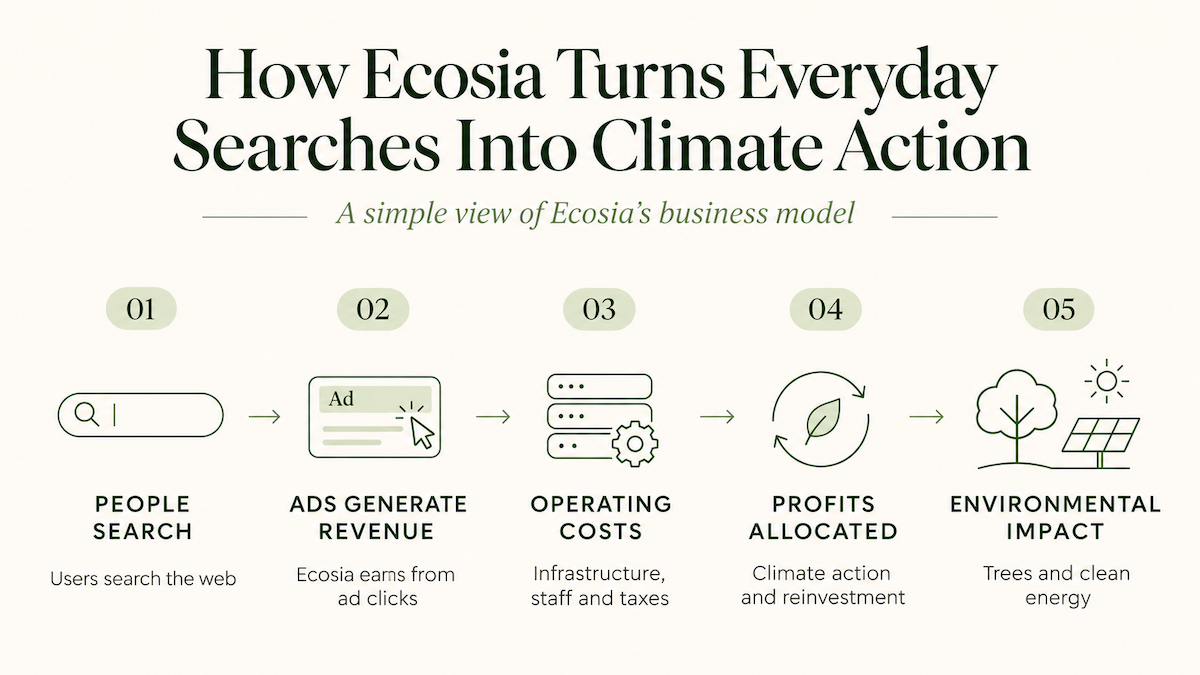
A user enters a search query. The search engine delivers relevant results, including sponsored listings. Advertisers pay when users click certain advertisements.
For companies operating at sufficient scale, this activity can generate substantial revenue.
However, building a competitive search platform presents several challenges.
Search is a business built on scale
Ecosia reports that it earns only a few cents from an advertising click.
That means the company depends on a large, consistent user base to generate enough revenue to cover its operating costs and finance its environmental commitments.
Unlike businesses that earn hundreds or thousands of dollars from individual transactions, search engines typically depend on high volumes of relatively small revenue events.
User retention, search frequency, advertising performance, and the quality of search results all influence the economics of the business.
Search infrastructure is expensive
Operating a search engine requires significant technical infrastructure.
Companies must maintain software, servers, security systems, engineering teams, and access to reliable search results.
Ecosia's financial reporting illustrates these expenses.
In October 2026, the company reported €152,000 in search index costs, alongside €227,030 in server and software expenses.
These costs demonstrate that even a mission-driven digital platform must maintain the operational infrastructure necessary to compete with established technology companies.
Privacy and environmental transparency create opportunities
Consumer expectations around digital privacy and corporate environmental responsibility have also influenced the market.
Users increasingly encounter questions about how technology companies handle personal information, how advertising data is used, and whether environmental commitments are supported by measurable outcomes.
Ecosia has positioned itself around these concerns.
The company states that advertising clicks are not connected to individual user profiles. It also says its AI answers are private and are not used to train models.
On the environmental side, Ecosia publishes monthly financial reports, details its tree-counting methodology, and identifies the organizations receiving project funding.
These practices help differentiate the company in a market where most search services are free and the largest competitors have significant technological advantages.
Competitive Landscape
Ecosia competes with some of the world's largest technology companies.
Its most recognizable competitors include Google, Microsoft's Bing, and DuckDuckGo.
Each offers a free search experience, but they differ in their business priorities, technology, and positioning.
Google competes through its extensive search infrastructure, broad product ecosystem, and established position in the market.
Bing offers general web search supported by Microsoft's technology and advertising infrastructure.
DuckDuckGo has built its positioning around online privacy.
Ecosia differentiates itself primarily through what happens to the money generated by its users.
An unusual relationship with Microsoft
Ecosia's relationship with Microsoft illustrates an important aspect of its strategy.
Although Microsoft operates Bing, a competing search engine, it also provides the advertising infrastructure that generates Ecosia's primary revenue.
Advertisements displayed through Ecosia are delivered by Microsoft Advertising, which shares advertising revenue with Ecosia when users click those ads.
This arrangement allows Ecosia to participate in the search advertising market without independently building every component of a large advertising platform.
It also introduces a business risk.
A company that depends on a larger technology provider for a major source of revenue is exposed to changes in commercial agreements, advertising economics, and platform strategy.
For Ecosia, balancing that dependency with the ability to deliver a competitive search experience remains an important part of its business model.
What makes Ecosia different?
Ecosia's competitive positioning rests on four characteristics.
1. Climate-focused profit allocation
The company commits its profits to ecological purposes, including tree planting, renewable energy investment, and reinvestment in Ecosia.
2. Steward ownership
Its ownership structure is designed to prevent shareholders from extracting profits or selling the company for personal gain.
3. Public financial reporting
Ecosia publishes monthly financial reports showing how its income is allocated across operations, taxes, environmental projects, and investments.
4. Privacy commitments
The company emphasizes privacy protections in its search advertising practices and AI features.
Taken together, these characteristics give users a reason to choose Ecosia beyond search functionality alone.
The challenge is ensuring that its search experience remains sufficiently useful and reliable for people to continue using it regularly.
Business Model and Revenue Streams
Ecosia operates as a for-profit social business rather than a traditional charity.
Its commercial operations generate revenue, cover expenses, pay taxes, and provide the financial resources used to support its environmental mission.
The company identifies two principal sources of revenue.
1. Search advertising
Search advertising is the foundation of Ecosia's business.
When someone searches using Ecosia, advertisements may appear alongside the search results.
These ads are delivered through Microsoft Advertising.
When a user clicks an advertisement, Microsoft Advertising pays Ecosia a portion of the advertising revenue.
Ecosia states that it generally earns a few cents per advertising click.
While each transaction generates a small amount of revenue, millions of users conducting searches can create a meaningful recurring income stream.
This model creates a direct relationship between user activity and the company's capacity to finance environmental work.
The more frequently people use Ecosia, and the more advertising revenue those searches generate, the more resources may become available for climate projects after business expenses.
2. Affiliate revenue
Ecosia also generates revenue through affiliate partnerships.
When users follow certain affiliate links and complete qualifying purchases, Ecosia receives a portion of the transaction value.
Affiliate revenue provides an additional income source beyond search advertisements.
Although the available information does not establish the size of this revenue stream relative to search advertising, it represents a degree of diversification within Ecosia's commercial model.
How Ecosia uses its profits
A defining feature of Ecosia's business model is how it allocates the money remaining after expenses.
Ecosia defines profit as the amount remaining from revenue after operational costs, investments, and taxes.
Under its arrangements with the Purpose Foundation, those profits are directed toward ecological and public-good purposes or reinvested in the business.
The company describes this approach as directing 100% of its profits toward climate action.
Importantly, that does not mean every euro of revenue is spent on planting trees.
Ecosia must pay employees, maintain its infrastructure, purchase access to search services, market its product, and meet its tax obligations.
Environmental spending is supported by the economic activity that remains after these financial responsibilities are accounted for.
The business model in practice
Business activity | How it creates value |
|---|---|
Internet searches | Attracts users and creates advertising opportunities |
Search advertising | Generates revenue through paid advertising clicks |
Affiliate partnerships | Generates additional revenue from qualifying purchases |
Operating activities | Maintains the technology, infrastructure, and teams needed to run Ecosia |
Tree planting | Directs funding toward restoration projects and implementing partners |
Renewable energy | Supports investments in clean energy generation |
Business reinvestment | Supports the long-term sustainability and development of Ecosia |
The strength of the model is its connection to an existing consumer behavior.
Ecosia does not need to persuade users to make a separate charitable contribution. Instead, it offers an alternative provider for a service they already use.
Impact Strategy: Turning Search Revenue Into Environmental Outcomes
Ecosia's environmental work focuses primarily on tree planting and renewable energy.
The company also participates in climate-focused venture investment and publishes financial and environmental information intended to help users understand how its business generates impact.
Financing tree planting and ecosystem restoration
Tree planting has been central to Ecosia's identity since its founding.
Rather than operating planting projects entirely through its own employees, Ecosia finances environmental organizations and local partners that implement restoration programs.
These projects span multiple countries and ecological environments.
As of November, 2026, Ecosia's homepage reported:
Impact metric | Reported figure |
|---|---|
Trees planted | 258,666,137 |
Funding dedicated to climate action | €106,161,660 |
People using Ecosia | 20 million |
Native tree species | 900+ |
Countries | 35+ |
Active projects | 70+ |
Source: Ecosia homepage, November 21, 2026. Figures are reported by Ecosia and may change as the company updates its public counters.
These figures reflect the scale of the environmental program Ecosia has developed.
However, one of the more important aspects of its impact strategy is not simply the number of trees reported. It is how the company defines and verifies that number.
Ecosia's approach to measuring tree survival
Planting a tree is not the same as establishing a healthy, surviving tree.
Young trees can die because of drought, disease, unsuitable planting conditions, grazing, and other environmental pressures.
This makes long-term monitoring an important part of credible reforestation.
Ecosia distinguishes between trees it finances and trees it reports as planted.
According to the company's September 2026 guidance, a tree is counted as planted by Ecosia after a second field monitoring, conducted three years after planting, confirms that the tree remains alive.
This creates an important distinction between activity and results.
For example, Ecosia's October 2026 report recorded 3,459,287 trees financed during that month.
That figure represents trees supported through funding. It does not mean those trees have already passed Ecosia's three-year survival verification process.
The company also clarifies that it does not own the trees it finances. Instead, it holds the right to report trees supported through its funding.
For impact-focused businesses, this methodology offers an important lesson: measuring what an organization funds is different from measuring what the funding ultimately achieves.
Investing in renewable energy
Ecosia's climate strategy extends beyond tree planting.
The company also invests in renewable energy infrastructure, including solar generation.
These investments are intended to increase the supply of clean electricity and support the transition away from fossil fuel-based energy generation.
According to Ecosia's 2026 Help Center documentation, internal metering showed that its renewable energy systems generated 9,127 MWh of electricity during 2025.
Ecosia also acknowledges a limitation in its environmental accounting.
Its estimate of the electricity footprint associated with running searches has not been independently audited.
This distinction matters because renewable electricity generation and the environmental footprint of operating a digital service are different measurements.
Publishing the internal energy generation figure while acknowledging the limits of its footprint assessment provides a clearer understanding of what has been measured.
Ecosia has also described renewable energy investment activity involving Naturstrom.
Supporting climate innovation through venture investment
Ecosia has extended its climate involvement into venture capital.
The company helped incubate World Fund and identifies itself as the fund's first investor.
World Fund focuses on climate technology investments, providing another way for capital associated with Ecosia's mission to support environmental innovation.
This represents a broader approach to climate impact.
Tree planting addresses ecological restoration, while renewable energy investments and climate technology venture capital support other parts of the transition toward a lower-carbon economy.
Although the available information does not establish the financial performance of these investments, their inclusion shows how Ecosia has developed a climate strategy that reaches beyond its original tree-planting proposition.
Financial Overview: How Ecosia Allocates Its Revenue
Enjoying this? Get the next one.
We send one email each Monday with what just published on Causeartist.
Free. Unsubscribe anytime.
Sources
- Communicating in line with the European Directive, Ecosia Help Center
- How does Ecosia use profits from ad income to finance tree planting?, Ecosia Help Center
- Ecosia financial reports and tree planting receipts, Ecosia Blog
- Ecosia financial reports data (key 2026-10), Ecosia
- Ecosia homepage, Ecosia
- Climate investments: World Fund, Ecosia Blog
- Climate investments: Naturstrom solar park, Ecosia Blog
FAQ
How does Ecosia make money?
Ecosia earns money when people click ads shown with search results and from a portion of purchases made through affiliate links. Ads are delivered by Microsoft Advertising, which pays Ecosia a share. Ecosia says it earns a few cents per ad click, and ad-click behavior is not tied to a user profile.
Who owns Ecosia?
Ecosia has been steward-owned since 2018. Its financial equity sits with the Purpose Foundation. Founder Christian Kroll and early investors gave up the right to sell the company, and profit cannot be paid out to shareholders.
Does all of Ecosia's revenue go to planting trees?
No. Ecosia's monthly reports show where income goes, including costs and taxes. Ecosia says 100% of its profit goes into climate action, where profit means what remains after operational costs, investments and taxes. That profit is spent on tree planting and renewable energy investment or reinvested in Ecosia.
When does Ecosia count a tree as planted?
A tree counts as planted by Ecosia once a second field monitoring, three years after planting, confirms it is alive. Ecosia does not own the trees. It holds the right to report trees it financed.
How much income did Ecosia report for October 2026?
Ecosia's published October 2026 financial report shows total income of €4,273,454. That month it financed 3,459,287 trees and made €1,666,765 in tree payments to projects.
More Case Studies
Browse all
Photo credit: method, modified by causeartist


Photo credit: Who Gives A Crap, modified by Causeartist


Photo credit: New Belgium Brewing Company / modified by Causeartist

Get the Monday roundup
New companies, funders, stories, podcasts, and case studies. One email a week.
Join 25,000+ Causeartists
Free. Unsubscribe anytime.
