For decades, nonprofits have relied on the same narrow funding playbook. Donations spike at year end. Grant cycles are slow and unpredictable. Teams spend enormous time fundraising instead of delivering impact.
Meanwhile, trillions of dollars move through global markets every day with no connection to social outcomes.
In Episode 235 of the Disruptors for GOOD podcast, we sat down with Martin Simms and Aaron Rafferty, co founders of WYDE Impact Exchange, to explore a bold alternative.
What if markets themselves could fund missions automatically.
What if trading activity generated real nonprofit revenue. And what if transparency and accountability were built directly into the system.
WYDE is not another crypto exchange chasing speculation.
It is an attempt to rewire how capital flows to real world problems, starting with hunger.
What WYDE Is and Why It Exists
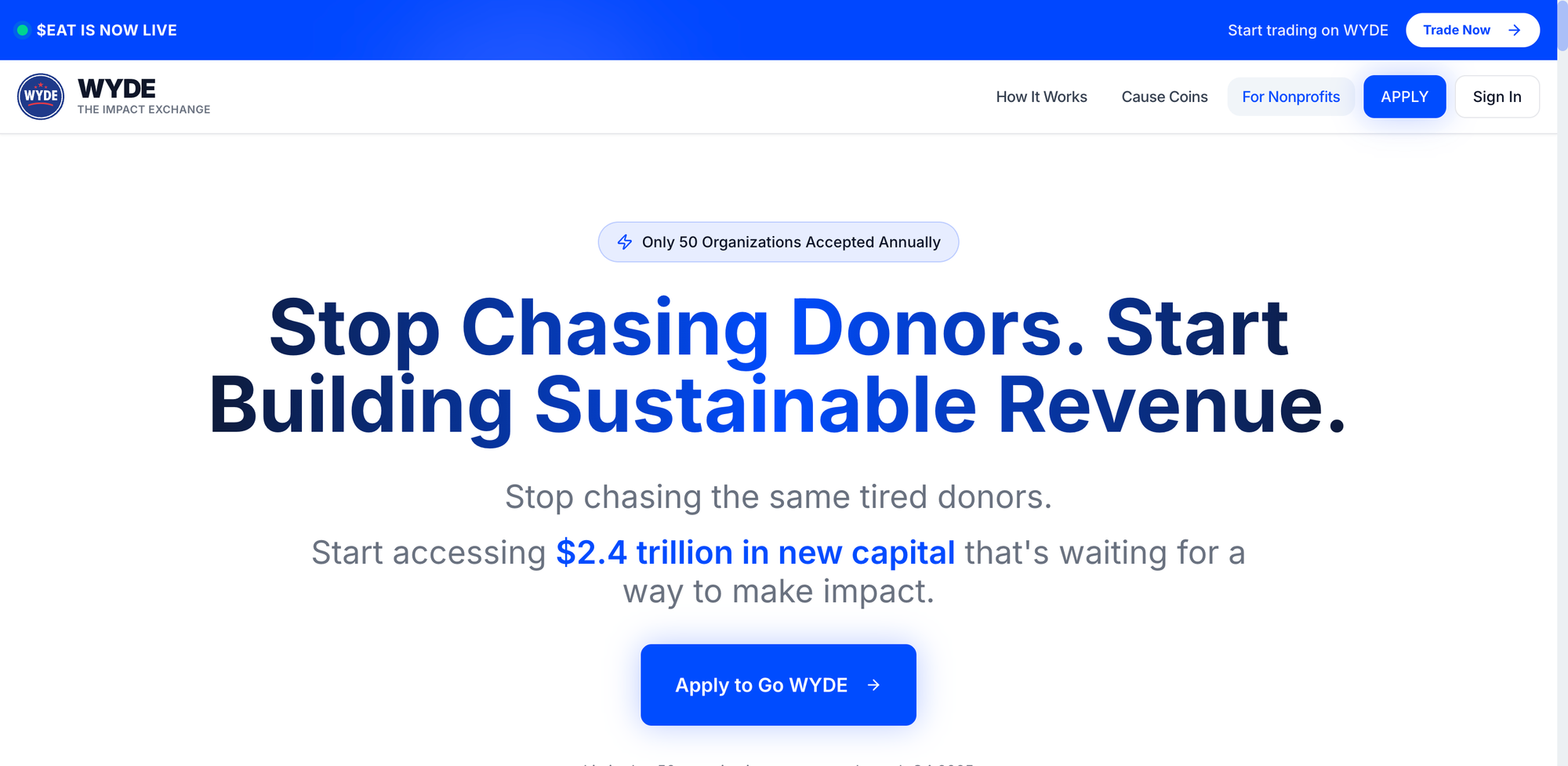
At the highest level, WYDE is an impact exchange. It allows people to trade cause specific tokens, called Cause Coins, where a portion of every trade automatically funds verified nonprofit work.
This is not donation driven.
There are no fundraising campaigns.
No pledge drives. No one asking for a tax receipt.
Instead, WYDE redirects trading fees, the same fees that already exist in every financial market, toward social impact.
The platform is built using Wyoming DUNA law, which allows decentralized nonprofit associations to exist with legal clarity and limited liability. Each Cause Coin is its own nonprofit entity, governed by its token holders over time.
The first Cause Coin is $EAT, focused on ending hunger.
How the Model Works in Practice
The mechanics are intentionally simple.
People trade Cause Coins for causes they care about. Hunger, food security, and eventually other categories like climate, health, education, and disaster response.
Every trade generates fees, roughly half a percent, that are automatically routed on chain to a cause specific treasury.
Those funds flow to verified nonprofit partners that are actively working on the issue. All transactions are transparent and auditable.
Over time, token holders gain governance rights. They can vote on which nonprofit partners receive funding, how funds are allocated, and how the cause evolves.
This creates something entirely new.
A perpetual funding engine for social impact that does not depend on donor fatigue or annual fundraising cycles.
Why This Is Not Just Crypto for Charity
One of the most important points Martin and Aaron emphasized is that WYDE is not trying to compete with traditional donors. It is aimed at a completely different pool of capital.
People already trade trillions of dollars worth of tokens every year.
Meme coins with no purpose generate massive volume.
WYDE simply asks a different question. If people are already trading, why should those fees disappear into opaque systems instead of funding real outcomes.
This is why the comparison to donations misses the point.
WYDE is not asking people to give money away. It allows participants to own tokens, retain value, and still generate impact through market activity.
As Aaron put it during the conversation, this is closer to a public market for impact than a fundraising tool.
Transparency and Accountability Built In
A recurring theme in the episode was trust.
Nonprofits often struggle with transparency, even when they are doing excellent work. Donors rarely see exactly where money goes or what it accomplishes. Crypto, for all its flaws, excels at one thing.
Verifiable transparency.
Every transaction on WYDE is visible on chain. Funding flows can be tracked in real time. Impact reporting becomes a core driver of value, not a marketing afterthought.
Rather than quarterly earnings calls, WYDE envisions quarterly impact reports. How many meals were funded.
How many people were served.
What outcomes were achieved.
In this model, strong impact drives attention. Attention drives trading activity.
Trading activity funds missions.
It is a flywheel, not a campaign.
Early Focus on Hunger and What Comes Next
WYDE is intentionally starting narrow. The $EAT token launches first to focus on hunger and food insecurity, a problem with clear metrics and immediate relevance.
The team is already exploring integrations that could allow traders to receive food related benefits themselves, creating stronger participation incentives while still prioritizing impact.
There is also strong interest coming from outside the United States, particularly from crypto native communities in regions like Nigeria, where access to global financial systems and social funding remains limited.
Over time, the vision expands.
Natural disaster response.
Climate adaptation.
Healthcare access.
Education.
Each with its own Cause Coin, governance structure, and nonprofit partners.
A New Category, Not a Replacement
WYDE is not claiming to replace nonprofits, donors, or public funding. It is adding a new layer.
A market layer that operates continuously. A funding stream that scales with participation. A system where ownership, accountability, and outcomes are aligned.
As Martin noted, early markets are always messy. The first stock exchanges were chaotic. The early internet was crude. What matters is whether the infrastructure points capital toward something meaningful.
WYDE is an attempt to make markets serve humanity, not just profit.