

The modern retail landscape is currently defined by a structural tension between consumer demands for convenience, the escalating necessity for sustainable practices, and the persistent inflationary pressures affecting household food security.
Thrive Market has emerged as a seminal case study in resolving these tensions through a membership-based, digital-first model that integrates social impact directly into its financial architecture.
Founded in 2014, the organization was conceptualized not just as a commercial enterprise but as a movement to democratize access to healthy living, specifically targeting the geographic and monetary barriers that have historically rendered organic and non-GMO products the exclusive domain of affluent, urban demographics.
By operating as a hybrid of a wholesale club and a specialty health store, frequently articulated as "Costco meets Whole Foods", Thrive Market has successfully bypassed traditional retail markups, offering a hyper-curated catalog of over 6,500 products at prices 25% to 50% below traditional retail.
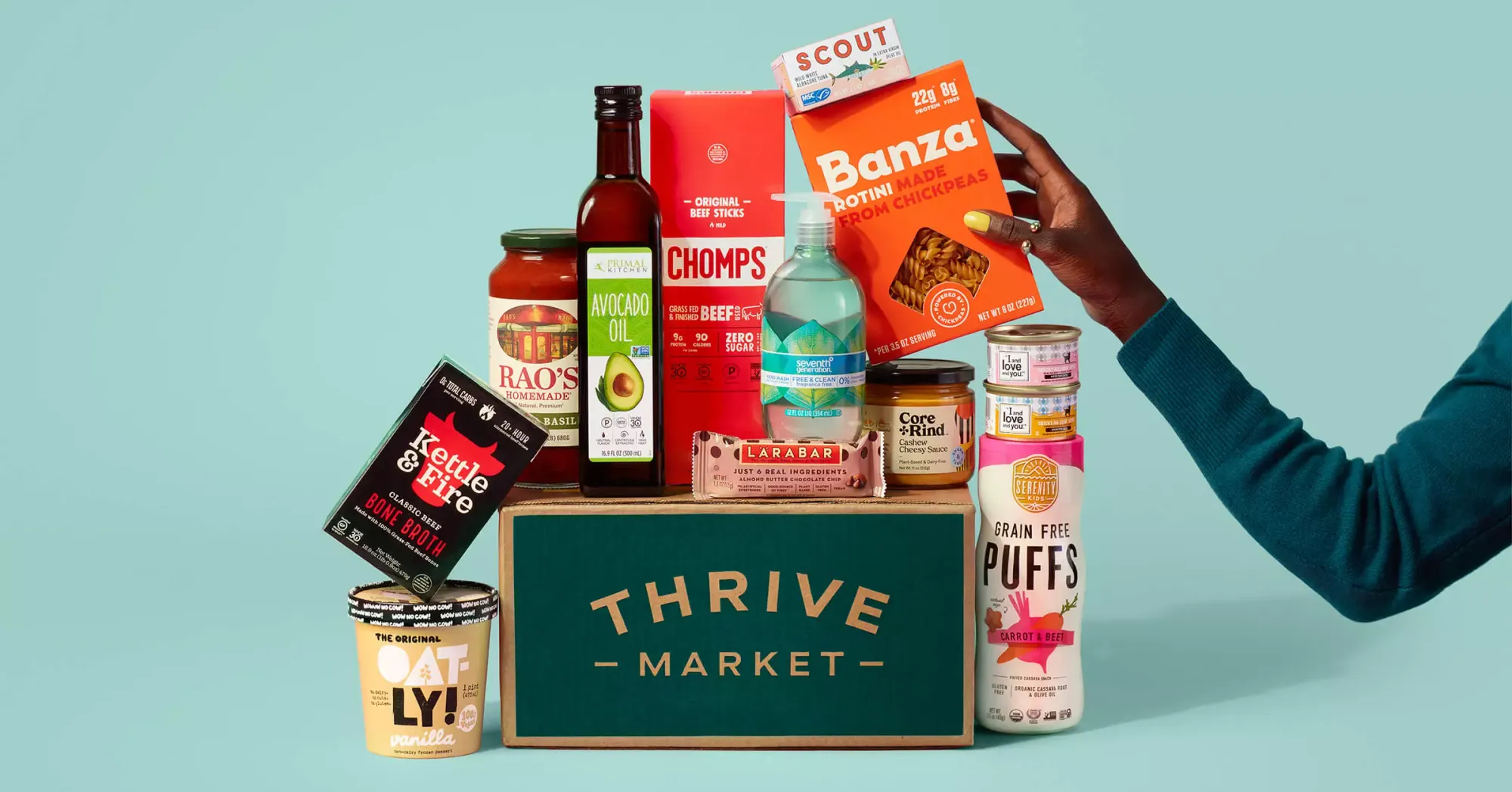
The company's evolution has been marked by a transition from a niche e-commerce startup to a Public Benefit Corporation (PBC) with a valuation exceeding $1.2 billion, serving over 1.5 million paying members as of late 2024.
This growth has been underpinned by a series of strategic innovations, most notably the use of an influencer-investor network to circumvent institutional fundraising rejections and the recent integration of Supplemental Nutrition Assistance Program (SNAP) EBT payments, making it the first online-only grocer to bridge the digital divide for 42 million food-insecure Americans.
Operationally, the organization distinguishes itself through a logistics network characterized by "quiet discipline", prioritizing climate-neutral, zero-waste fulfillment nodes that leverage predictive AI to optimize the "freight-forward" nature of grocery delivery.
As the industry looks toward 2026, Thrive Market stands at the intersection of several pivotal trends: the surge in "Physical AI" within fulfillment, the broadening of the organic market into mainstream segments, and a shift toward "agentic" shopping experiences where personalization engines anticipate up to 50% of a consumer's recurring needs.
The following report provides a detailed dissection of Thrive Market’s organizational structure, financial health, and strategic trajectory, offering professional peers an exhaustive analysis of a business model that has fundamentally challenged the traditional grocery paradigm.
| Key Performance Metric | 2024 Reported/Estimated Value |
|---|---|
| Membership Base | 1.5M+ Active Paid Members |
| Estimated Annual GMV | $500M+ |
| Private Label Revenue Share | 25% of Total Sales |
| SKU Count (Curated) | ~6,500 items |
| Private Label SKU Count | 650+ items |
| Order Repeat Rate | 80% of total GMV |
| B-Corp Score Improvement | 33% (since 2020) |
Company Background & History

The genesis of Thrive Market is a narrative of entrepreneurial resilience and a critique of the "broken" legacy grocery model.
The company was co-founded by Nick Green, Gunnar Lovelace, Sasha Siddhartha, and Kate Mulling, each bringing a distinct perspective to the challenge of food accessibility.
Gunnar Lovelace, raised on an organic farm in Ojai, California, witnessed firsthand the community-building power of group buying and the structural hurdles faced by small-scale sustainable producers.
Nick Green’s motivation was more personal, rooted in his childhood in the Midwest during the 1990s, where his mother struggled to provide nutritious meals on a limited budget, a struggle he identified as being exacerbated by a lack of local options rather than a lack of intent.
The early conceptual phase, initially under the name "Shop Tribe," focused on bulk buying events. However, the founders quickly realized that a two-to-four-week fulfillment cycle was incompatible with modern grocery expectations.
They pivoted toward a membership-only model inspired by Costco, aiming to centralize demand to drive down costs for the individual consumer.
Despite the clarity of their mission, the fundraising environment of 2014 was remarkably hostile. Green and Lovelace pitched to more than 50 venture capital firms, all of whom rejected the proposal.
The prevailing institutional sentiment was that a distributed health food startup could not survive against the impending dominance of Whole Foods (pre-Amazon acquisition) or the logistical "last-mile" nightmares associated with low-margin perishables.
This institutional skepticism forced a strategic pivot in capital acquisition that would ultimately become one of the company's greatest competitive advantages.
The founders began building a network of over 200 health and wellness influencers, bloggers, and celebrities, individuals who already commanded the trust of the brand’s target audience.
By January 2014, they had raised an $8 million seed round from these strategic investors, including prominent figures such as Deepak Chopra, Tony Robbins, and Jillian Michaels.
This round not only provided liquidity but also embedded a built-in marketing machine: these investors were equity-holders who were inherently motivated to promote the platform to their millions of followers, effectively solving the "cold start" problem of user acquisition.
| Historical Era | Key Developments |
|---|---|
| Foundational Pivot (2013-2014) | Rebranding from Shop Tribe to Thrive Market; 50+ VC rejections |
| Seed & Launch (2014) | $8M Seed Round from 200 influencers; platform launch in Nov 2014 |
| Scaling & Diversification (2015-2018) | Launch of Private Label (2015); Series A ($30M) and B ($111M) rounds |
| Expansion Phase (2019-2022) | Entry into frozen food, meat, seafood, and biodynamic wine |
| Mission Consolidation (2023-2024) | Conversion to PBC; attainment of SNAP EBT acceptance |
In November 2014, the platform officially launched, and its growth was immediate. By 2016, Thrive Market had 300,000 paying members and was generating $200,000 in daily sales.
The subsequent decade saw the organization systematically expand its footprint into the "clean beauty" and supplement categories, and eventually into high-margin, high-complexity segments like frozen meats and organic wines.
The 2023 conversion to a Public Benefit Corporation was a formal legal recognition of the company’s "Access for All" promise, which had been part of its DNA since the launch of the Thrive Gives program, a one-for-one membership donation model that remains central to its brand identity.
Industry & Market Analysis
The global organic foods market is transitioning from a high-growth niche to a foundational sector of the broader consumer packaged goods (CPG) industry.
As of 2025, the market is valued at approximately $186.77 billion, with projections indicating a rise to over $402 billion by 2032, a compound annual growth rate (CAGR) of 11.6%.
This growth is not merely a function of increased supply but a structural shift in consumer psychology.
Health consciousness has become the leading driver for organic consumption, outstripping environmental concerns as consumers increasingly link organic products to a reduction in pesticide exposure and improved personal wellbeing.
Within the United States, this trend is further amplified by the rapid evolution of grocery e-commerce. In 2024, online grocery marketplaces grew three times faster than traditional brick-and-mortar stores, reaching a milestone of $10 billion in monthly sales by early 2025.
This "digital-first" shift has been catalyzed by the increasing technological proficiency of Millennial and Gen Z parents, Thrive Market’s core demographic—who prioritize time-efficiency and dietary curation.However, the market faces significant "macro-economic rewiring."
The linear model of global supply chains is fracturing into regional systems that must balance efficiency with structural volatility, particularly in the face of inflation and shifting trade policies.
| Market Force | Industry Impact | Thrive Market Positioning |
|---|---|---|
| Inflationary Pressure | Consumers trading down to private labels | 25% revenue from high-value private label |
| SNAP EBT Integration | Expands market to 42M low-income participants | First online-only retailer to accept SNAP |
| Personalization (GenAI) | Search-to-purchase conversion 23x higher via AI | Proprietary "AI Cart" and personalization engines |
| Sustainability (ESG) | Strict demand for plastic-neutral/zero-waste | B-Corp certified; TRUE Zero Waste warehouses |
The industry is also witnessing a "flight to value." While organic produce often costs 21% more than conventional produce, sales volume for organic items grew by 6.7% in late 2024, suggesting that for a core segment of consumers, health is a non-discretionary expense.
This "persistent prioritize-health" behavior allows retailers like Thrive Market to maintain a loyal base even during economic contractions.
The integration of Retail Media Networks (RMNs) has also introduced a new revenue frontier; as grocers leverage their first-party data to offer highly targeted advertising, the line between retailer and media platform continues to blur.
Competitive Landscape
Thrive Market occupies a strategic "middle ground" in a market contested by established giants and niche specialists.
Its competitive moat is built on a combination of membership-driven pricing, ethical curation, and a direct-to-consumer (DTC) logistics model that eliminates the "last-mile" racing costs typical of platforms like DoorDash or Instacart.
Legacy and Omnichannel Retailers
Costco Wholesale remains the most formidable comparative model. As a membership-based wholesale giant with $249.6 billion in sales, Costco leverages massive volume to offer the lowest prices in the industry.
However, Thrive Market differentiates itself by focusing exclusively on a "better-for-you" standard. While Costco is a leader in organic volume ($6 billion), its inventory is "broad and shallow," requiring customers to buy in bulk.
Thrive’s "narrow and deep" curation focuses on specialty diets (Keto, Paleo, Non-GMO) and allows for standard household quantities, making it more practical for frequent, targeted shopping.
Whole Foods Market (Amazon) provides the omnichannel experience that Thrive lacks. With over 500 physical locations, Whole Foods offers immediate gratification through pickup and same-day delivery via Prime.
However, the "Whole Paycheck" reputation persists; Thrive Market’s lack of physical real estate overhead allows it to consistently underprice Whole Foods on shelf-stable and private-label items, positioning itself as the more affordable alternative for the price-conscious organic shopper.
Emerging Digital Competitors
Misfits Market (including Imperfect Foods) has evolved into a direct digital competitor. Its primary advantage is the lack of a mandatory membership fee, which lowers the barrier for entry.
However, Misfits’ inventory is inherently tied to agricultural surplus and "rescued" items, leading to fluctuations in product availability.
In contrast, Thrive Market maintains a consistent catalog of 6,500 premium SKUs, appealing to the "pantry-stocking" behavior that requires reliability over opportunistic discounts.
| Feature Comparison | Thrive Market | Misfits Market | Costco |
|---|---|---|---|
| Membership Fee | $59.95/year | $0 (Flex Plan) | $60+/year |
| Core Value | Ethical Curation | Waste Reduction | Bulk Savings |
| Private Label % | 25% of revenue | Variable ("Odds & Ends") | 34% of revenue |
| Product Focus | Healthy/Organic | Produce/Surplus | Mass Market |
| Shipping Threshold | $49+ for free | $15 min / $60+ free | Varies |
Niche Subscription Services
Services like ButcherBox (meat) and Daily Harvest (smoothies) compete for "share of wallet" in specific categories.
Thrive Market’s strategy has been to absorb these niches into its platform. By partnering with brands like Beyond Meat and developing its own meat and seafood lines, Thrive offers a "one-stop-shop" that reduces the subscription fatigue felt by consumers managing multiple niche deliveries.
Go-to-Market & Marketing Strategy
Thrive Market’s go-to-market strategy has evolved from an "influencer-led" model into a "multi-channel content machine." By treating its mission of food equity as a marketing asset rather than just a corporate social responsibility (CSR) goal, the company has achieved a "challenger brand" status that resonates with conscious consumers.
The Influencer-Investor Flywheel
As previously noted, the early strategy of bringing in 200 influencers as equity-holders was transformative. Unlike traditional "pay-to-post" influencer marketing, these wellness figures were long-term partners whose credibility was lent to the brand.
This created a "built-in backlink" strategy and a high-trust entry point for health-conscious consumers.
By 2025, this strategy has been refined into a performance-based affiliate program that pays commissions for sales while maintaining personal relationships with key influencers through retreats and exclusive collaborations.
PR as Activism
Thrive Market uses political and social advocacy as a high-impact marketing tool.
- SNAP Petition: In 2016, the company launched a petition asking the USDA to bring food stamps online, generating 310,000 signatures and significant media coverage.
- PBC and B-Corp Status: By positioning itself as a Public Benefit Corporation, Thrive differentiates itself from Amazon and Walmart, appealing to the segment of consumers who want their spending to support "systemic change".
Content-First Growth
The organization employs a "Strategy-First" marketing plan that prioritizes educational content over "salesy" promotions.
- The Blog and Newsletters: A robust library of recipes, DIY beauty tips, and health insights acts as a top-of-funnel attraction for organic search traffic.
- Personalization: The company uses data analytics to deliver "bespoke service," such as customized email reminders based on a member's predicted depletion of staples like coffee or olive oil.
| Marketing Pillar | Strategic Tactic | Metric of Success |
|---|---|---|
| Influencer | Equity-based partnerships | 6M+ unique monthly visitors |
| Advocacy | SNAP EBT integration petitions | 310,000+ signatures |
| Paid Media | Experimental spends on TikTok/Tatari | Efficient iCPA (Incremental CPA) |
| Retail Media | Brand partnerships via Instacart Carrot Ads | High-margin advertising revenue |
| Social Proof | "Savings Guarantee" and member reviews | 1.5M+ paid memberships |
Business Model & Revenue Streams
The Thrive Market business model is a sophisticated synthesis of multiple monetization strategies designed to ensure a "virtuous cycle" of loyalty and low costs.
At its core, the organization operates as an e-commerce membership club that utilizes a direct-to-consumer (DTC) advantage to eliminate intermediaries and pass savings to members.
Recurring Membership Revenue
The primary financial engine is the membership fee, $59.95 per year or $12 per month.
This model provides a stream of predictable, high-margin revenue that the company uses to subsidize its low prices.
Unlike traditional grocers who must extract profit from every can of beans, Thrive Market can sell items at near-wholesale prices because its profitability is decoupled from the individual transaction.
This leads to a superior customer lifetime value (LTV) and lower churn, as members who pay the fee are psychologically incentivized to "get their money's worth" through repeat purchases.
Private Label Integration
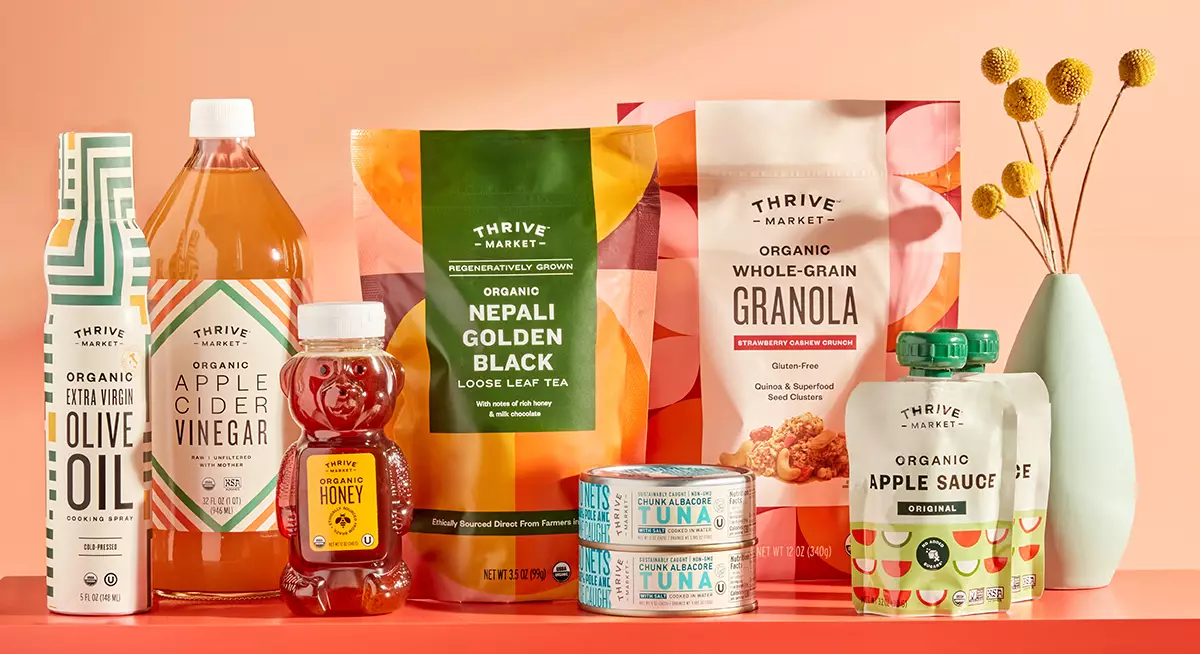
A critical pillar of the revenue model is the aggressive development of private label products. As of 2024, Thrive Market has launched over 650 owned-brand SKUs, representing 25% of its total revenue.
These products are ranging from coconut oil to the Rosey cleaning line and f.a.e. beauty products, offer significantly higher margins than third-party goods while still being priced lower for the consumer.
| Revenue Stream | Mechanism | Strategic Benefit |
|---|---|---|
| Membership Fees | Yearly/Monthly recurring billing | High-margin predictable cash flow |
| Product Sales (3rd Party) | Direct-to-consumer retail | High volume; wide variety |
| Private Label Sales | Owned-brand manufacturing | Maximum margin; supply chain control |
| Retail Media | Targeted advertising for brands | New high-margin digital revenue |
| Shipping & Fees | Logistics recovery for small orders | Offsets fulfillment overhead |
The "Savings Guarantee" Mechanism
To mitigate the "subscription risk" perceived by consumers, Thrive Market offers a unique guarantee: if a member does not make back their annual fee in savings over the course of the year, the company credits the difference to their account as "Thrive Cash" upon renewal.
This drastically lowers the barrier to entry, transforming the membership from a "cost" into an "investment" with a guaranteed return. On average, members recoup their annual fee in just two purchases.
Operational Cash Flow Effects
The membership model also creates a "negative cash conversion cycle" similar to Costco's. By collecting membership fees upfront and maintaining an 80% repeat purchase rate, Thrive can forecast demand with high precision, reducing inventory redundancy and bloated warehouse stock.
This predictability allows for leaner inbound ordering and higher fill rates (consistently above 95%), which further stabilizes the operational margin.
Financial Performance
Thrive Market’s financial trajectory is characterized by a "step-function" acceleration during the 2020-2022 period followed by a consolidation of its market position in the inflationary environment of 2023-2024.
Total funding raised by the organization is estimated to be between $241 million and $602 million, depending on the inclusion of secondary market activities and convertible notes.
Revenue and Growth Trajectory
During the COVID-19 pandemic, Thrive Market saw a 90% surge in revenue as digital grocery penetration moved from a convenience to a necessity.
By 2023, the company reported reaching $500 million in annual sales.
In 2024, gross merchandise value (GMV) was estimated at $241 million for the flagship domain, with a projected annual growth rate of 10-15% into 2025.
This growth is particularly notable given the "grocery price inflation" that caused many consumers to tighten discretionary spending.
Funding Rounds and Valuation
The company has successfully executed multiple rounds of financing, progressively attracting more institutional capital.
| Round | Date | Amount | Key Investors |
|---|---|---|---|
| Seed | Jan 2014 | $8M | 150+ influencers/angels |
| Series A | July 2015 | $30M | Led by Greycroft |
| Series A (follow-on) | Jan 2016 | Undisclosed | Investors undisclosed |
| Series B | June 2016 | $111M | Led by Invus, with Greycroft, Cross Culture Ventures, and others |
| Convertible Note | Oct 2016 | $10M | Investors undisclosed |
| Series B (extension) | May 2017 | $20M | Investors undisclosed |
| Series B (extension) | July 2018 | $42.4M | Investors undisclosed |
| Convertible Note | Oct 2019 | $20M | Led by Invus |
As of 2021, the company sought a valuation of over $2 billion in preparation for a potential public offering.
While the IPO window for tech-heavy DTC brands narrowed in late 2022-2023, Thrive Market’s conversion to a Public Benefit Corporation and its achievement of climate and plastic neutrality have made it a high-value target for ESG-focused (Environmental, Social, and Governance) investment funds.
In secondary markets, shares have recently traded at prices implying a valuation between $1.16 billion and $1.3 billion.
Unit Economics and KPI Analysis
The company's financial health is underpinned by strong transactional KPIs. In 2024, its conversion rate reached 5.0-5.5%, which is significantly higher than the industry average for general e-commerce.
Member retention is another critical metric; early cohorts show retention rates exceeding 70% after the first year, providing a stable foundation for revenue growth.
The average order value (AOV) is bolstered by minimum order thresholds for free shipping ($49), which encourages members to "bundle and replenish in bulk," a behavior that improves the net margin per box.
Product or Service Offerings
Thrive Market's product strategy is an exercise in "curation as a service." By rejecting the traditional supermarket's "infinite aisle" (which can contain 50,000+ SKUs), Thrive limits its offering to a hyper-curated selection of 6,500 items that meet rigorous ethical and nutritional standards.
The "Trust Test" and Quality Standards
Every product on the platform undergoes a "trust test" by an expert team of innovators.This vetting process ensures that 100% of the food catalog is non-GMO.
Furthermore, the company restricts over 1,000 specific ingredients—including artificial flavors, antibiotics, synthetic nitrates, and parabens—that are common in mainstream grocery items.
Core Product Categories
- Pantry Staples: High-quality grains, oils, baking supplies, and snacks.
- Meat & Seafood: A focus on grass-fed beef, pasture-raised poultry, and sustainably sourced seafood.
- Frozen Meals: Collaborations with innovative brands like Beyond Meat to provide healthy convenience.
- Personal Care & Beauty: Products under the f.a.e. (face, arms, etc.) sub-brand, which currently includes 55 SKUs of non-toxic skincare.
- Home Cleaning: The Rosey sub-brand, which features over 35 eco-friendly, plant-powered cleaning products.
- Vitamins & Supplements: Vetted for bioavailability and transparency.
Personalization and AI-Driven Experience
The "service" aspect of Thrive Market extends to how users discover products. Members can filter the catalog by over 90 different diets and lifestyle choices, such as Paleo, Keto, Gluten-Free, Vegan, and Fair Trade.
In 2025, the company launched "AI Cart," a feature that uses a member-onboarding quiz and past purchase behavior to pre-fill a weekly cart with predicted essentials.
This "intelligent default" model allows the AI to accurately predict about 50% of an order, saving members significant time during their weekly shop.
Social Impact as a Service: Thrive Gives
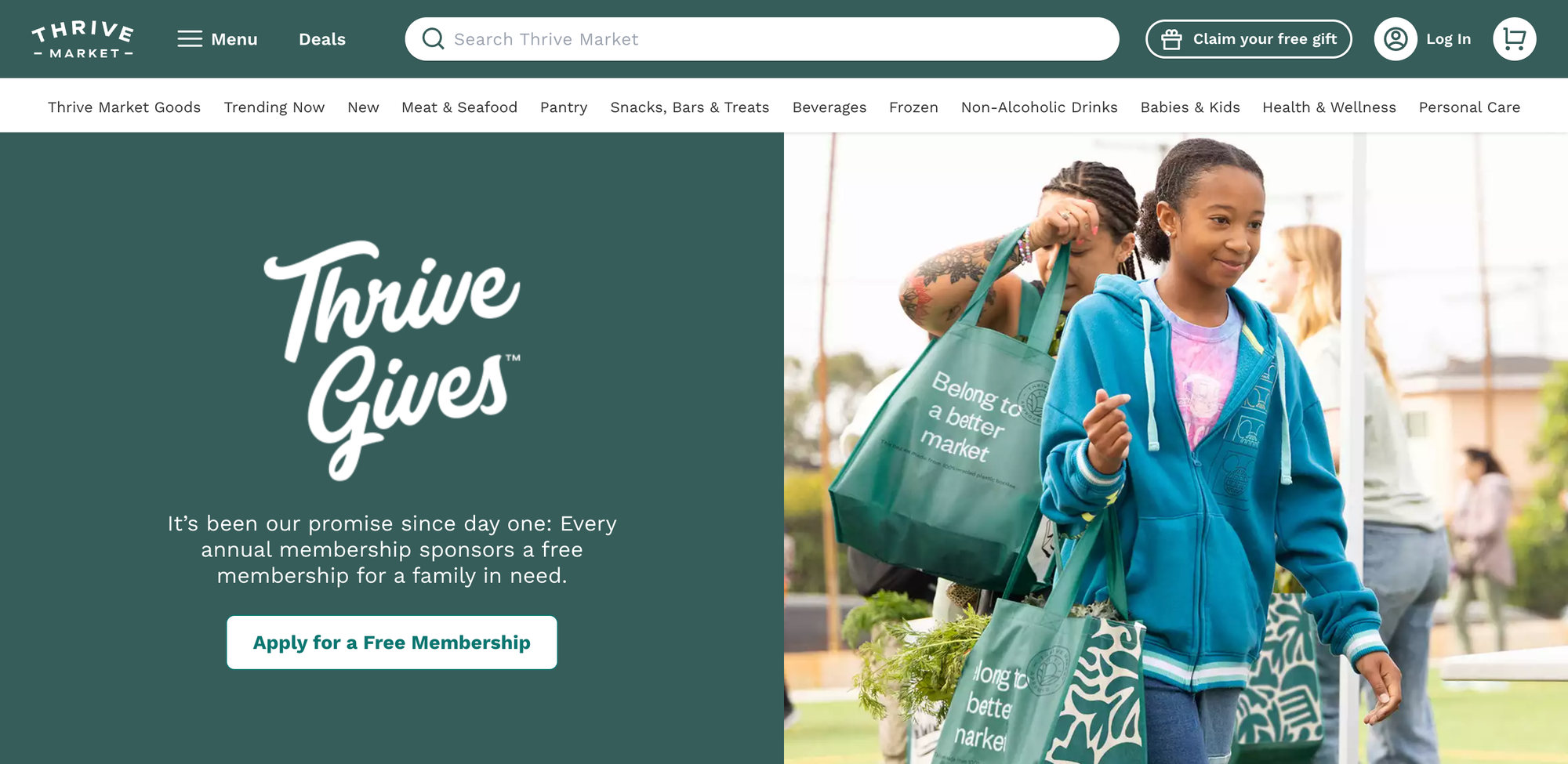
Integral to the offering is the Thrive Gives program. For every paid annual membership, Thrive Market donates a free one-year membership to a family in need, including teachers, nurses, first responders, veterans, and students.
In 2024, this program was expanded by the acceptance of SNAP EBT, allowing members to spend their federal benefits on the platform's organic goods.
Operations & Organizational Structure
Thrive Market’s operational architecture is defined by "freight-forward" efficiency.
Unlike "instant" grocery apps that rely on expensive gig-labor and micro-fulfillment, Thrive has built a centralized, high-throughput system optimized for national ground transit.
Fulfillment Infrastructure
The company operates a network of four primary distribution centers, strategically located to provide 1-to-2-day ground delivery to 90% of U.S. households.
- Zero Waste Certification: All fulfillment centers, including the massive Hanover, PA facility, are TRUE-certified for Zero Waste, meaning they divert over 90% of their waste through recycling and composting.
- Swisslog Automation: To manage the rapid scaling, the centers use Swisslog logistics automation, including automated storage and retrieval systems (ASRS) and conveyors that have reduced shipment times by one full day in key regions.
Social & Environmental Impact
Thrive Market’s identity is inextricably linked to its status as a mission-driven enterprise, a commitment formalized through its conversion to a Public Benefit Corporation (PBC) and its rigorous B-Corp certification.
The organization views social equity and environmental stewardship not as secondary initiatives but as core operational mandates.
Social Equity and Food Access
The "Access for All" mission is operationalized through the Thrive Gives program, which utilizes a one-for-one membership model.
For every paid annual membership, a free membership is donated to a low-income family, student, teacher, veteran, or first responder.
As of 2024, this initiative has provided over 1.5 million free memberships.
A landmark achievement in the company's social impact history was the 2024 launch of SNAP EBT acceptance.
This was the culmination of a multi-year advocacy campaign, including a 2016 petition to the USDA that garnered 310,000 signatures. By becoming the first online-only grocer to accept these benefits, Thrive Market removed the digital barrier for 42 million food-insecure Americans to access organic products.
Additionally, through the Food Equality Now campaign, the company has raised and donated over $17 million in healthy groceries as of late 2024, with a target to reach $20 million by 2030.
Environmental Stewardship
Thrive Market manages its environmental footprint through a three-pillared strategy: climate, waste, and plastic management.
- Climate & Carbon Management: Since 2015, the company has maintained a "no airship" policy, offsetting 100% of carbon emissions from ground shipping. In 2023, it achieved Climate Neutral Certification.
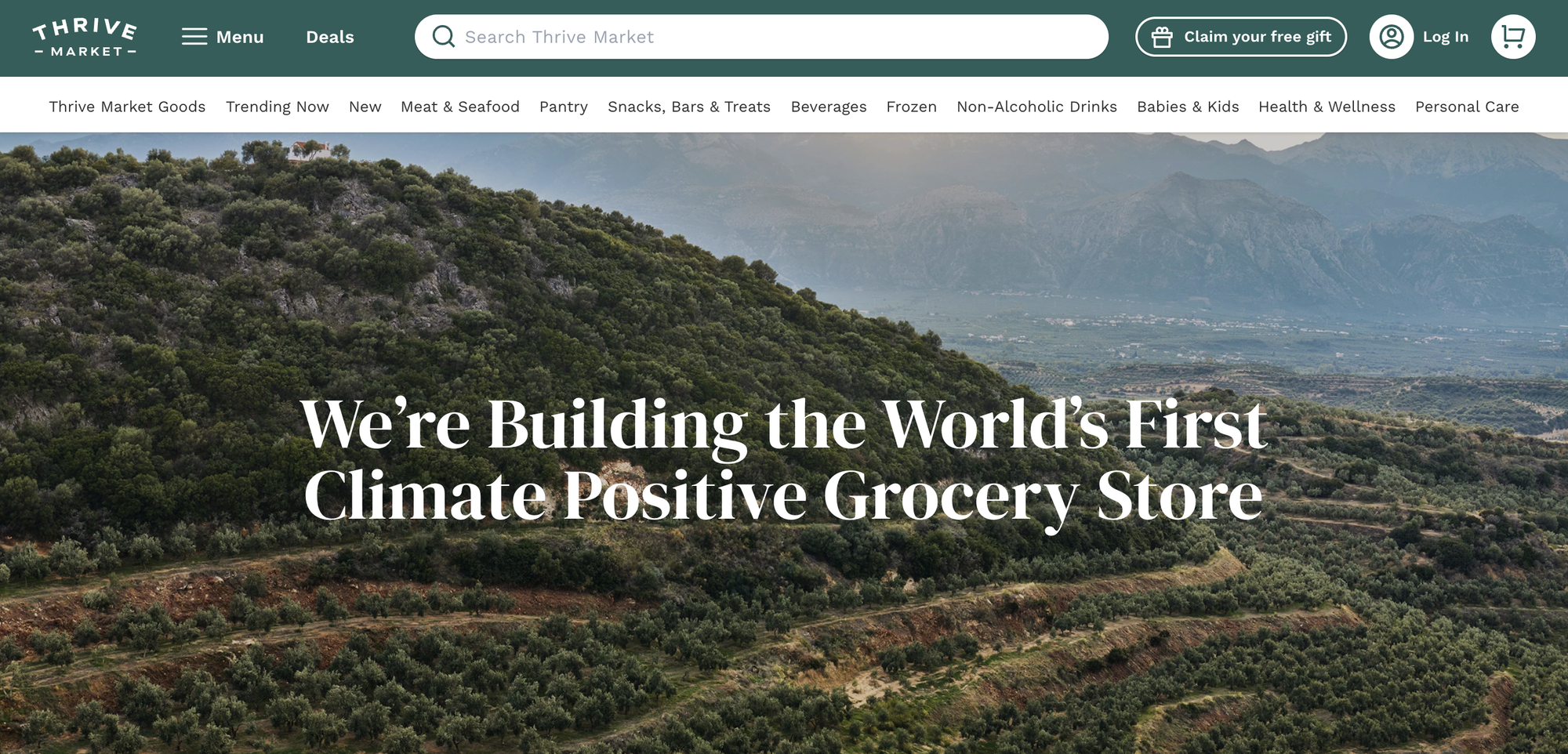
The organization has now moved its target to Climate Positivity by 2030, transitioning from carbon avoidance to permanent carbon removal credits.
In 2024, the company addressed its total greenhouse gas emissions of 324,665 metric tons, with Scope 2 emissions (direct electricity) being 100% covered by renewable energy certificates. - Zero Waste Operations: All fulfillment centers have achieved TRUE Zero Waste Certification. In 2024 alone, these facilities diverted 11,163,954 lbs of waste from landfills, maintaining a diversion rate of over 90%.
- Plastic Neutrality: Through a partnership with rePurpose Global, Thrive Market is Plastic Neutral Certified. The company finances the recovery of nature-bound plastic waste equal to the volume used in its shipping materials and private-label packaging, having recovered over 1 million pounds of plastic (equivalent to 26 million water bottles) as of early 2025.
Ethical Sourcing and Governance
The company leverages its buying power to influence the broader supply chain. It is the largest national retailer of exclusively non-GMO foods and restricts over 1,000 specific ingredients across its catalog.
Furthermore, Thrive Market is a leader in regenerative agriculture, with a goal to increase regenerative and organic sourcing for its owned brands to 84% by 2026. This commitment to ethical excellence is reflected in its B-Corp score, which saw a 33% improvement during its 2024 recertification.
Challenges & Crisis Management
The journey of Thrive Market has been through some structural risks and operational setbacks that have tested its foundational model.
Institutional Fundraising Rejection
The initial rejection by 50 VCs was a formative crisis.
By failing to secure traditional venture capital, the founders were forced to innovate their business model early on, leading to the high-retention membership system and the influencer-investor strategy.
This "setback" ultimately protected the company from the "growth-at-all-costs" pressure that led many other VC-backed grocery apps to bankruptcy.
Pandemic Demand Shock
During the COVID-19 pandemic, Thrive Market faced a sudden spike in demand that threatened to overwhelm its fulfillment nodes. The crisis was managed by re-structuring the procurement team to use EDI data to manage "exceptions" rather than manual tracking.
By receiving advanced ship notices (ASNs) from vendors, Thrive could accurately track "on order" quantities and set realistic customer expectations, avoiding the "black hole" of unfulfilled orders that plagued its competitors.
Warehouse Cultural and Language Barriers
Recent reviews from 2025-2026 indicate ongoing challenges in the Batesville, IN and Sparks, NV warehouses. Employees have reported a "language barrier" and communication issues floor-side, alongside management challenges during mandatory overtime (VTO/VOT) periods.
The organization has responded by engaging "People Operations" to strengthen inclusivity and mutual respect across teams, showing a commitment to learning from these cultural frictions.
Inflation and Pricing Discipline
As food prices rose in 2024, Thrive Market had to balance its "low price promise" with its own rising costs. The management of this tension involved a "hyper-focus" on its private label, which served as a buffer against national brand price hikes.
Key Takeaways & Lessons Learned
The Thrive Market case study offers several critical lessons for the modern retail professional and business strategist.
- Curation is a Value Multiplier: In a world of over-abundance, filtering the "noise" for the consumer is more valuable than offering the "everything store." By limiting its catalog to 6,500 highly vetted items, Thrive Market reduces operational complexity and increases consumer trust.
- Membership Models De-risk Growth: Decoupling profit from individual transactions through membership fees creates a stable floor for recurring revenue, allowing the organization to survive macro-economic volatility that bankrupts margin-dependent competitors.
- Equity-Driven Influencer Marketing: The shift from "paying for posts" to "sharing the upside" with 200 health influencers created a sustainable growth engine that traditional venture capital could not buy.
- Social Impact is a Competitive Moat: Being the "first online-only grocer to accept SNAP EBT" and a Public Benefit Corporation is not just "good PR"; it is a strategic expansion into a massive, underserved market segment.
- Logistics as a Predictive System: By optimizing for "rhythm and control" rather than just "instant speed," Thrive has built a logistics network that beats big-box retailers on predictability and unit economics.
In summary, Thrive Market has successfully engineered a business that resolves the paradox of the "healthy but expensive" grocery model.
Through a combination of disciplined logistics, aggressive private-label development, and a mission-first brand identity, it has established itself as a resilient leader in the ethical commerce landscape, well-positioned to navigate the structural rewiring of the global economy in 2026 and beyond.