
How Innovative Finance Can Build Markets for Impact
Episode 96In this episode of Investing in Impact, Slav Gatchev explains how catalytic capital, debt conversions, transition credits, and patient philanthropy can help build markets that attract private investment.

Photo credit: Rockefeller Foundation, modified by Causeartist
The biggest opportunity in impact investing may not be finding more money.
It may be building the markets that allow money to move.
That idea runs through this episode of Investing in Impact with Slav Gatchev, Vice President of Innovative Finance at The Rockefeller Foundation.
Gatchev has spent much of his career working at the intersection of finance, infrastructure, emerging markets, and conservation. Before joining The Rockefeller Foundation, he led large sovereign debt conversion transactions at The Nature Conservancy. Earlier in his career, he spent more than two decades advising on infrastructure investments across global emerging markets.
His experience gives him a useful perspective on one of the central questions facing impact finance today:
How do we move from funding individual projects to creating systems that can attract capital at scale?
Throughout the conversation, Gatchev explains why the answer often begins with flexible capital, patient institutions, and a willingness to solve problems that traditional investors cannot yet address.
Innovative finance starts with the problem
Innovative finance can sound like a narrow category, but Gatchev describes it more as a flexible way of thinking.
The Rockefeller Foundation can invest through:
equity
debt
guarantees
recoverable grants
program related investments
funds
It can also provide traditional grants when a market or organization is too early for investment capital.
The important point is that the team does not begin with a preferred financial product.
It begins with the problem.
That may sound obvious, but it is a meaningful distinction. Many investors begin with a mandate. They may need to deploy equity, lend capital, or target a specific return.
A foundation has more flexibility.
If the barrier is a lack of data, a grant may be appropriate. If the problem is early stage risk, the answer may be patient equity. If commercial investors need protection from a specific downside, a guarantee may be more useful.
Sometimes the real barrier is not capital at all. It may be policy, market infrastructure, measurement, or a lack of credible projects.
“We start with the problem,” Gatchev explains.
That approach allows the capital to fit the need, rather than forcing every impact challenge into the same financial structure.

The real purpose of catalytic capital
Catalytic capital is often described as capital willing to take more risk or accept a lower return.
That is true, but it does not fully capture its purpose.
The real goal is to make other capital possible.
Early markets are difficult for traditional investors. There may be limited data, no track record, uncertain demand, or unclear regulation. Even when the underlying solution is promising, the investment may still feel too risky.
Catalytic investors can step into that gap.
They can fund the first transactions, test new models, absorb early uncertainty, and create evidence that a market can work.
One example discussed in the episode is the Zero Gap Fund, a partnership between The Rockefeller Foundation and the MacArthur Foundation.
The two foundations each committed $15 million, creating a $30 million fund that invested across climate, power, health, food, jobs, and other areas connected to the United Nations Sustainable Development Goals.
According to Gatchev, those investments helped mobilize approximately $1 billion in additional capital.
That is the leverage foundations are looking for.
The success of the investment is not measured only by what the foundation contributed. It is measured by what happened next.
Did the initial investment prove the model?
Did other investors follow?
Did the market become less dependent on philanthropic capital?
That is the larger promise of innovative finance.
How sovereign debt can fund conservation
Before joining The Rockefeller Foundation, Gatchev led work at The Nature Conservancy on sovereign debt conversions for nature.
These transactions are often called debt for nature swaps, although the modern structures are far larger and more sophisticated than many of the early examples.
The basic idea is relatively simple.
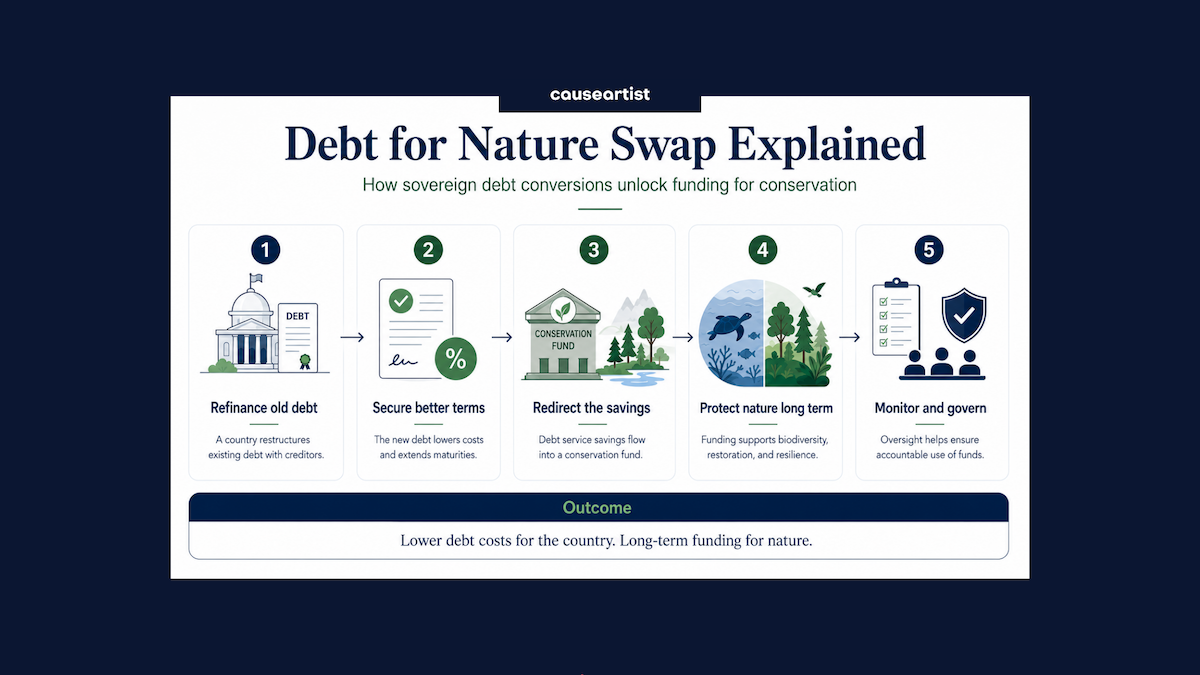
A country refinances existing debt using new financing with more favorable terms. A portion of the resulting savings is then committed to conservation, climate resilience, or another public benefit.
Gatchev described five transactions completed between 2021 and 2024 in Belize, Barbados, Gabon, The Bahamas, and Ecuador.
Together, those transactions refinanced approximately $3 billion in sovereign debt. They generated roughly $1 billion for nature based solutions, including ocean conservation and protection of the Ecuadorian Amazon.
What makes these deals important is their scale.
Earlier debt for nature transactions were often measured in hundreds of thousands or a few million dollars. The newer transactions operate at the level of sovereign bonds, development finance institutions, insurance, and global capital markets.
They also show how financial innovation can create environmental commitments that last beyond a single grant cycle.
Instead of funding one conservation project, a debt conversion can support national conservation plans, long term protected areas, and ongoing local financing.
Nature creates value, but markets rarely pay for it
Nature finance exists because ecosystems create enormous value that is rarely reflected in financial markets.
Forests store carbon, regulate water systems, support agriculture, and protect biodiversity. Wetlands reduce flooding. Healthy oceans support food systems, tourism, and local livelihoods.
The problem is that many of these benefits are treated as free.
A standing forest may benefit millions of people, but the owner or local community may receive little direct financial value for protecting it. Clearing that same forest for timber, agriculture, or mining may create a much more immediate source of income.
That creates a powerful economic imbalance.
The benefits of conservation are shared broadly. The financial incentives for extraction are often concentrated.
Innovative finance attempts to correct that imbalance.
Debt conversions are one tool. Carbon markets are another. Conservation funds, biodiversity credits, sustainable agriculture, tourism, and outcome based payments can also play a role.
None of these mechanisms is perfect. But they are all trying to answer the same question:
How do we financially reward the people, communities, companies, and countries that protect assets the entire world depends on?
Carbon credits and biodiversity credits are not interchangeable
One of the clearest parts of the conversation is Gatchev’s explanation of the difference between carbon and biodiversity credits.
Carbon dioxide can be measured as a standardized unit. A verified ton of carbon reduced or removed in one place can be compared with a ton somewhere else.
That does not make carbon markets simple. They still face serious questions around additionality, permanence, leakage, and verification.
But the underlying unit is measurable and fungible.
Biodiversity is different.
A square kilometer of Amazon rainforest cannot be treated as equal to a square kilometer of forest, wetland, or grassland somewhere else. Each place has different species, ecological relationships, cultural meaning, and importance to local communities.
For that reason, Gatchev argues that biodiversity credits should not be treated as offsets.
A company should not be able to destroy one ecosystem and claim the impact has been cancelled because it funded conservation somewhere else.
Biodiversity credits make more sense as an additional commitment.
They can give companies and institutions a way to support nature, but they should not become permission to cause harm elsewhere.
That distinction will be important as the biodiversity market develops.
Transition credits could help move energy systems away from coal
Another promising idea discussed in the episode is the use of transition credits.
Renewable energy is becoming more competitive in many markets. Battery storage, improved transmission, and modern grid technology are also making clean energy more reliable.
But economics still matter.
A company may own a functioning coal plant with years remaining on its contract. Another developer may already have plans to build new coal capacity. Asking either company to abandon those assets because it is better for the climate may not be enough.
The transition must make financial sense.
Transition credits could help cover the difference.
A developer that retires a coal plant early, cancels a planned facility, or replaces coal capacity with renewable energy could receive credits tied to the emissions avoided.
Those credits could then be sold to governments or other qualified buyers.
“You have to incentivize the transition,” Gatchev says.
That sentence captures one of the central realities of impact finance.
Moral arguments matter. Policy matters. Public pressure matters.
But large scale transitions also require economic incentives.
Companies need a credible reason to change course, particularly when they are moving away from assets that still generate revenue.
Building a market requires more than money
Enjoying this? Get the next one.
We send one email each Monday with what just published on Causeartist.
Free. Unsubscribe anytime.
Creating a new financial market is difficult because every part of the system has to develop together.
There must be trusted standards, credible data, willing buyers, investable projects, supportive policy, and organizations capable of executing transactions.
If any one of those pieces is missing, the market may not function.
Gatchev describes The Rockefeller Foundation’s work as happening at both the macro and project levels.
At the macro level, the Foundation can support the development of methodologies, standards, and policy frameworks. It can bring together governments, investors, developers, and potential buyers.
At the project level, it can work directly with companies to understand the economics of closing a coal plant, replacing planned capacity, or financing renewable energy.
The market begins to work when those two sides meet.
Developers need confidence that credits will be recognized and purchased. Buyers need confidence that the emissions reductions are real. Investors need projects that are properly structured and ready for capital.
That is why market creation takes time.
It is not simply a matter of putting money into a fund and waiting for results.
Grants remain an essential part of the capital stack
The growth of impact investing has sometimes created the impression that grants are outdated or less sophisticated.
Gatchev’s examples show why that is not true.
Some opportunities are not ready for investment. Others may never generate a conventional financial return, even when they create meaningful economic and social value.
In those situations, grant capital is still necessary.
Gatchev points to work supporting women’s cooperatives in the Brazilian Amazon. The grant helped communities strengthen sustainable businesses, bring products to market, explore carbon revenue, and protect surrounding rainforest.
According to Gatchev, a $500,000 grant supported work that could affect approximately 20,000 community members and protect two million hectares of rainforest.
The value extends beyond the immediate grant recipients.
It affects families, jobs, local businesses, food systems, and the wider regional economy.
This is an important part of the impact investing story that is often missed.
A grant is not simply money given away.
Used strategically, it can create the conditions for communities, businesses, and markets to grow.
Impact investing creates economic value
The impact sector often does a strong job of communicating social and environmental benefits.
It is sometimes less effective at explaining the economic value those benefits create.
Protecting a natural area can support tourism, agriculture, fisheries, and local businesses. Investing in clean energy can create construction jobs, improve grid reliability, and reduce long term energy costs.
Child care can increase workforce participation. Transportation can connect workers with employers. Environmental cleanup can turn abandoned industrial land into productive commercial property.
These are not side benefits.
They are part of the economic case for impact investing.
Gatchev argues that foundations must be clear about how their limited capital creates broader outcomes. That includes measuring the capital mobilized, the people reached, the land protected, and the systems changed.
The strongest impact investments do not create one isolated result.
They produce effects that spread across families, communities, industries, and regions.
Innovative finance in the United States
Much of Gatchev’s career has focused on emerging markets, but his new role also includes work in the United States.
The Rockefeller Foundation is active across food, health, power, and jobs.
One example is Food is Medicine, which connects nutrition and healthcare.
The idea is that food can become part of a patient’s treatment plan. Instead of treating diet as separate from healthcare, doctors and health systems can prescribe meals or nutrition plans based on a patient’s needs.
Another example involves former industrial sites in cities such as Cleveland.
These properties may be contaminated, abandoned, or tied up in complicated ownership issues. Private developers often avoid them because the cleanup costs and early risks are too high.
Public and philanthropic capital can help acquire the land, resolve ownership, complete environmental remediation, and prepare the property for development.
Once that work is done, private companies can build new facilities and create jobs.
This is market building in a different form.
The goal is not for philanthropy to become the permanent owner or developer. The goal is to remove the barriers preventing private investment from entering.
Jobs depend on more than employers
Job creation is often discussed as if the only challenge is attracting companies.
But people also need to be able to reach those jobs and remain in the workforce.
Transportation, child care, education, and training all play a role.
A person may be qualified and willing to work, but still unable to accept a job because transportation is unreliable or child care is unaffordable.
These are market failures too.
Gatchev highlights child care as an especially important issue. Without reliable care, parents may be forced to reduce their hours, leave the workforce, or turn down better opportunities.
Addressing these barriers creates economic value for workers, families, employers, and cities.
It is another example of why impact investing cannot be separated from economic development.
The end goal is a normal, functioning market
The best outcome for catalytic capital is not permanent dependence.
It is graduation.
A successful intervention proves that a solution works, reduces uncertainty, establishes standards, and attracts more conventional investors.
Eventually, the project or industry should be able to raise ordinary equity, borrow from commercial lenders, or issue bonds without needing the same level of philanthropic support.
At that point, catalytic capital can move on to the next problem.
This is what makes innovative finance so powerful.
Foundations will never have enough money to fund every solution directly. But they can help build systems that attract capital far beyond what philanthropy could provide on its own.
A growing field for the next generation
The conversation ends with a discussion about careers in impact investing and innovative finance.
The field is becoming more specialized, but it is also becoming more interdisciplinary.
Finance and business skills remain valuable. So do public policy, environmental science, law, energy, infrastructure, data, community development, and entrepreneurship.
There is no single path into the sector.
The people who succeed will likely be those who can work across disciplines, understand complex systems, and identify why good solutions are not reaching scale.
Gatchev also remains optimistic about artificial intelligence and the future of work.
AI may transform or replace certain tasks, but it can also create new industries and free people to focus on creativity, judgment, relationships, and original thinking.
Technology is not automatically good or bad.
Its impact depends on how people choose to build, regulate, and use it.
Building the markets impact requires
The world’s social and environmental challenges are far larger than the resources available through philanthropy.
That does not make foundations irrelevant.
It makes their role more strategic.
They can absorb early risk, prove new models, improve policy, fund research, support communities, and build the market infrastructure that allows other investors to participate.
The most important contribution may not be a particular bond, grant, fund, or credit.
It may be the ability to look at a broken market, understand why capital is not flowing, and build the conditions that allow it to move.
Once those conditions exist, much larger pools of investment can follow.
That is how innovative finance moves from supporting individual projects to changing entire systems.
Listen to the full episode
Listen to the full episode of Investing in Impact to hear Slav Gatchev discuss nature finance, sovereign debt conversions, catalytic capital, transition credits, clean energy, American jobs, artificial intelligence, and the future of impact investing.