
What Traditional Impact Metrics Miss About Refugee Entrepreneurs

Episode 245

A year-long study of Afghan refugee women in Malaysia found that entrepreneurship created autonomy, confidence, resilience, and belonging, even when business income remained limited.

What Traditional Impact Metrics Miss About Refugee Entrepreneurs

Photo credit: Ihsan Adityawarman, modified by Causeartist

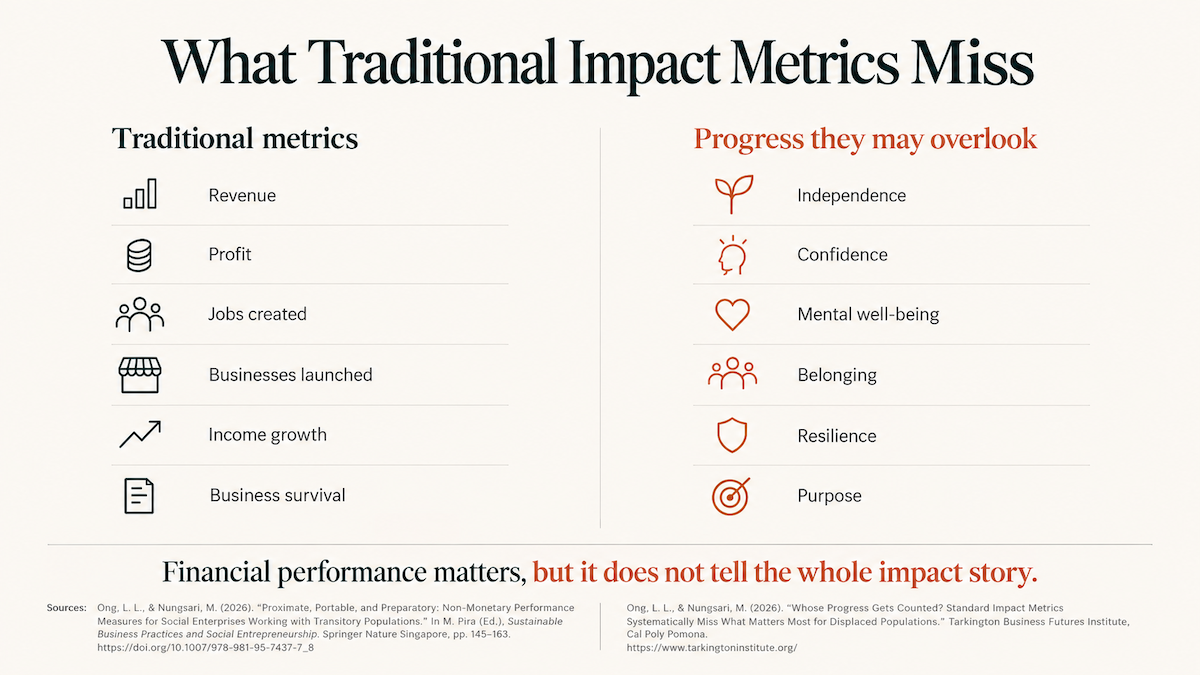
When we measure the success of a small business, we usually start with revenue, profit, and jobs created. But for people rebuilding their lives in uncertain circumstances, progress can look very different.

A year-long study of eight Afghan refugee women running small businesses in Malaysia found that these ventures created value far beyond income. While most of the businesses remained small, the women described gaining greater independence, confidence, resilience, purpose, and a stronger sense of belonging.

Researchers Prof. Lin Ong of Cal Poly Pomona and Melati Nungsari of the Asia School of Business believe outcomes like these deserve to be recognized. Their research introduces a new framework for understanding whether a program meets someone’s immediate needs, creates skills they can carry forward, and helps prepare them for an uncertain future.

The Problem With the Usual Impact Scorecard

Entrepreneurship programs are commonly evaluated through financial and operational metrics. Evaluators might track businesses launched, jobs created, revenue earned, profit generated, or household income increased.

These indicators are useful. A business ultimately needs customers and revenue if it is expected to survive. Income and stable employment also matter deeply to families trying to build secure lives.

The problem is not that financial metrics are wrong. It is that they can be incomplete, particularly when applied to people living in unstable legal, economic, or geographic conditions.

Ong and Nungsari studied eight Afghan refugee women living in Malaysia. At the beginning of the research, the average participant was 29 years old and had already spent approximately six years in the country. None had the legal right to work.

The women were navigating restrictions on employment, financial services, movement, and long-term residency. They could not plan around the assumptions that shape most entrepreneurship programs: a stable address, predictable access to markets, formal employment rights, a bank account, or certainty about where they would live in the future.

Under those conditions, business growth cannot be separated from the surrounding legal and social environment.

A participant may develop a useful product but remain unable to rent a storefront legally. She may build a customer base and still lose access to the market where she sells. She may develop skills in one country while preparing for possible resettlement in another.

Evaluating that person only through revenue can make meaningful progress appear invisible.

Prof. Lin Ong of Cal Poly Pomona(Left) and Melati Nungsari of the Asia School of Business(Right)

Inside the Year-Long Study

The women participated in a six-month entrepreneurship program that combined classroom instruction with one-to-one mentoring. The curriculum included business planning, financial literacy, marketing, digital skills, and practical assignments such as developing and presenting a business plan.

Researchers conducted six rounds of in-depth interviews during and after the program. Interviews were held in Pashto or English based on each participant’s preference, with interpreters used when necessary.

The participants pursued businesses based on skills they already had and opportunities available within their circumstances. Their ventures included home-based catering, tailoring, garment repair, handicrafts, and the resale of cosmetics or household products.

Most remained microbusinesses supported by family labor and community relationships. Most participants did not report significant monthly income.

However, the repeated interviews revealed changes that a standard financial assessment would have struggled to capture.

Ten Outcomes That Income Alone Cannot Measure

Across the six interview rounds, the researchers identified ten recurring non-monetary outcomes:

  1. Independence and autonomy

  2. Confidence and self-worth

  3. Mental well-being

  4. Skills development

  5. Purpose and aspirations

  6. Social recognition and belonging

  7. Family and spousal collaboration

  8. Work-life balance

  9. Social contribution

  10. Adaptability and resilience

These outcomes did not appear all at once. Autonomy and confidence often emerged first. Deeper relational and community outcomes developed as participants gained experience and began seeing themselves differently.

Personal Agency

Many participants entered the program after years of depending on aid or family members. Even small business decisions gave them greater control over how they used their time, managed money, and contributed to household needs.

Confidence grew as customers valued their products and participants saw themselves becoming capable business owners. The researchers found that this confidence extended beyond the enterprise. It affected participants’ willingness to navigate public systems, advocate for their children, communicate with people outside their immediate communities, and mentor others.

Entrepreneurship also gave structure to days otherwise shaped by waiting and uncertainty. Participants described having goals, responsibilities, and reasons to interact with customers. The research does not establish entrepreneurship as a mental health treatment, but participants associated meaningful activity with improved motivation and well-being.

Practical Capacity

The program helped participants develop financial, marketing, communication, language, and digital skills. They learned to price products, manage inventory, communicate with customers, promote businesses through digital platforms, and adjust their offerings.

Those capabilities mattered even when a particular business remained small. A physical business can disappear after a move or change in legal circumstances. Knowledge and experience are more likely to remain with the person.

Adaptability became particularly important. Participants dealt with changing customer demand, family emergencies, rising costs, and enforcement actions. One woman shifted to phone orders and deliveries after authorities closed her craft stall.

The value was not limited to whether that specific venture survived. Participants were learning how to solve problems and continue operating under unpredictable conditions.

Family and Community

Entrepreneurship also changed how some participants related to their families and communities.

Some spouses moved from skepticism to active participation. Children helped with social media, production, or caregiving. Participants developed new relationships with customers, suppliers, neighbors, and other entrepreneurs.

Several women began teaching skills, mentoring neighbors, or imagining businesses that could eventually train and employ other refugee women. Entrepreneurship became a way to contribute rather than remain defined by dependency.

This sense of recognition and belonging is difficult to express through a traditional return-on-investment calculation. It may nevertheless affect a person’s resilience, social support, and ability to navigate future challenges.
The 3P Framework for Measuring Impact

Enjoying this? Get the next one.

We send one email each Monday with what just published on Causeartist.

Free. Unsubscribe anytime.

The study organizes these findings into the 3P framework: proximate, portable, and preparatory outcomes.

Proximate

The first question is: Does this outcome meet an immediate need?

Proximate outcomes respond to the conditions people face now. They can include emotional stability, safety, family cohesion, community connection, or the ability to navigate an immediate conflict.

These outcomes are not merely preliminary steps that should be ignored until a financial result appears. They can be the foundation that makes future progress possible.

Portable

The second question is: Can this outcome travel with the person?

People experiencing displacement may move across cities, countries, legal systems, or employment environments. Physical assets and locally dependent businesses may be lost during those transitions.

Skills, confidence, resilience, communication abilities, and financial knowledge are more portable. Their value can continue even when external circumstances change.

Preparatory

The third question is: Does this outcome help someone navigate what comes next?

Preparatory outcomes equip people for futures that cannot yet be clearly defined. Adaptability, critical thinking, planning, emotional regulation, and the ability to engage with unfamiliar systems can all help someone respond to a new opportunity or disruption.

Together, the framework asks evaluators to consider whether an intervention creates value that is useful now, capable of moving with the person, and relevant to an uncertain future.

What This Means for Funders

Measurement requirements influence organizational behavior. When funders demand simple, standardized, and primarily financial results, organizations may shift resources toward outcomes that are easier to document.

That can create impact drift. A program may prioritize the number of businesses launched over whether participants gained useful skills. It may celebrate short-term income while overlooking whether the work is safe, sustainable, or compatible with caregiving. It may count jobs without asking whether participants have greater agency or stability.

The study suggests several ways funders could improve evaluation:

  • Let communities help define meaningful progress.

  • Combine financial indicators with qualitative evidence.

  • Use stage-specific metrics rather than expecting immediate business growth.

  • Fund longitudinal evaluation that follows outcomes over time.

  • Allow organizations to adapt metrics when legal or social conditions change.

  • Treat learning and program improvement as part of accountability.

This does not require abandoning rigor. It requires matching the evaluation system to the reality in which a program operates.

What This Means for Social Enterprises

Social enterprises serving displaced populations can use the 3P framework during program design, not only after a program ends.

Before selecting indicators, an organization can ask:

  • What does the community consider meaningful progress?

  • Which immediate needs must be addressed before longer-term outcomes are realistic?

  • Which skills and capabilities will remain useful if participants move?

  • How is the program preparing people for uncertain future conditions?

  • Are we measuring changes in agency, relationships, and resilience alongside income?

Organizations should also resist the temptation to convert every social outcome into a monetary value. Financial proxies can make reporting appear more precise while obscuring the lived meaning of the outcome.

Participant interviews, repeated assessments, observation, and stories of change can complement quantitative data without replacing it.

The Framework Could Apply Beyond Refugee Entrepreneurship

The 3P framework was developed through research with Afghan refugee women, but its core questions may be useful in other unstable or transitional settings.

Programs serving people returning from incarceration, families recovering from disasters, young people aging out of care, people experiencing homelessness, or workers displaced by major economic change face similar measurement challenges.

In these settings, progress may not be linear. Confidence, social support, practical knowledge, and adaptability may develop before stable employment or income becomes possible.

The framework should be tested rather than assumed to apply universally. But it provides a useful starting point for recognizing forms of value that conventional performance systems often overlook.

Important Limitations

This was a small qualitative study involving eight women in one country and one entrepreneurship program. The findings should not be presented as representative of all refugees, all women entrepreneurs, or all livelihood programs.

Participants may have been more motivated or resourceful than other people facing similar conditions because they voluntarily joined an entrepreneurship program. The research relied heavily on self-reported experiences, which can be influenced by social desirability, personal expectations, and relationships with researchers or program staff.

The study also does not prove that entrepreneurship caused every reported change. The repeated interviews provide detailed evidence about participants’ experiences, but they do not offer a control group or a basis for broad causal claims.

The researchers present the 3P framework as an approach that warrants further study and validation across different populations and contexts.

Entrepreneurship Cannot Replace Structural Rights

There is another caution worth emphasizing.

Celebrating resilience can become dangerous when it shifts responsibility away from institutions and onto people experiencing exclusion.

Entrepreneurship cannot replace the legal right to work. It cannot substitute for healthcare, education, stable housing, access to financial services, or a functioning refugee and resettlement system.

The businesses in this study helped participants create agency within deeply constrained conditions. That should not be used to justify the conditions themselves.

The strongest interpretation of the research is not that displaced people should simply become more entrepreneurial. It is that programs and funders should recognize the full range of value people create while also addressing the structural barriers limiting their choices.

The Bigger Takeaway

Impact measurement is never completely neutral.

What gets counted influences what gets funded. What gets funded influences what organizations build. And what organizations build shapes the opportunities available to the people they serve.

Revenue, employment, and business growth belong in an evaluation. But they should not automatically crowd out autonomy, confidence, skills, belonging, resilience, or purpose.

Ong and Nungsari’s research offers a straightforward test for a more human-centered approach: Is the outcome useful now? Can the person carry it forward? Does it help prepare them for what comes next?

For people living through prolonged uncertainty, those questions may reveal forms of progress that a conventional impact report would otherwise miss.

Source

Prof. Lin Ong and Melati Nungsari. “Proximate, Portable, and Preparatory: Non-Monetary Performance Measures for Social Enterprises Working with Transitory Populations.” Sustainable Business Practices and Social Entrepreneurship. Springer Nature, 2026.

Read the full research chapter

Visit the Tarkington Business Futures Institute

Share: