
Meet Harbor Fund: Bringing Philanthropic Capital Into Hollywood
Episode 242Harbor Fund is rethinking how socially meaningful films get financed. In this episode of Disruptors for Good, founder Lindsay Hadley shares how the nonprofit invests philanthropic capital into impact driven films, reinvests potential returns, and uses powerful storytelling to influence culture, behavior, and systems.

Photo credit: Harbor Fund modified by Causeartist
In this episode of Disruptors for Good, we speak with Lindsay Hadley, founder and CEO of Harbor Fund, about building a new financing model for films designed to influence culture and create social impact.
Hollywood has a financing problem. Capital is drying up, distribution is harder to secure than it has been in decades, and films that once would have sparked bidding wars now struggle to get made. Lindsay Hadley believes philanthropy can fill part of that gap, and she has built a first-of-its-kind structure to prove it.
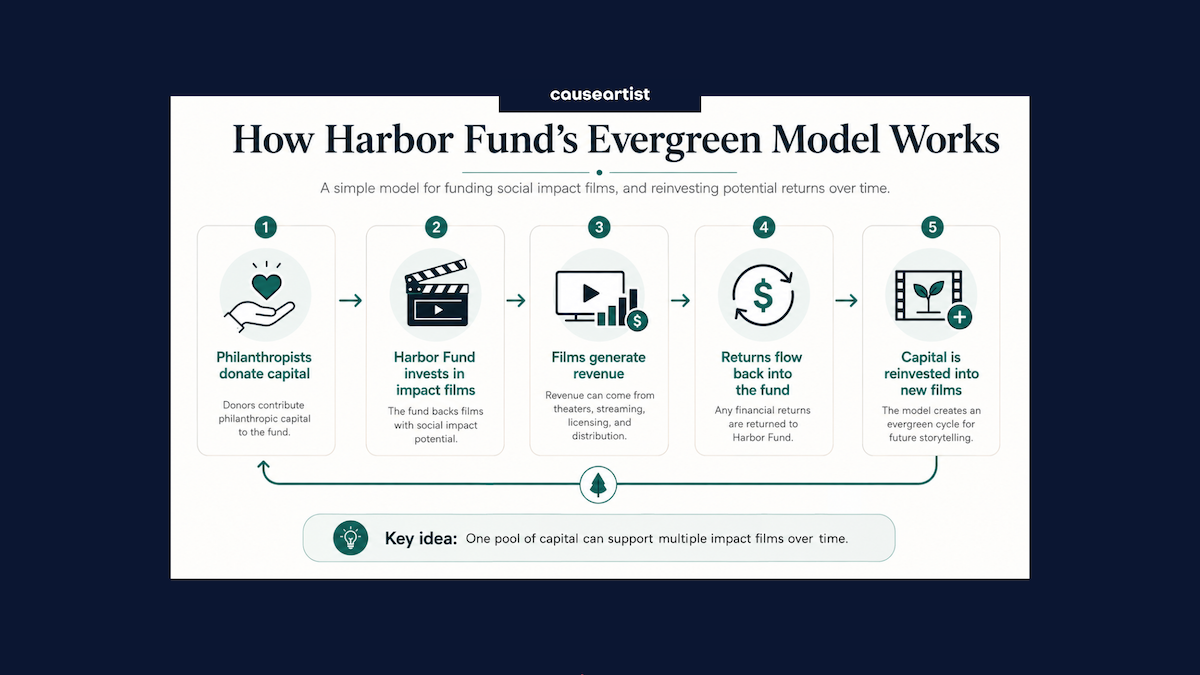
Harbor Fund is a venture capital-shaped film fund organized as a 501(c)(3) public charity. Philanthropists donate to the fund. The fund then takes equity positions in social impact films alongside traditional investors. When those films generate returns, the money flows back into the fund and is reinvested into future projects. Hadley describes it as a perpetual, evergreen war chest for storytelling.
Two years in, the model is showing proof of concept. Harbor Fund has raised $15 million, including $12 million directly into the fund, and has invested in 22 films. Its advisory board includes Mark Burnett, Mark Cuban, Katie Couric, Patty Jenkins, and Amy Redford. The goal for the next two years is $100 million, which would place Harbor in the top 1 percent of independent film financing.
What Is Harbor Fund and How Does the Model Work?
Harbor Fund operates like a venture fund with a nonprofit wrapper. The mechanics work like this:
Philanthropists donate to the fund. Because Harbor is a public charity, contributions are tax-deductible donations rather than LP commitments. There are no limited partners.
The fund invests in films as an equity participant. Each film is structured like a special purpose vehicle, with its own LLC, cap table, and investors. Harbor comes in pari passu with the other investors on each project.
Returns recycle back into the fund. Revenue from theatrical release, streaming, licensing, and derivative IP flows back to Harbor and is redeployed into new films.
The structural inspiration is Acumen Fund, the nonprofit impact investing pioneer founded by Jacqueline Novogratz. Hadley took the same recycled-capital strategy Acumen applied to social enterprises and brought it to entertainment.
The model also draws a deliberate contrast with Participant Media, the Jeff Skoll-backed studio behind films like Green Book and Spotlight that shut down despite critical and commercial wins. Hadley's diagnosis is that Participant's studio overhead made the model unsustainable.
Harbor is not a studio. It invests, takes producer credits, and offers strategic support such as talent introductions and script notes, but it does not carry production infrastructure. Hadley says the fund would never exceed ten employees, even at a billion dollars under management.
Why Scripted Films Instead of Documentaries
Hadley spent 20 years as a fundraising consultant in the nonprofit sector, raising over $100 million for clients through her agency, Hadley Impact Consulting. Her path into film began with documentaries. She executive produced Uncharitable, featuring Edward Norton and directed by Stephen Gyllenhaal, funded by $1.5 million in donations.
The film's reach fell short of her hopes, and that gap sparked the insight behind Harbor. Documentaries, she found, rarely match the cultural penetration of scripted narrative features with major talent attached. Blood Diamond did more for ethical supply chain awareness than the documentaries on the subject combined. That led to a question few had asked: if philanthropic dollars have long funded documentaries, why not scripted films?
She tested the thesis with Flash Before the Bang, a scripted feature executive produced by Matt Damon and Ben Affleck alongside Hadley and others. It tells the true story of a deaf high school track team that won a state championship in the 1980s, made with the most deaf-inclusive cast and crew in cinematic history, including a deaf director, lead producer, screenwriter, and all 28 deaf-character actors.
A significant portion of the production budget came from philanthropists. That precedent became the blueprint for building the approach at scale.
Harbor still invests in documentaries selectively. Current examples include Evicted, a Chris Pine documentary based on the Pulitzer Prize-winning book about America's affordable housing crisis, and The Telepathy Tapes, adapted from the chart-topping podcast. But the bar is high: documentaries need either A-list involvement or IP with a built-in audience to earn a place in the portfolio.
How Harbor Fund Selects Films
Hadley receives roughly a thousand submissions a week across email, social media, and the fund's online portal. For filmmakers considering a pitch, the criteria are explicit:
A social good element is a non-starter requirement. This does not mean message-driven films with a donate button. Shawshank Redemption, Dances with Wolves, and Ted Lasso all qualify under Harbor's definition: stories that build empathy, espouse shared values, or shift how audiences see an issue or a group of people.
A-list talent must be attached. Harbor matches philanthropists to projects, and donors consistently write checks only when top-tier talent is involved. Hadley is direct about the reasoning: A-list attachment signals craft quality, improves distribution odds, and builds donor confidence in commercial viability. The rare exception is when the IP itself is the star, as with The Telepathy Tapes.
The talent must engage with Harbor's donor community. Attached talent are expected to participate in Harbor's events, including the Harbor Film Forum, where filmmakers pitch directly to philanthropists. Projects where talent will not engage have not succeeded for the fund.
Final decisions run through Hadley and the advisory board, with board members weighing in on their areas of expertise. Unscripted concepts, for example, go to Mark Burnett.
Inside the Portfolio
Several Harbor-backed projects are reaching audiences this year:
By Any Means, starring Mark Wahlberg and Yahya Abdul-Mateen II, directed by Elegance Bratton, releases theatrically September 4 through Paramount. Based on a true story, it follows one of the first Black FBI agents, who during the civil rights era hires a former mafia hitman to target the head of the KKK. The trailer drew tens of millions of views within its first 48 hours.
Flash Before the Bang, the deaf track team drama executive produced by Matt Damon and Ben Affleck, arrives this year.
Hershey, distributed through Angel Studios, opens Thanksgiving. The scripted feature tells the story of Milton Hershey, who left his founding shares to an orphanage, seeding what became a $26 billion endowment supporting vulnerable children.
Evicted, the Chris Pine documentary on housing insecurity, received its first funding through Harbor after Pine shared his own childhood experience of eviction at the fund's Sundance event.
Harbor expects roughly six portfolio films to release in the current quarter.
How Do You Measure the Impact of a Film?
Hadley is candid that film impact resists the clean metrics of traditional philanthropy. There is no equivalent of counting water wells. Commercial viability serves as the leading proxy, since reach is the precondition for changing hearts, minds, and behavior. Every Harbor investment already carries a social thesis, so revenue and viewership indicate how far that thesis traveled.
The stronger evidence, in her view, shows up in policy and institutional change:
Blood Diamond contributed to De Beers transforming its supply chain policies, with ripple effects for exploited workers across Sub-Saharan Africa.
Lion, the Dev Patel and Nicole Kidman film, prompted UNICEF executives to rethink institutional orphan care. Roughly 80 percent of orphans in the global south are economic orphans with living family. The resulting Lion Project has reunited 1.2 million children with their families.
Hadley's long-term ambition is to fund rigorous measurement and evaluation across the portfolio, tracking correlations between films and shifts in behavior, policy, and public attitudes.
What's Next for Harbor Fund
The near-term target is $100 million raised within two years. Beyond fund size, Hadley's markers of success include Oscar recognition within the portfolio, documented policy change traceable to Harbor-backed films, and a growing library of impact case studies.
Her underlying conviction is simple: storytelling is the most powerful lever humans have for change. Politicians, teachers, and everyday people all operate from the narratives they believe. Fund better stories, and behavior follows.
Podcast Q&A Interview
Q: Can you share your background and the moment that led you to create Harbor Fund?
Lindsay: For decades, I worked as a consultant in the nonprofit sector, raising money and producing large-scale campaigns and events for causes I cared about.
The work covered different areas of social good, but every project was ultimately trying to diminish human suffering and make the world better. That included extreme poverty, vulnerable children, climate change, animal rights, and other major social issues.
Over 20 years, I raised more than $100 million for clients. Some of the campaigns and events I worked on also helped leverage billions of dollars for important causes.
My consultancy, Hadley Impact Consulting, operated like a small special forces team for good. Our clients included A-list celebrities, family offices, high-profile individuals, business leaders, corporations, and NGOs.
All of that experience eventually culminated in Harbor Fund.
I also remember attending a lunch where Viola Davis was receiving an award. During her speech, she said that the two most important moments in a person’s life are the day they are born and the day they find out why.
I feel like I found my why with Harbor.
Q: What exactly is Harbor Fund?
Lindsay: Harbor Fund is a first-of-its-kind, venture capital-shaped film fund structured as a 501(c)(3) nonprofit.
Philanthropists donate to the fund. We then invest that capital into films and take an equity position according to the cap table and terms of each project.
We invest like a for-profit investor. We expect and hope to receive a financial return. The difference is that every film must have a social good component.
These are the kinds of films that could become the next Blood Diamond, Schindler’s List, Hotel Rwanda, or Love on the Spectrum.
When one of our investments generates a return, the money comes back into Harbor Fund and is reinvested into future films. The goal is to build a perpetual, evergreen source of capital for storytelling.
We have been operating for about two years. During that time, we have helped finance 22 films and raised approximately $15 million, including about $12 million directly into the fund and additional capital invested into specific projects.
Q: What inspired the idea of using philanthropic capital to invest in films?
Lindsay: A few years ago, I began making films myself.
I executive produced a documentary called UnCharitable, starring Ed Norton and directed by Stephen Gyllenhaal. I raised about $1.5 million in donations to help make it.
People have used philanthropic dollars to fund documentaries for a long time. But after the film was released, it did not reach as many people as I had hoped.
That made me realize that documentaries are not viewed as widely as scripted narrative films featuring major actors.
I started thinking about films such as Blood Diamond. That film arguably did more to raise awareness about ethical supply chains and conflict diamonds than many documentaries combined.
The question became: Why could we not use philanthropic capital to help finance scripted narrative films?
Q: What was the first scripted film you helped finance with philanthropic capital?
Lindsay: The first was Flash Before the Bang, which will be released soon.
Matt Damon and Ben Affleck executive produced the film alongside myself and others.
It is the true story of a high school running team in the 1980s whose members were deaf and went on to win a state championship. I describe it as CODA meets Chariots of Fire.
The title comes from the fact that deaf runners cannot hear the gunshot that starts a race, but they can see the flash. The flash actually travels slightly faster than the sound.
The film has one of the most inclusive casts and crews in cinematic history. The director is deaf, the lead producer is deaf, the screenwriter is deaf, and all 28 actors portraying deaf characters are deaf in real life.
It is very much an “about us, by us” film.
I was able to raise a significant portion of the production budget from philanthropists. That became the precedent for Harbor Fund.
I thought, if philanthropists are willing to support one scripted film this way, why not build a fund that can do it at scale?
Q: Were there existing models that influenced Harbor Fund?
Lindsay: Acumen Fund was a major inspiration.
Jacqueline Novogratz is one of my heroes. Acumen pioneered the use of philanthropic capital for social impact investing.
We stand on the shoulders of people such as Jacqueline Novogratz and Jeff Skoll, who have helped advance impact investing and social impact filmmaking.
Harbor Fund takes a similar strategy and applies it to entertainment.
Our goal is to raise $100 million over the next two years and become one of the most significant independent film financiers in the industry.
Q: Is Harbor Fund itself a nonprofit?
Lindsay: Yes. Harbor Fund is a public charity and a tax-exempt 501(c)(3).
We use donated capital to make for-profit investments in films with a social good component.
If an investment generates revenue, that money comes back into the nonprofit and is reinvested into future projects.
Q: Does Harbor Fund produce films, or does it operate primarily as an investor?
Lindsay: Harbor Fund invests. We are not a film studio.
I have personally produced and executive produced films, but Harbor Fund itself does not operate as a traditional production company.
We receive producer credits because we bring capital into projects. We may also provide strategic support, including introducing talent or directors, reviewing scripts, or helping with development.
But our core function is investing.
This distinction is important because it allows us to stay lean.
Participant Media produced extraordinary films, including Green Book, Spotlight, Wonder, and Lincoln. But it also carried the significant overhead of operating a studio.
Harbor Fund is structured more like a venture capital fund. Even if we eventually manage $1 billion, I do not envision us having more than roughly 10 employees.
That lean structure is designed to protect the organization’s long-term sustainability.
Q: How does a film investment generate revenue?
Lindsay: Every deal is different.
A film may generate revenue through theatrical distribution, streaming, international licensing, educational licensing, airlines, television, or future adaptations of the intellectual property.
An investor may receive ongoing participation in that revenue, depending on how the deal is structured.
Some investments may be structured as loans with a capped return. Others may receive first-money-out provisions or ongoing upside.
In general, each film is similar to a special purpose vehicle. It has its own LLC, cap table, investors, and investment terms.
Harbor Fund takes a position alongside the other investors in the project.
Q: Were donors hesitant to support such an unfamiliar model?
Lindsay: Fundraising is always difficult.
In the beginning, you need trust, confidence, and strong relationships because you do not yet have proof of concept.
A significant part of our early fundraising came from the trust I built during my 20-year career working with family offices, philanthropists, and foundations.
But a lot of the capital also came from new relationships.
What we have created is a structure that allows philanthropists to become patrons of film in the same way they have historically supported ballet, museums, universities, and other cultural institutions.
The Medici family supported Michelangelo, and the world received the Sistine Chapel. Today, philanthropists can help give the world the next Hotel Rwanda, Erin Brockovich, or Pay It Forward.
People understood that idea.
Mark Burnett, who is now on our board, initially asked me, “Is this legal?”
After I explained the structure and models such as Acumen Fund, he asked why no one had done it before. He called it “dumb smart.”
Sometimes the best ideas are common sense but not common practice.
Q: What does Harbor Fund look for when evaluating a film?
Lindsay: The first requirement is a meaningful social good component.
We are not investing in films solely for entertainment. We are generally not financing conventional horror films, franchise action movies, or projects without an edifying or socially relevant element.
That does not mean a film has to be preachy or include an obvious call to action.
A thriller could qualify if it explores an important historical event, highlights resilience, builds empathy, or addresses a meaningful social or geopolitical issue.
Films such as The Shawshank Redemption or Dances with Wolves are examples of stories that carry powerful themes without feeling like advocacy campaigns.
Q: How many film pitches do you receive?
Enjoying this? Get the next one.
We send one email each Monday with what just published on Causeartist.
Free. Unsubscribe anytime.