
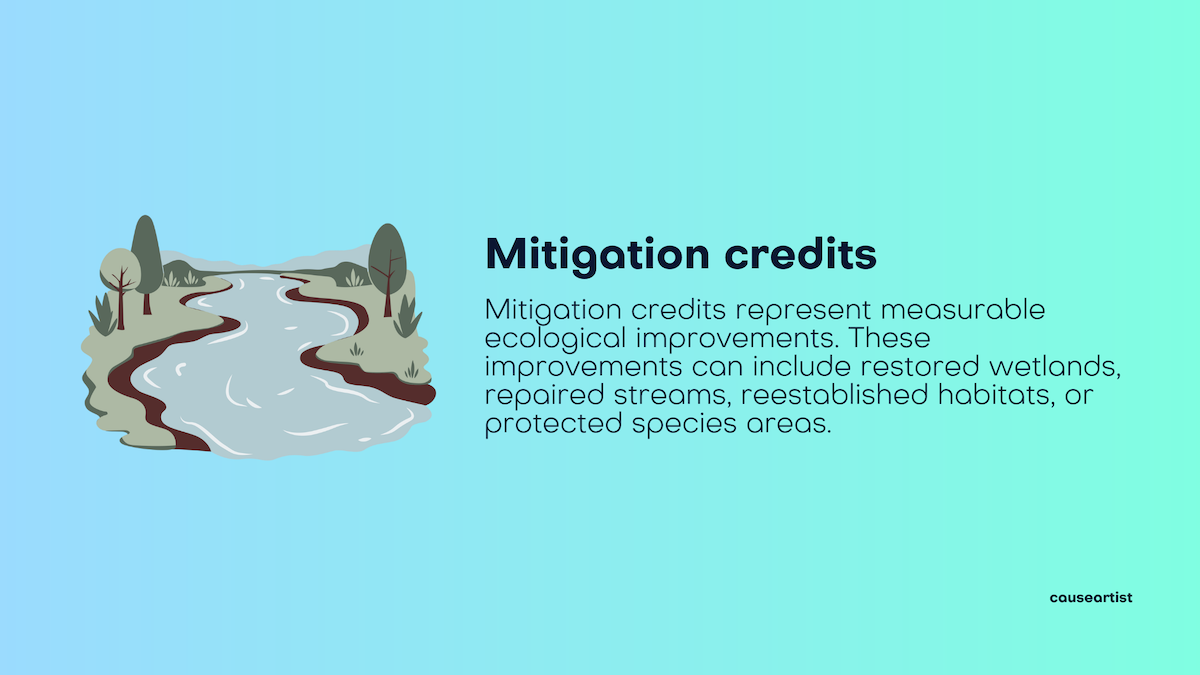
Mitigation credits represent measurable ecological improvements. These improvements can include restored wetlands, repaired streams, reestablished habitats, or protected species areas.
Credits are created when a qualified entity restores or preserves land that meets federal and state standards. Developers who damage similar resources must purchase those credits to meet legal requirements.
Credits are used under two main federal frameworks.
Section 404 of the Clean Water Act regulates impacts to wetlands and streams.
The Endangered Species Act regulates impacts to threatened species and their habitats.
Why Mitigation Credits Exist
The idea is simple.
If a project harms an aquatic resource or protected species habitat, the law requires action to offset that harm.
The federal government calls this compensatory mitigation.
Credits allow this mitigation to happen at scale.
Instead of every developer trying to restore small patches of land on their own, larger restoration sites are created that deliver stronger ecological outcomes.
How Mitigation Credits Work
Step 1: A Project Creates an Impact
A developer, utility, or public works agency proposes a project that fills a wetland, modifies a stream, or affects habitat for a listed species.
Step 2: Regulators Review the Impact
- The U.S. Army Corps of Engineers oversees Clean Water Act section 404 permits.
- The U.S. Fish and Wildlife Service oversees species impacts under the
- Endangered Species Act. State environmental agencies may also be involved.
Step 3: Mitigation Is Required
If the impact cannot be avoided, the applicant must offset it. They can buy mitigation credits or create their own mitigation plan.
Step 4: Credits Are Used to Offset the Impact
The regulator confirms that the purchased credits match the type and location of the damage. The credit sale is recorded, then the developer can proceed.
Types of Mitigation Credits
Wetland Mitigation Credits
These credits are tied to restored, enhanced, or preserved wetlands. They are scored by ecological value. Wetland credits are the most common form and are heavily regulated by the Corps of Engineers.
Stream Mitigation Credits
Stream credits come from restoring stream channels, stabilizing banks, improving water quality, and rebuilding natural flow patterns. States often use their own scoring systems.
Species Mitigation Credits
These credits offset harm to protected species. Credits are created by conserving or restoring habitat. They fall under the Endangered Species Act and often involve long term land protection.
Mitigation Banks vs Permittee Responsible Mitigation
Developers have two paths.
Mitigation Banks
A mitigation bank is a large site that has already been restored by a private mitigation banker or public agency. Credits are released by regulators only after ecological milestones are met. Banks provide certainty because the restoration work is done before the credit is sold. Prices are higher but risk is lower.
Permittee Responsible Mitigation
The developer creates their own mitigation project. It requires land, expertise, and long term management. It is cheaper upfront but carries higher risk. If the project fails, the developer is still responsible.
Most developers prefer buying credits from banks because it simplifies compliance and reduces delays.
Who Buys Mitigation Credits
Credit buyers include:
- Developers of residential and commercial projects
- Transportation departments
- Energy companies
- Utilities
- Mining companies
- Local governments
- Public infrastructure agencies
Anyone who causes a regulated environmental impact must comply.
How Prices Are Set
Mitigation credit prices vary widely because they reflect land value, restoration cost, ecological value, regulatory demand, and credit availability.
Prices can range from a few thousand dollars per credit to several hundred thousand dollars per credit. Wetland credits in high growth markets often command premium prices. Species credits can be even higher due to limited supply.
Private mitigation bankers use long term financial planning to set prices that cover land acquisition, restoration, monitoring, legal requirements, and endowment funds for perpetual management.
The Role of the Army Corps, State Agencies, and Private Bankers
The U.S. Army Corps of Engineers oversees section 404 permitting and approves wetland and stream mitigation banks.
State agencies review water quality and may run their own credit systems.
The U.S. Fish and Wildlife Service approves species mitigation plans.
Private mitigation bankers supply credits by restoring large areas of land. They operate under detailed agreements that spell out performance standards, monitoring schedules, and long term stewardship.
This public and private partnership is what drives the market.
Real World Examples
Section 404 permits often require a developer to buy wetland credits from a local bank before filling a small wetland for a roadway project.
Species impacts, such as harming habitat for the lesser prairie chicken or gopher tortoise, may require buying species credits in approved conservation areas.
Stream impacts from utility line crossings may require stream credits that match the same watershed.
Use Cases for Developers, Investors, Conservation Groups, and Landowners
Developers rely on credits to stay compliant and avoid delays.
Impact investors fund mitigation banks because they produce both revenue and measurable ecological gains.
Conservation groups use the system to protect high value land.
Landowners can participate by selling land to banks or converting their own land into a mitigation site under strict oversight.
Common Misconceptions
Credits do not allow unchecked destruction.
The law requires avoidance first, then minimization, and only then compensation.
Credits are not unlimited. Banks have fixed inventories.
Credits do not guarantee ecological success everywhere. They only offset impacts within approved service areas.
Mitigation is not a free market. It is a regulated compliance market.