The Citi Impact Fund operates from inside one of the largest banks in the world. That's a different kind of leverage.
Meredith Shields manages a $500 million carve-out from Citi's balance sheet, deployed exclusively into double bottom line companies.
In this episode, she covers how the fund defines impact, why it moved to Series B investing, and what she's watching in sectors like care, education, and financial resilience.
From Investment Banking to Impact Capital
Shields started her career supporting lower middle market companies in tier three and four cities across the US. These were the kinds of businesses that anchored their communities, the largest employers, the arts donors, the civic anchors. The 2008 financial crisis wiped out access to capital for many of them, and she watched the ripple effects hit communities directly.
That experience sent her to graduate school with a clear thesis: capital allocation should account for community impact. She arrived in 2009, a year after Rockefeller Foundation coined the term "impact investing." The field was two years old.
After stints in consulting, finance, and a formative period working with Beyond Capital Ventures on due diligence for companies in East Africa and India, she joined Sorenson Impact Group in Salt Lake City to build out their early-stage VC practice. Then Citi called.
What the Citi Impact Fund Actually Is
The fund was established in 2019 on a straightforward premise: a global bank has more resources than just its balance sheet. It has expertise across 90 countries, relationships with over 80 percent of the Fortune 500, and operational depth across every major sector. Philanthropy alone doesn't tap that.
The Citi Impact Fund was built to deploy equity capital, not grants. Shields reports through two separate chains: CFO and the head of Citi's community investing and development. That dual accountability structure is the mechanism that makes the double bottom line real. Both sides have to see results.
The fund has invested roughly $200 million across more than 55 companies to date, targeting $25 to $50 million per year depending on market conditions.
Why They Moved to Series B
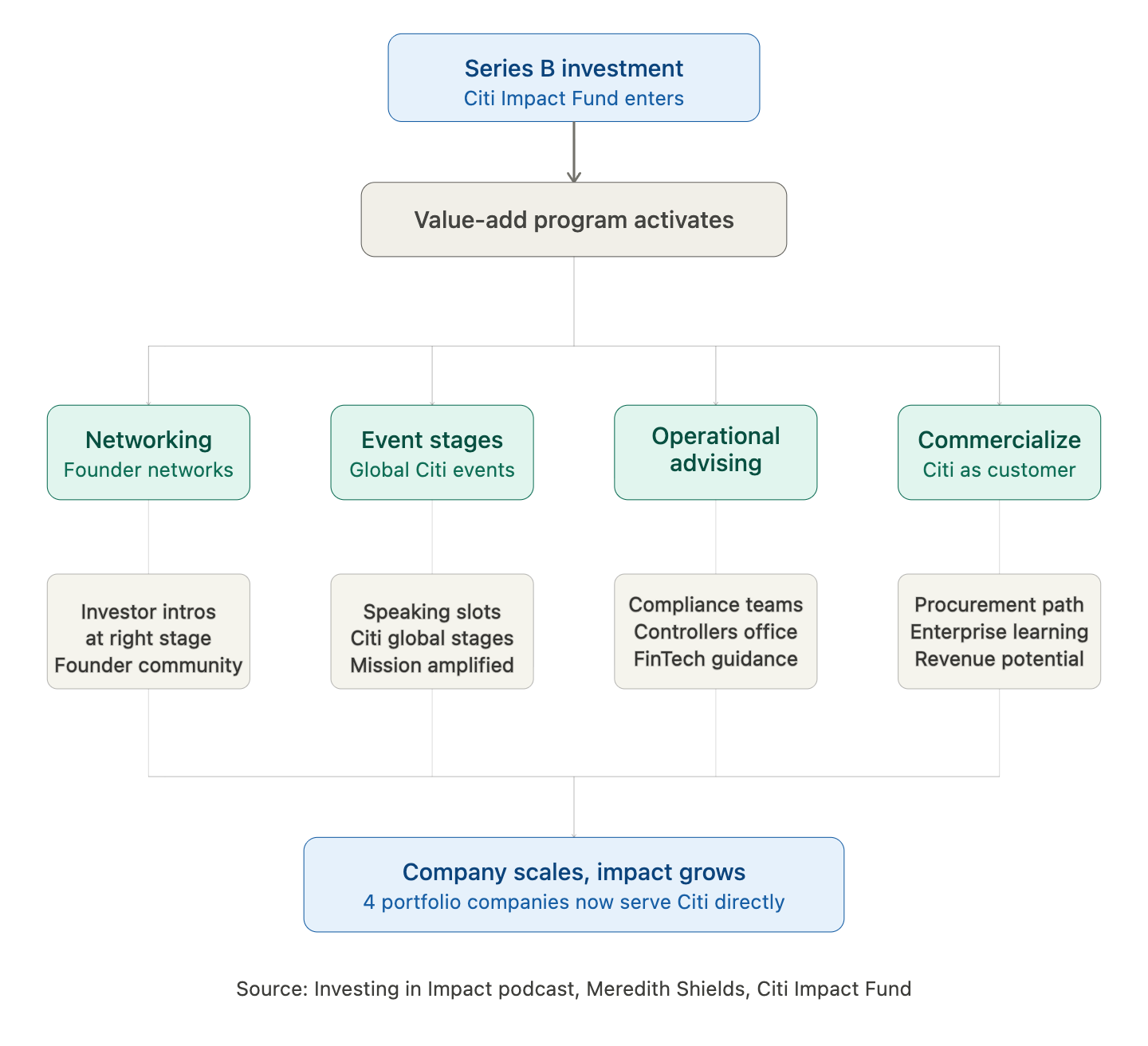
Early on, the fund invested at pre-seed and seed. The thesis made sense in theory: get in early, shape companies from the ground. In practice, the fund's real advantage, connecting portfolio companies to Citi's networks, enterprise relationships, marketing reach, and operational expertise, worked better with companies that had already found product-market fit.
At the Series B stage, Shields and her team can do things that genuinely move the needle. They've placed founders on Citi event stages in front of the right audiences. They've connected portfolio companies with Citi's compliance and controller teams for guidance. In a few cases, Citi itself has become a paying customer of portfolio companies after running them through procurement.
Four portfolio companies are now active Citi vendors. That's not a symbolic win. That's revenue.
For seed-stage exposure, the fund has shifted to investing in pre-seed and seed funds rather than direct early-stage deals. The pipeline visibility stays intact without the operational mismatch.
How They Define Impact
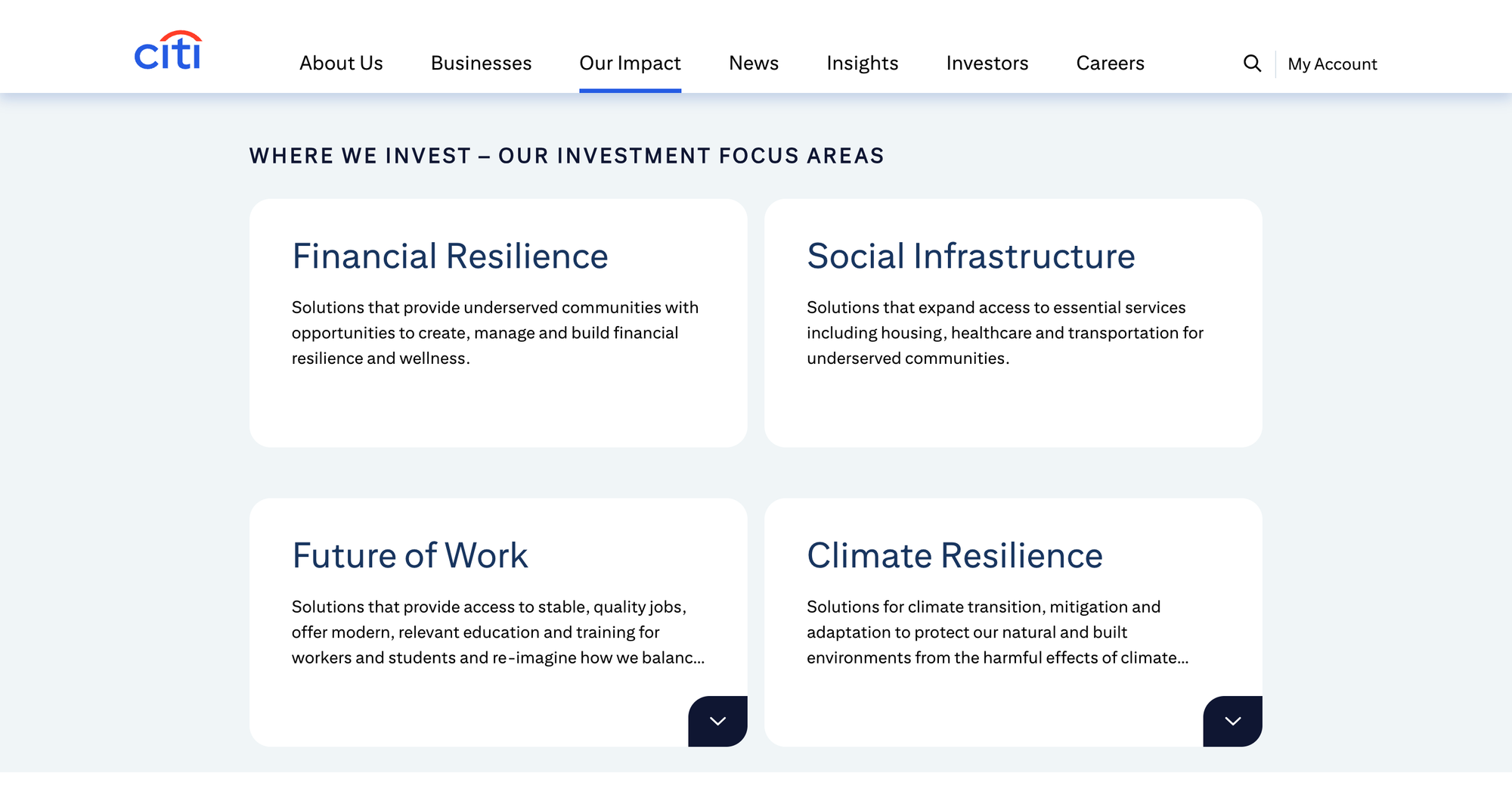
The fund's impact framework centers on one question: is the business model optimized to serve economically vulnerable Americans?
That's the baseline. From there, the team scores companies across additional dimensions: how much access does the product create, how genuinely innovative is the approach, and can it reach people at meaningful scale. Scale matters here. Shields is explicit that impact at scale is core to the fund's mission, which is part of why they moved later stage.
Companies that clear those bars get shared with the Citi Impact Fund investment committee. Those that don't fit the impact criteria get routed to other VC teams at Citi.
Portfolio Companies Worth Knowing
Shields named more portfolio companies in this conversation than most fund managers share in a year. Here's a quick breakdown of several she highlighted.
WorkWhile connects hourly workers with jobs using AI to assess candidate skills and company needs. The platform also offers next-day pay, a high-impact feature for workers who can't float a two-week payroll gap.
Wellthy is a care economy company built for working adults managing caregiving responsibilities alongside a job. The platform pairs AI tools with former social workers to provide concierge support for navigating benefits, legal paperwork, employer accommodations, and mental health. Delphi recently acquired Patch, a backup childcare solution for when regular care arrangements fall through.
Empathy built an employee benefit for navigating grief, estate settlement, and end-of-life logistics. The platform helps employees create wills, navigate the financial and legal aftermath of losing a family member, and access mental health support. Employers offer it because losing a team member to grief-related disruption is expensive. The employee benefit distribution model lets the company scale rapidly: one enterprise contract means thousands of users.
Cartwheel operates in pediatric mental health. Average wait times to see a child mental health provider run two years. Cartwheel embeds in school districts using a telehealth model to address the mental health worker shortage and provide continuity of care across school transitions. The company is now in more than 300 school districts.
Rapid SOS connects emergency response infrastructure to modern device data. The founder built it after being assaulted and unable to accurately report his location to 911. The platform now integrates with nearly every 911 operator in the US, providing geolocation, health data where permitted, and alerts for nearby AED equipment. The company measures success in lives saved.
On AI in the Portfolio
The fund spent two years monitoring AI closely before leaning in. Now every company coming through has an AI story, whether that's internal operations, employee training, customer-facing tools, or payroll and workflow management.
Shields is optimistic about what AI enables for founders building in access and affordability gaps. Companies can test, iterate, and get to market faster than at any previous point. That's especially meaningful when the problem being solved has gone unaddressed for decades.
Two areas where she applies more scrutiny: education products aimed at children, who may not recognize AI errors or hallucinations, and healthcare, where automated recommendations carry direct risk to patients. Both require human oversight built into the product architecture, not bolted on after.
She's also watching the wealth gap. Historical technology booms have widened it. She's hoping AI-enabled products can start moving it in the other direction, particularly in underserved communities that have historically been last to access new tools.
Geography and the Fund's Reach
Over 80 percent of venture capital sits in California, New York, and Massachusetts. The Citi Impact Fund's portfolio companies are headquartered across roughly 25 states. More importantly, companies like Cartwheel and Rapid SOS operate nationwide, meaning the fund's impact footprint extends well beyond where a company files its incorporation papers.
Advice for Founders
Shields estimates that 90 percent or more of the founders she meets have direct lived experience with the problem they're solving. That's not coincidence. Founders who've felt a problem firsthand tend to understand it more precisely, and that precision shows up in how they pitch, how they position, and how they build.
Her most practical advice isn't about which accelerator to choose. It's about finding one or two people with deep founder or investor experience who will give genuine guidance, make introductions at the right time, and help founders understand what investors are actually looking for before they walk into a pitch. She says she can often tell from a pitch whether a founder has had that kind of mentorship. It shows in how they answer hard questions and how they follow up.