The technology for harvesting critical minerals from the ocean floor has barely changed since the 1960s. Big tracked vehicles.
Vacuum dredges. Sediment plumes.
The same architecture, decade after decade.
Oliver Gunasekara looked at that and saw an opportunity.
He's the CEO of Impossible Metals, a deep tech startup building a fleet of autonomous underwater robots designed to collect polymetallic nodules from the seafloor with a fraction of the environmental disruption of conventional methods.
On this episode of Disruptors for Good, Oliver walks through the technology, the regulatory landscape, the environmental tradeoffs, and why he thinks the first commercial deep sea mining operations are closer than most people realize.
What Are Polymetallic Nodules and Why Do They Matter
Polymetallic nodules are potato-sized rocks that sit on the ocean floor at depths of three to four miles. They're not rare.
The Clarion-Clipperton Zone alone, a stretch of international waters between Hawaii and Mexico larger than the continental United States, is estimated to hold over $20 trillion worth of metal.
Each nodule contains nickel, cobalt, manganese, and copper. That combination matters because these are the same metals powering the energy transition, AI data centers, defense systems, and battery manufacturing.
Copper moves electricity. Nickel and cobalt go into high-density lithium-ion batteries. Manganese is a core ingredient in steel and increasingly in battery chemistry too.
The problem on land is that easily accessible deposits are mostly gone. Mining operations are being pushed to remote locations with grades as low as 0.2 to 0.3 percent.
That means more infrastructure, more destruction, higher costs. Oceanic deposits are far richer and come with no roads, power lines, or worker housing to build.
Why the Old Architecture Had to Go
Oliver spent the early part of his career in semiconductors.
After selling his previous company, he started researching the deep sea mining space and kept finding the same system proposed over and over: a tracked collector on the seafloor, a riser pipe to the surface, and a support ship.
"I could read patents from 1965 and most of the rest of the industry was basically proposing the same architecture," he said.
The problems with that approach are well-documented among marine scientists. It generates sediment plumes at the seafloor and again mid-water when ships dewater the nodules and discharge residue.
It causes direct habitat destruction across everything in its path. It removes all nodules indiscriminately, wiping out the microbiota attached to them.
Impossible Metals started from scratch with a different framing: use 21st century technology to design a collection system that minimizes environmental impact first and optimizes cost second.
The Eureka Collection System
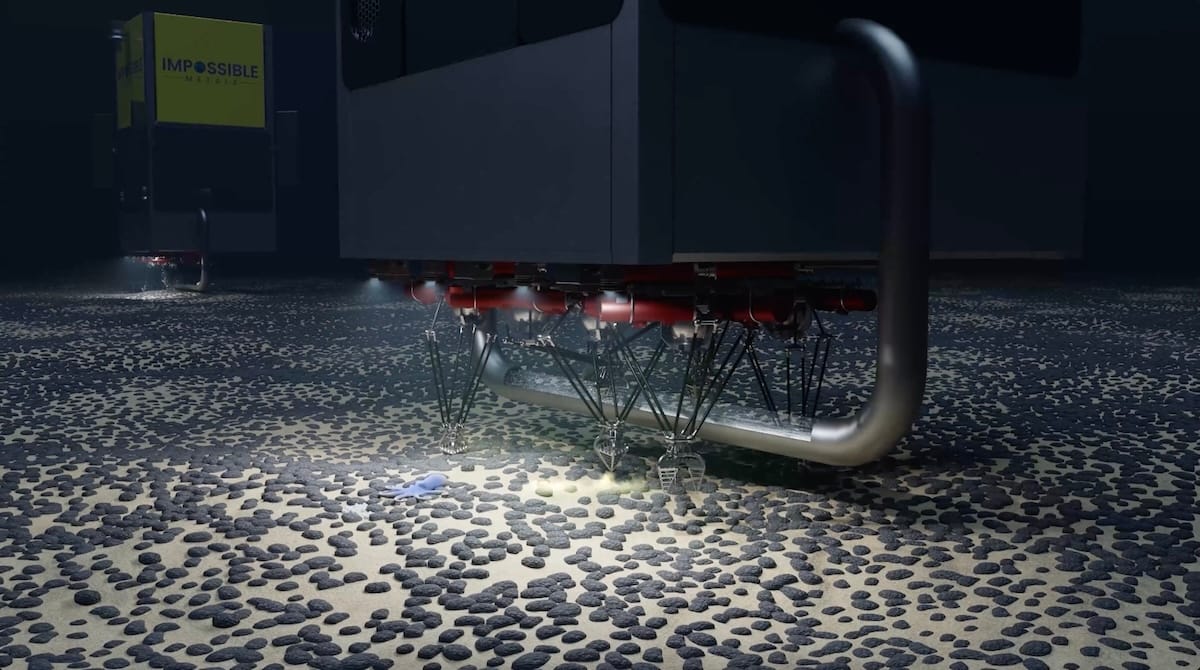
The result is a hovering autonomous robot called Eureka. The vehicle doesn't land on the seafloor. It uses an array of delta-arm robotic limbs equipped with stereo cameras to pick individual nodules, skipping any with visible life on them. The nodules are stored inside the vehicle.
Once full, the robot uses a buoyancy engine to ascend.
The buoyancy engine is one of Impossible Metals' core proprietary technologies: titanium spheres that pump seawater in and out to adjust mass.
Fill them and the vehicle sinks. Empty them and it rises. Getting that to work reliably at 600 times atmospheric pressure took considerable engineering.
At the surface, the vehicle docks with what the company calls a smart hook, an autonomous docking system on a cable that pulls the robot aboard the support ship.
No sediment discharge.
No mid-water plume.
No tracks on the seafloor.
About 70 percent of the vehicle uses off-the-shelf components sourced from the underwater ROV market, including battery packs, thrusters, sensors, and compute boards. The remaining 30 percent had to be invented.
That includes the buoyancy engine, the delta-arm array, the docking system, and an onboard NVIDIA GPU trained to recognize nodules in real time.
The Environmental Tradeoffs
Oliver is direct about the limits of the technology. This is still an extraction industry. There will be some impact.
The design target is to remove around 10 percent of nodules in any given collection area, leaving 90 percent behind. The goal is that a few days after collection, the site should look essentially undisturbed.
No tracks.
No large-scale habitat removal.
The microbes and single-cell organisms that form the base of the seafloor ecosystem, and which carry potential pharmaceutical and ecological value, remain viable.
Visible life, octopus, coral, sponge, is actively avoided through computer vision. The hovering design limits sediment disturbance to a fraction of what a tracked collector produces.
Regulation and Policy
Oliver testified before the House Natural Resources Subcommittee and has been active in shaping U.S. policy on critical mineral extraction.
The regulatory framework already exists: the Outer Continental Shelf Lands Act, administered by the Bureau of Ocean Energy Management, covers seabed leasing within the exclusive economic zone.
Impossible Metals was the first company to formally request a critical mineral lease under that law. The Trump administration has moved the process forward, conducting an RFI, identifying an area, and beginning environmental review. A provisional lease sale is expected sometime in 2026.
Oliver sees a few gaps worth fixing.
He thinks the extensive environmental review process should happen after a lease is awarded, not before, since the actual environmental impact depends heavily on what technology the lessee uses.
He's also advocating for a revenue-sharing model with coastal states, similar to how offshore oil and gas revenue is shared with Louisiana and Texas, to give coastal communities a direct economic stake in the industry.
Timeline and Scale
Eureka 3, the full production-scale robot, is currently in development. Components are on order. Lab infrastructure has been upgraded. The plan is to get it in the water by end of 2025 and into deep sea testing in 2026 and 2027. Fleet buildout would follow in 2028 and 2029, targeting the start of commercial production.
Each Eureka 3 vehicle collects four metric tons of nodules per four-hour mission. At six missions per day, per vehicle, and with a fleet scaling from tens to eventually hundreds of robots, the potential revenue is substantial. Oliver described it as capable of generating billions per year at scale.
The business model, at least initially, is to collect, process through tolling partners, and sell the extracted metals directly.
Longer term, Impossible Metals is open to a technology licensing or robot-as-a-service model for the roughly 20 nodule-specific exploration licenses already granted by the International Seabed Authority.
Why Now
The Clarion-Clipperton Zone conference, the industry's primary gathering, is in its 53rd year. There has never been commercial deep sea mining. Oliver attributes that to a combination of immature technology, insufficient investment, and a regulatory environment that wasn't ready.
All three are converging now. Battery demand, AI infrastructure growth, and supply chain pressure on critical minerals have created urgency. Robotics, AI, and materials science have caught up to the engineering requirements. And U.S. policy has shifted toward treating deep sea mineral extraction as a strategic priority.
"Technology, funding, regulations," Oliver said. "You're seeing all three coming together now."