Flexport.org is the social-impact and sustainability program of freight-forwarding company Flexport, not a separately presented corporate foundation. It applies Flexport's logistics technology, carrier relationships, freight expertise, and staff knowledge to humanitarian aid and lower-carbon supply chains. The public program dates its humanitarian funding activity to 2018. Donations to the Flexport.org Fund are managed by CAF America, an independent U.S. public charity, and pay transportation costs for nonprofits and mission-driven organizations; that sponsored-fund arrangement must not be described as a standalone Flexport.org legal entity.
Its humanitarian work combines several forms of support that should remain distinct. The fund can pay freight costs, Flexport can provide its logistics platform free to fund recipients, staff can advise aid organizations on shipping, and the product-donation program can connect donated goods with nonprofit demand. A funded shipment is therefore not necessarily an unrestricted cash grant, and the retail value of donated goods is not the same as cash deployed. Flexport.org also supports commercial customers with carbon measurement, reduction, and offset-related services, which are corporate services rather than charitable awards.
The 2024 impact report says donations had funded humanitarian-aid shipments to more than 86 countries since 2018. That is an organization-reported geographic/output measure, not a count of grants, unique beneficiaries, or independently evaluated outcomes. Current public pages direct prospective organizations to shipping and contact pathways but do not publish an always-open competitive grant application, a general award calendar, or a broadly applicable cheque range. This profile therefore leaves application and cheque-size fields empty.
Flexport.org targets a specific operational bottleneck: getting humanitarian goods from donors and suppliers to credible aid organizations quickly, compliantly, and at lower logistics cost. Its advantage is infrastructure rather than unrestricted philanthropy, freight procurement, shipment visibility, customs and routing knowledge, and a donor-supported transportation fund managed by CAF America. Support is most relevant when a mission-driven organization has a validated shipment, recipient, route, and delivery plan.
The program also frames freight decarbonization as an impact lever, but sustainability services offered to Flexport customers should not be conflated with charitable support. Selection information is not published as a standard grant rubric. Evidence of partner need, operational feasibility, shipment readiness, and fit with active humanitarian responses is likely material; no public source establishes automatic eligibility or funding.
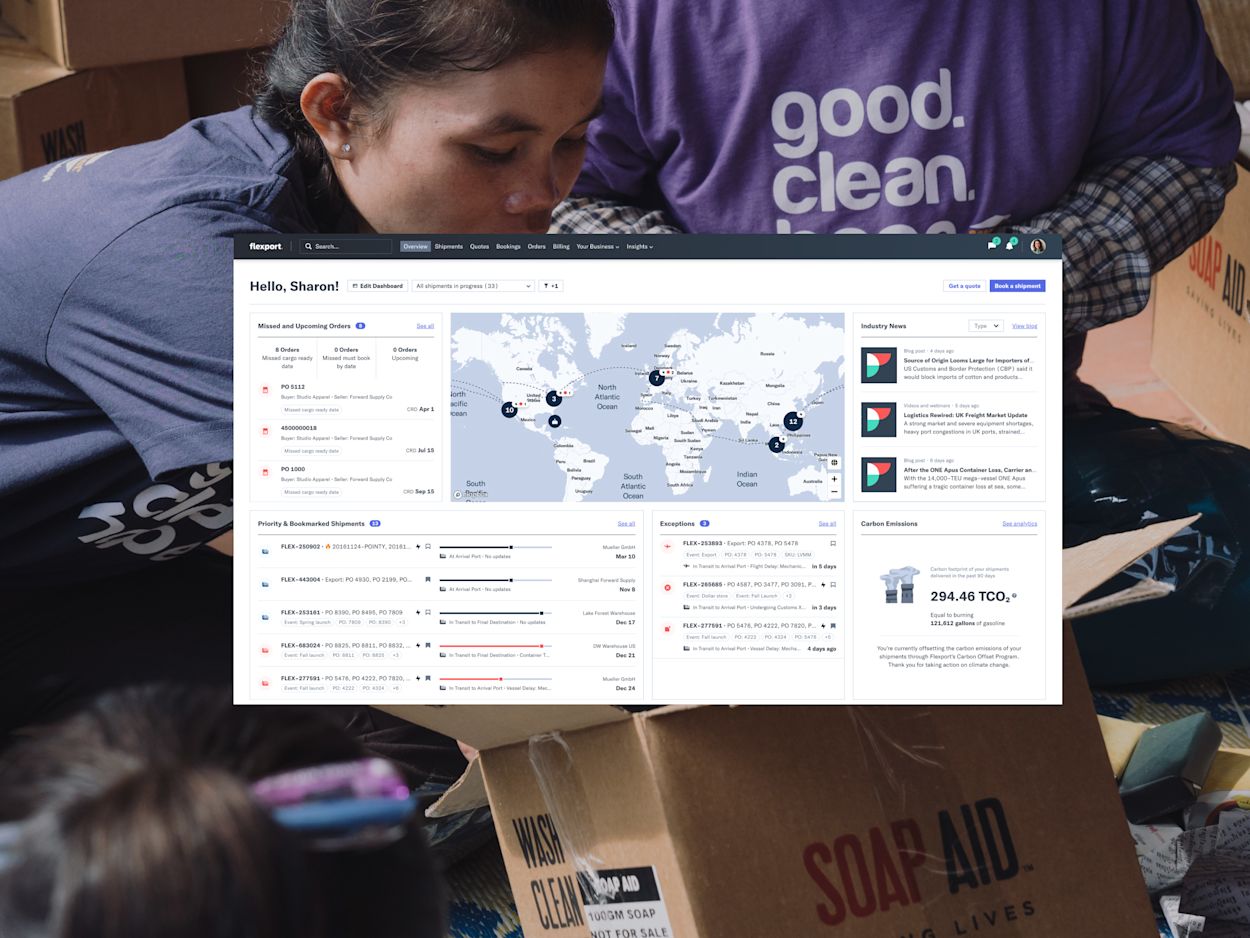
Photo credit: Flexport.org / official website
Funder structure
Corporate social-impact program of Flexport. The donation vehicle called the Flexport.org Fund is managed by CAF America; Flexport.org does not present itself as a separately incorporated foundation. Support may combine donor-funded freight, in-kind technology, employee expertise, and product matching.
Focus geography
Global and response-led. Flexport.org reported that donations had funded aid shipments to more than 86 countries since 2018. Coverage follows viable trade lanes, customs rules, carrier capacity, active emergencies, and vetted recipient operations rather than a permanent entitlement in every country.
Focus sectors
Humanitarian logistics, disaster and conflict response, donated-product movement, nonprofit supply-chain capacity, and freight sustainability. The charitable core is transportation and logistics enablement, not general operating support across all nonprofit causes.
Eligibility requirements
Nonprofits and mission-driven organizations with credible humanitarian cargo, consignee, route, and delivery plans are the clearest fit. Public materials do not establish that every nonprofit, donor, commodity, destination, or commercial sustainability customer qualifies for philanthropic freight support.
Decision process
Prospects engage Flexport.org or its shipping pathways; the team assesses the humanitarian need and practical shipment requirements. No public open-call calendar, scoring rubric, board schedule, or standard award range was found, so contact and shipping-intake routes must not be represented as guaranteed grant applications.
Impact approach
The model removes logistics friction through freight funding, technology, shipping advice, and donation matching. Reported countries served and shipments moved are operational outputs. They do not independently establish last-mile distribution, beneficiary-level outcomes, or the cash-equivalent value of in-kind support.
Reporting expectations
Recipients should expect shipment-level documentation: commodity details, origin and destination, consignee validation, customs information, delivery confirmation, and outcome stories or aggregate metrics. Public sources do not publish a universal grant-report template or unrestricted-grant reporting schedule.
Geographic restrictions
Support depends on active priorities, available funds, sanctions and export controls, customs admissibility, safe routing, carrier capacity, and a credible recipient. Hazardous, unsuitable, expired, unsolicited, or logistically impractical donations may be declined even when the intended purpose is charitable.
Alternatives and limitations
Organizations needing unrestricted cash, local procurement, direct cash assistance, warehousing, or last-mile distribution should also consider humanitarian pooled funds, specialist logistics NGOs, and local response partners. Flexport.org's strength is cross-border logistics; it is not a substitute for needs assessment or delivery to end users.
Locations