Amazon Disaster Relief is an internal Amazon corporate disaster-response initiative. It is not AmazonSmile, not a donor-advised fund, and not a separately incorporated Amazon foundation. Amazon uses its inventory, fulfillment centers, disaster-relief hubs, transportation network, cloud and communications technology, employees, and cash or product donations to support vetted humanitarian organizations before, during, and after disasters. Amazon describes sustained response activity beginning in 2017.
The model is predominantly operational and in-kind. Relief hubs pre-position commonly requested items; response teams coordinate with nonprofit and public-sector partners; Amazon transports donated products from its inventory and wish lists; and AWS or technical teams may provide cloud, connectivity, mapping, and recovery support. Announced retail value, item counts, flights, truckloads, and logistics capacity are different from cash grants and should not be added together as a grant total.
Amazon's current disaster-relief pages and 2026 response stories show active deployments, including relief shipments tied to floods, fires, earthquakes, and other emergencies. Partners—not the general public—typically identify priority goods and distribution needs. The public Disaster Relief by Amazon portal is a partner logistics mechanism, not a general grant application. No organization-wide open funding round, broadly applicable cheque size, or AUM exists for this internal initiative.
Amazon Disaster Relief applies Amazon's operating infrastructure to the time-sensitive supply and information gaps that follow disasters. Pre-positioned relief goods and fulfillment capacity enable rapid movement; humanitarian partners define needs and distribute assistance; technology teams support situational awareness, connectivity, and recovery. The comparative advantage is speed and logistics scale, not open-ended institutional grantmaking.
Responses are selected based on disaster severity, community and partner requests, Amazon's operational footprint, available inventory, and the usefulness of its logistics or technology. A commitment or announced donation is not necessarily fully delivered at announcement, and an item shipped is not proof that it reached a particular beneficiary or produced an independently verified outcome.
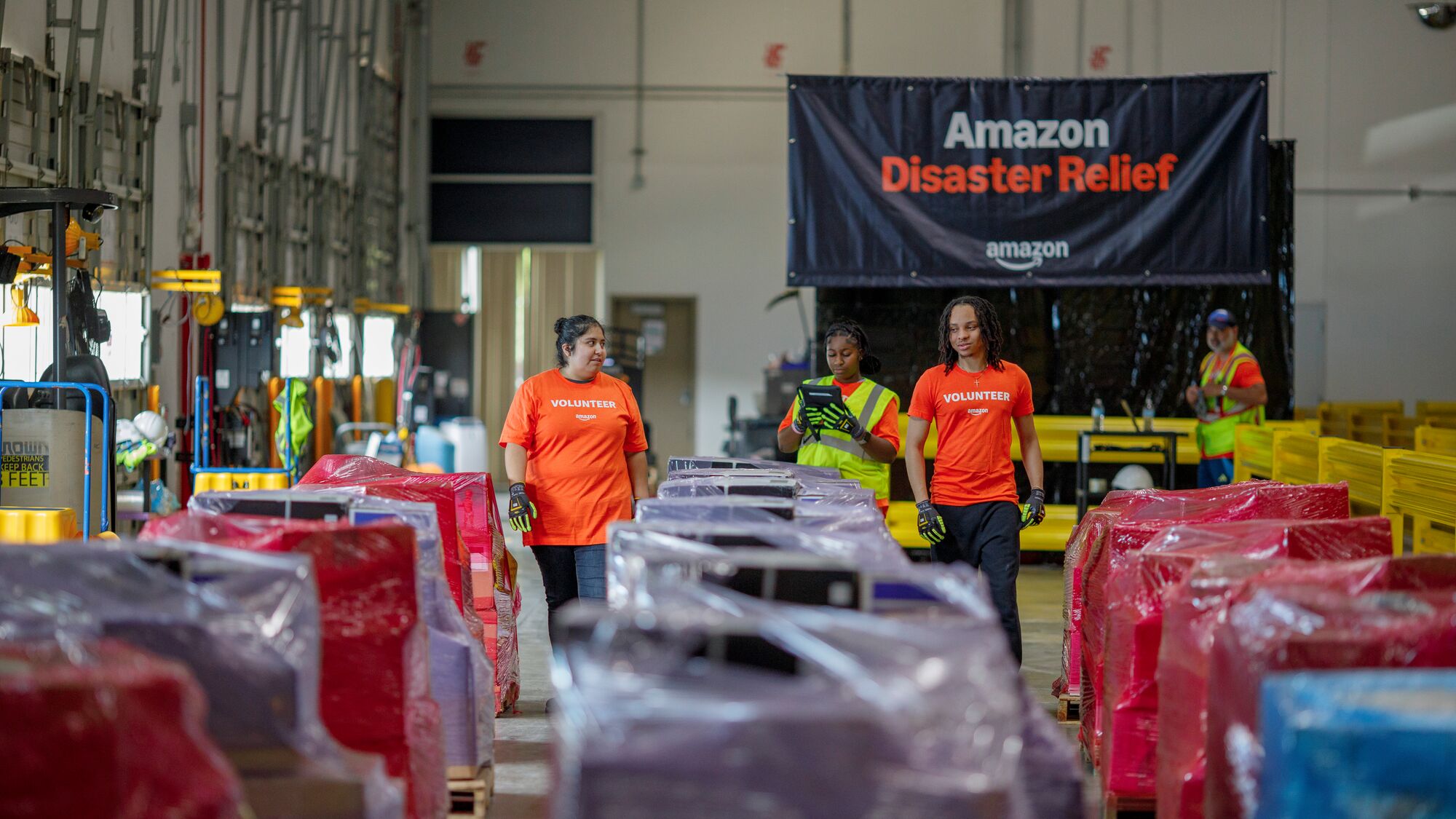
Photo credit: Amazon / About Amazon disaster relief
Funder structure
Internal Amazon corporate initiative, not a separate foundation and not AmazonSmile. Resources can come from Amazon inventory, business operations, employees, AWS and other technology teams, cash donations, customer wish lists, and nonprofit partnerships.
Focus geography
Global but event-driven, with strongest response where Amazon has usable inventory, fulfillment and transport capacity, technical teams, or established humanitarian partners. Current stories document responses in multiple regions; no universal country entitlement exists.
Focus sectors
Disaster preparedness and response, emergency supplies, humanitarian logistics, connectivity, cloud and mapping support, shelter and household goods, food and water logistics, and longer-term recovery when Amazon capabilities match partner needs.
Eligibility requirements
Primary recipients are vetted humanitarian nonprofits, public agencies, and response partners able to specify needs and distribute aid. Individuals generally access assistance through those organizations rather than applying to Amazon for a grant or shipment.
Decision process
Amazon response teams monitor events and consult partners, authorities, and local operations to determine needs and feasible support. The public partner portal facilitates requested relief logistics; it is not an open competitive cash-grant process or guarantee of assistance.
Impact approach
The model measures operational response through items donated or shipped, logistics movements, hubs, deployments, technology provided, and reported communities supported. These organization-reported outputs are not interchangeable with cash, commitments, unique beneficiaries, or independently verified outcomes.
Reporting expectations
Partners should expect item-level needs lists, delivery and distribution coordination, compliance and safety checks, acknowledgements, and response updates. Technology engagements may add security, data, uptime, and handoff requirements. No universal public grantee report was found.
Geographic restrictions
Assistance depends on an active disaster, verified partner demand, suitable inventory, safe access, lawful transport, and operational capacity. Amazon does not promise support for every emergency, geography, organization, requested product, or recovery phase.
Alternatives and limitations
Amazon's logistics and technology complement government response, humanitarian cash assistance, local procurement, mutual aid, shelters, and specialist relief agencies. Communities should use official emergency channels; nonprofits needing unrestricted grants should pursue dedicated disaster funds.
Focus areas
Locations