

Slate Auto
A customizable electric truck you can wrap, convert, and actually own.
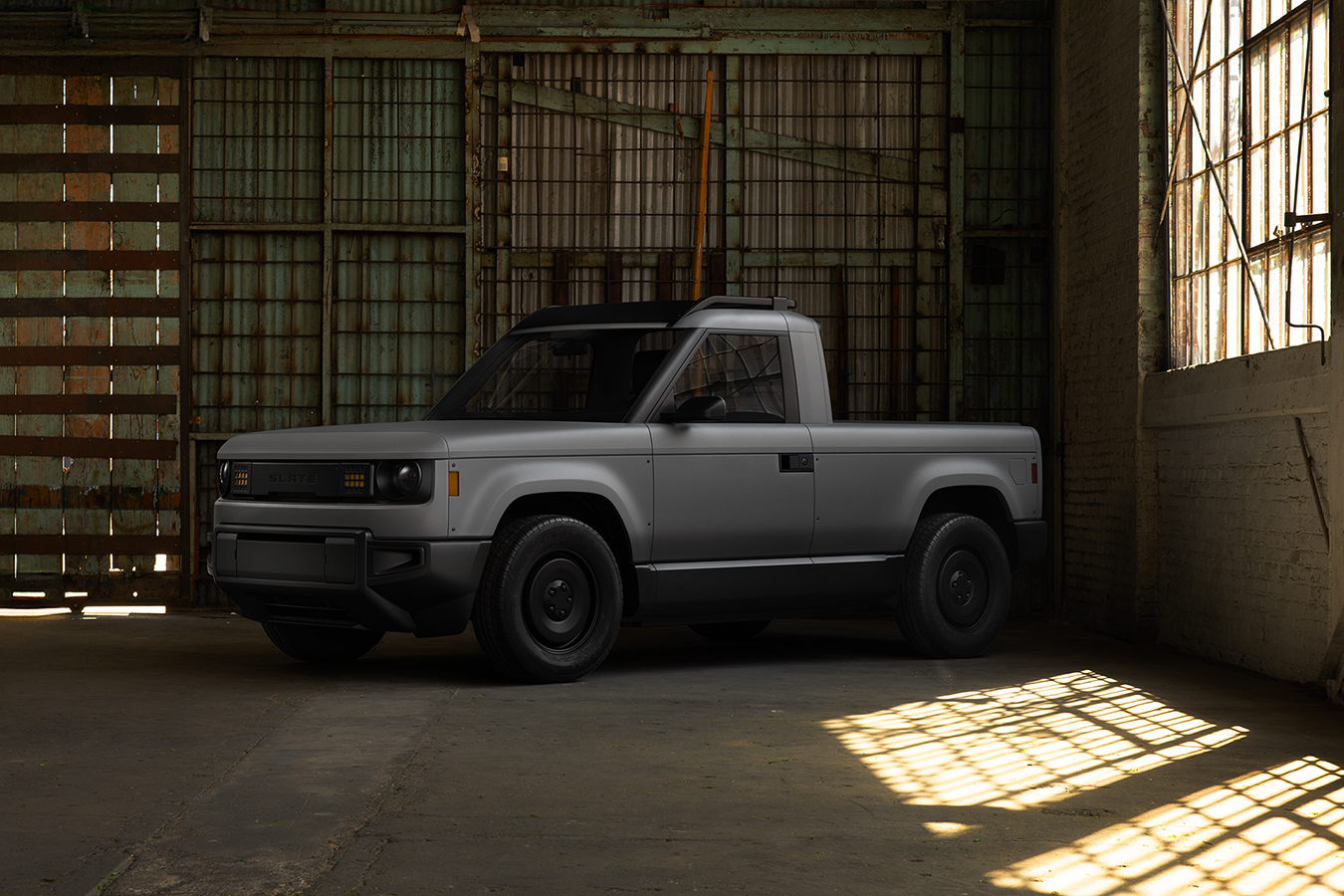
Photo credit: Slate Auto / slate.auto
Browse related lists
Related on Causeartist
- Founder
- Miles Arnone, William Barker, and Jeff Wilke

Slate Auto is a U.S. electric-vehicle startup building a deliberately simple, highly customizable pickup that buyers can keep as a two-seat truck or convert into a five-seat SUV or Fastback. The company markets the base “Blank Slate” from $24,950, with an advertised 205 miles of range, and positions wraps, accessories, and owner-serviceable parts as the product—not factory paint and trim levels.
The vehicle is designed to be wrapped rather than painted, which Slate says enables more color options, easier color changes, and lower cost than a traditional paint shop. The company lists 200-plus accessories (more than 80% priced under $500), including starter packs and a Slate x Crayola collaboration. Charging is framed as household-simple: a regular 120V outlet, a 240V dryer outlet, or Tesla Superchargers (Slate cites 30,500 Superchargers in the U.S.), with the needed hardware included.
Slate was founded in 2022 inside Re:Build Manufacturing (originally as Re:Car) by Miles Arnone, William Barker, and Jeff Wilke, and came out of stealth in April 2025. It is headquartered in Troy, Michigan, with a design studio in Long Beach, California, and is retrofitting a former printing plant in Warsaw, Indiana, for production targeted for late 2026. CEO Peter Faricy (former Amazon Marketplace VP) leads the company; Chris Barman, an early hire, serves as President of Vehicles. Public reporting puts total capital raised at about $1.4 billion after a mid-2026 Series C, with backers including Jeff Bezos, Mark Walter / TWG Global, General Catalyst, and Re:Build Manufacturing.
Key benefits
Price-first electric truck
The Blank Slate is marketed from $24,950 as a two-seat EV pickup, with an SUV/Fastback path instead of a ladder of expensive factory trims.
Wrap-first, owner-customizable
Bodies are designed to be wrapped rather than painted, with 200-plus accessories and starter packs so buyers add color, seats, lighting, and work gear after the essentials.
Charge like a household appliance
Slate says the truck can charge on a 120V wall outlet or 240V dryer circuit, and is included for Tesla Superchargers—no extra adapter hunt in the marketing pitch.
Built to be serviced, not sealed
The company emphasizes swap-able panels, accessible parts, and free manuals so owners and fleets can maintain the vehicle without a dealer-only ecosystem.
Latest News and Funding Rounds
Slate’s climate and circular-economy case is lower-cost electric mobility plus simpler manufacturing. Skipping a paint shop and stamping-heavy trim, using wrap-first exteriors, and designing panels and parts that owners can swap is meant to cut factory complexity, make repairs more accessible, and keep a small EV truck in service longer. The product is aimed at personal and fleet buyers who need a work-capable vehicle that can charge at home without installing a dedicated high-power station.
The company also frames domestic reindustrialization as part of the story: converting a closed Warsaw, Indiana, printing plant into an EV factory with a planned customer experience center, rather than building a greenfield auto campus with a paint shop.
Company-stated product specs (subject to EPA/official ratings and the footnotes on slate.auto): Blank Slate starting price $24,950; SUV conversion marketed from about $29,950 in 2026 coverage; claimed estimated range 205 miles; 181 hp and 195 lb-ft of torque (CNBC, June 2026); 200+ accessories with over 80% under $500; Level 1 (120V), Level 2 (240V), and Tesla Supercharger access advertised as included.
Reported company scale: founded 2022; public reveal April 24, 2025; preorders opened June 24, 2026; more than 160,000 reservations reported ahead of priced preorders; ~$1.4 billion raised through Series C (about $111M Series A, ~$600M 2024 round, $650M Series C led by TWG Global); Warsaw plant investment reported near $400 million, with claimed capacity up to 150,000 vehicles per year and 2,000-plus jobs at full ramp. First customer deliveries have been discussed for Q4 2026.
Frequently asked questions
- What does Slate Auto do?
- Slate Auto is a U.S. electric-vehicle startup building a deliberately simple, highly customizable pickup that buyers can keep as a two-seat truck or convert into a five-seat SUV or Fastback. The company markets the base “Blank Slate” from $24,950, with an advertised 205 miles of range, and positions wraps, accessories, and owner-serviceable parts as the product—not factory paint and trim levels…
- Where is Slate Auto based?
- Slate Auto is based in Michigan, United States.
- What sector does Slate Auto operate in?
- Slate Auto operates in the Circular Economy sector.
- Who founded Slate Auto?
- Miles Arnone, William Barker, and Jeff Wilke


