Applying extremophile microbes to climate-stressed crops and depleted soils.
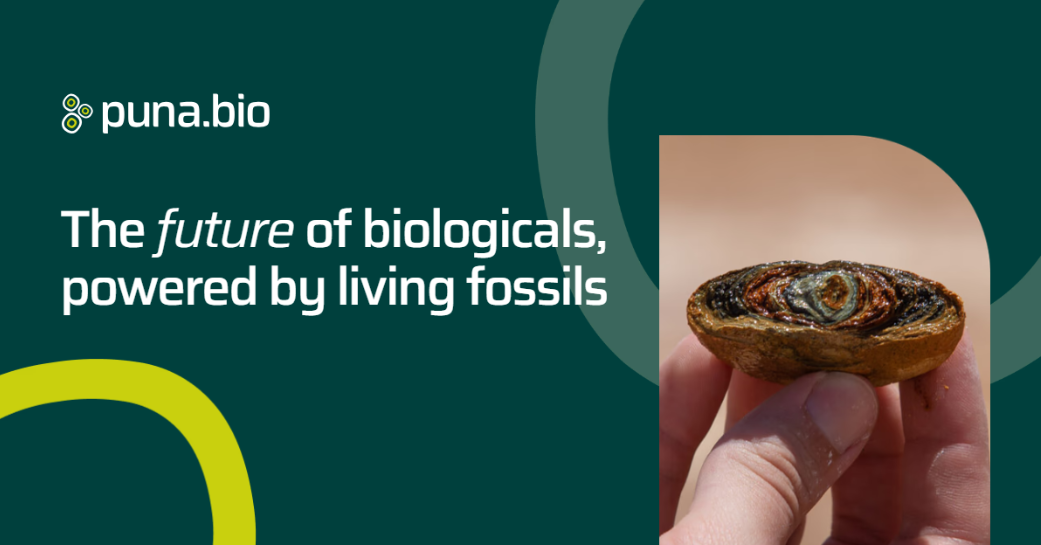
Photo credit: Puna Bio / puna.bio
Puna Bio is an Argentine agricultural-biotechnology company founded in 2020 by María Eugenia Farías, Elisa Violeta Bertini, Carolina Belfiore, and Franco Martínez Levis. Its scientists collect and study extremophile microorganisms from high-altitude Andean environments, then screen strains for traits that may support crop nutrition and resilience under drought, salinity, and nutrient stress.
The company develops seed-applied biological inputs. Kanzama is an extremophile-based microbial inoculant for wheat and barley intended to improve nutrient availability and nitrogen fixation. Kunza targets soybean under abiotic stress, and Tayrix is presented as an extremophile-derived seed biofungicide. Product registrations, crop labels, and commercial availability differ by country.
Puna operates a laboratory in Tucumán and a commercial office in Buenos Aires and reports validation across more than 35 international testing sites. It has expanded field and regulatory work in Latin America, the United States, and Africa with investors and partners including Corteva Catalyst and the Gates Foundation. Tests and expansion plans do not establish consistent farm-scale outcomes across soils, climates, and management systems.
Puna’s microbial seed treatments are intended to help crops acquire nutrients and tolerate environmental stress, potentially maintaining yield with less synthetic fertilizer or on land with degraded soils. Biological nitrogen fixation and improved nutrient-use efficiency could reduce input costs and upstream fertilizer emissions. Seed treatment also uses small product volumes and can fit existing planting workflows.
Benefits are not automatic. Microbial performance is highly dependent on strain, crop, soil community, weather, formulation, storage, and farm practice. Yield gains in selected trials may not reproduce across regions, and restoring soil function is broader than increasing one season’s harvest. Puna has not published a company-wide lifecycle assessment, verified fertilizer-displacement total, or long-term soil-carbon result.
Puna reports more than 35 international testing sites and field trials across multiple crops and environments. Company and investor materials have cited yield gains reaching approximately 15%–20% in selected soybean and wheat trials under stress. These are attributed trial results, not guaranteed commercial performance, and public summaries do not provide enough protocol and site-level data for a pooled independent estimate.
Kanzama and Kunza are commercial seed-treatment inoculants in specified markets, while Tayrix’s status must be checked against each national registration before sale or agronomic recommendation. Partnerships supporting testing in Africa and the United States represent planned validation and market development, not hectares treated or food produced.
Puna announced a $3.7 million seed round in 2023 and an undisclosed Series A in 2025 that included Corteva Catalyst and Gates Foundation participation. Funding, awards, strain-library size, and test-site counts measure organizational progress; they do not quantify avoided emissions, restored soil, or farmer income.
Stress-adapted microbial library
Puna screens organisms evolved in extreme Andean environments for crop-relevant traits under drought, salinity, and nutrient constraints.
Seed-treatment compatibility
Microbial formulations are applied through familiar seed-treatment workflows rather than requiring entirely new field equipment.
Crop-specific product pipeline
Kanzama targets wheat and barley, Kunza targets soybean, and Tayrix adds a biofungicide pathway, subject to local labels and registrations.
Multi-region field validation
Testing across more than 35 sites helps evaluate performance beyond the original Argentine environments, although results remain context-dependent.
Locations