Turning point-of-care ultrasound into structured clinical-trial data.
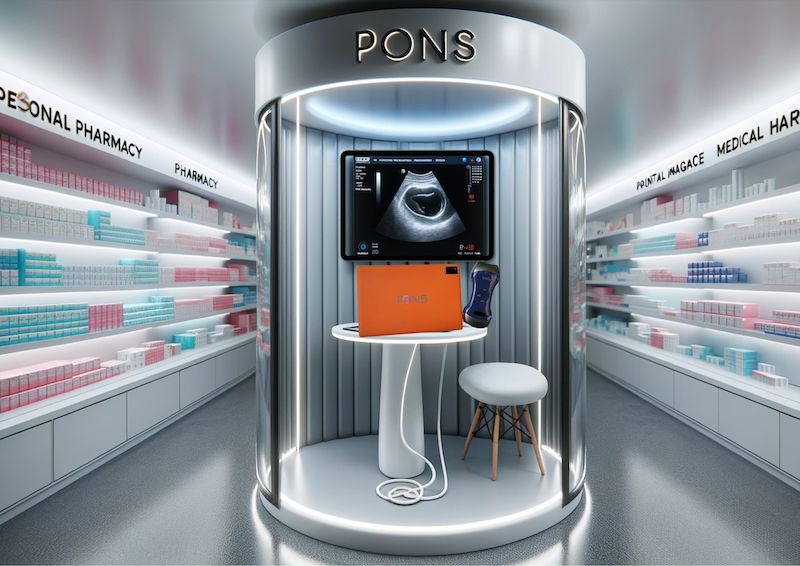
Photo credit: PONS, via SOSV
PONS is a health-technology company founded in 2021 by brothers Soner Hacihaliloglu and Ilker Hacihaliloglu. It is developing AI-enabled hardware and software intended to standardize point-of-care ultrasound capture and convert scans into quantitative data for clinical trials, biomarker development, and longitudinal disease research. The company describes portable “pods” that pair with mobile ultrasound rather than manufacturing a general-purpose ultrasound scanner.
The platform aims to make repeat ultrasound collection possible in pharmacies, retail clinics, and decentralized research sites. Guided acquisition and automated analysis could reduce operator variability and create datasets spanning healthy people and earlier disease stages, where conventional imaging programs often have limited reach. The intended customers include life-science sponsors and research organizations.
PONS should be described as an investigational clinical-data platform, not an approved autonomous diagnostic. Public materials discuss pilots, research, and clinical-trial applications; they do not establish FDA clearance for diagnosing disease, completed pivotal validation, or routine clinical adoption. An AI-derived measurement can be scientifically useful only after the relevant endpoint, acquisition protocol, population, and device combination are validated.
PONS targets the access and data-quality gap in medical imaging research. Portable ultrasound is less expensive and easier to deploy than MRI or CT, while guided acquisition may let more sites collect repeatable scans. More representative longitudinal data could improve trial recruitment, reveal treatment response sooner, and support biomarker discovery without requiring every participant to visit a specialist imaging center.
These benefits remain prospective. Algorithm performance can vary by anatomy, disease, probe, operator, site, and patient population. Decentralized imaging also raises requirements for privacy, consent, quality control, and clinical oversight. PONS has not published evidence that its platform reduces drug-development failure rates, improves patient outcomes, or performs as a validated diagnostic across indications.
SOSV reports that PONS participated in HAX’s 2022 cohort and is at seed stage. Company and investor materials describe AI-guided mobile-ultrasound pods and clinical-trial use cases, but they do not disclose a completed pivotal trial, regulatory authorization for autonomous diagnosis, number of commercial sites, or peer-reviewed multicenter performance results.
The frequently cited estimate that roughly 90% of clinical drug development fails is industry context, not an outcome attributable to PONS. Likewise, the described $100 billion clinical-trial and biomarker market is an addressable-market estimate rather than company revenue or social impact.
PONS’s total funding has not been publicly disclosed in a form that can be independently reconciled. As of September 17, 2026, pilots and platform development indicate technical progress; validated biomarkers, trial acceleration, diagnoses made, patients benefiting, and healthcare savings should not be presented as achieved metrics.
Guided ultrasound acquisition
AI-assisted workflows are intended to help non-specialist sites capture more consistent point-of-care ultrasound data.
Quantitative research datasets
PONS aims to convert portable scans into structured longitudinal measurements for biomarker and treatment-response analysis.
Decentralized trial reach
Portable pods could move repeat imaging into pharmacies and community settings, reducing dependence on specialist imaging centers.
Works with mobile ultrasound
The platform is designed to add data capture and analysis to compatible portable systems instead of requiring full-size imaging infrastructure.
Focus areas
Locations