Storing renewable electricity as high-temperature industrial heat.
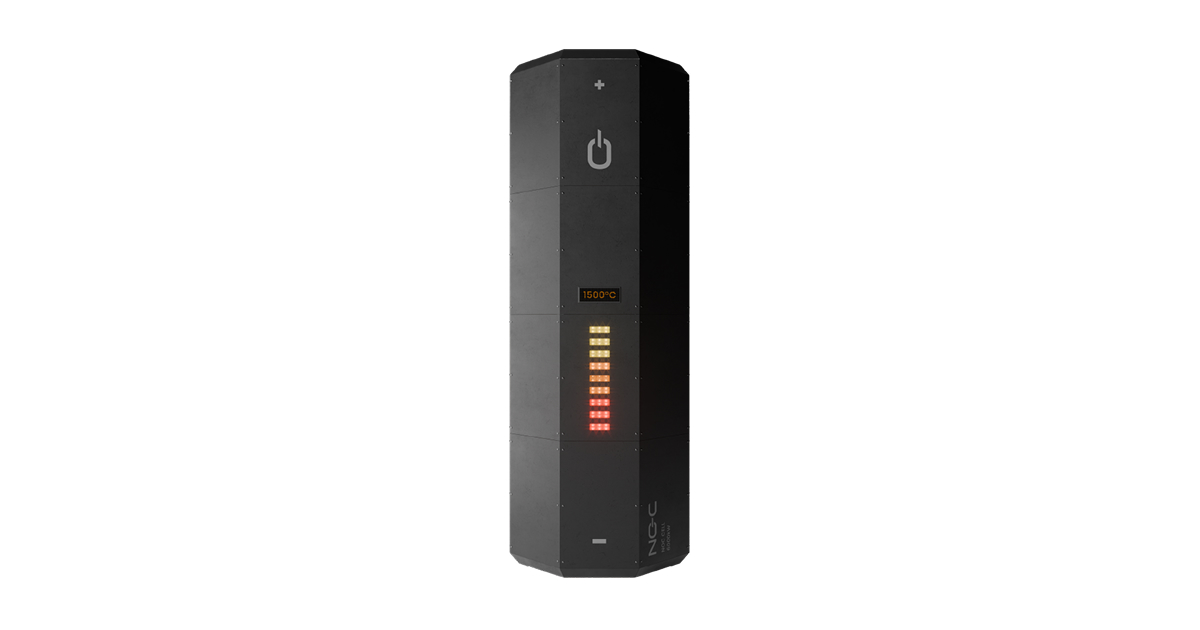
Photo credit: NOC Energy / nocenergy.com
NOC Energy is a French industrial-heat company founded in 2023 by Carlos Ceballos. Its NOC Cell converts electricity directly into heat through electromagnetic induction of conductive thermal media. A packed bed stores that thermal energy and later transfers it to process gas, allowing the same modular architecture to provide direct electric heat, thermal energy storage, or hybrid operation alongside existing combustion equipment.
The company targets process temperatures from steam applications below 300°C through high-temperature operations reaching 1,500°C. It describes multi-cell configurations capable of storing hundreds of megawatt-hours and markets the system for cement, minerals, chemicals, food, paper, and other heat-intensive industries. The design relies on industrially established components and storage materials rather than a novel chemical fuel.
In 2026 NOC Energy announced a strategic partnership with Fives FCB to test the NOC Cell at Fives’ pilot clay-calcination facility for cement and supplementary cementitious materials. It has also published an industrial-electrification paper with Schneider Electric. These are credible development and partner-validation steps, but no public source documents a full commercial installation, delivered heat volume, customer emissions reduction, or long-duration operating performance as of September 17, 2026.
Industrial plants can use NOC Cells when electricity is abundant or relatively inexpensive, store the resulting heat, and discharge it when production needs it. Where supplied by low-carbon electricity, each unit of fossil heat displaced can reduce direct combustion emissions. Storage and hybrid operation may make electrification practical for facilities that cannot align constant process demand with variable renewable generation.
Actual climate impact depends on grid marginal emissions, charging schedule, round-trip losses, thermal integration, utilization, materials, and the fossil system displaced. NOC’s 97% figure covers induction heat generation rather than the complete charge-store-discharge cycle. Hybrid configurations still burn fuel, and the company has not released a lifecycle assessment, independently verified pilot results, or customer-level avoided-emissions data.
NOC Energy states that induction converts electricity to heat at 97% efficiency and that its architecture can deliver heat up to 1,500°C. It also says multi-cell installations can provide hundreds of megawatt-hours of thermal storage and that economically attractive projects can electrify 20%–80% of a facility’s heat. These are company engineering and commercial claims, not independently audited operating results.
Fives and NOC announced pilot testing for clay calcination in May 2026. The partners describe the objective as replacing fossil-fired high-temperature heat and reducing cement-related emissions; they had not published test output, efficiency, durability, cost, or avoided-carbon results by the review date. Schneider Electric’s collaboration is a technical and market-development relationship, not evidence of deployment.
NOC announced a $2.7 million seed round in 2026. The company cites sector-level figures that 70% of industrial heat is produced by fossil-fuel combustion and that industrial heat represents 25% of global carbon dioxide emissions. Those figures describe the addressable problem and must not be reported as NOC’s achieved impact.
High-temperature electric heat
The NOC Cell is designed to supply applications from lower-temperature steam service through process heat as high as 1,500°C.
Integrated thermal storage
Conductive media and a packed bed combine heat generation, storage, and process-gas heat exchange in one modular system.
Hybrid retrofit pathway
Plants can pair electric heat with existing burners, increasing electrification in stages while retaining operational backup and flexibility.
Modular multi-cell scaling
Individual cells can be combined for larger power and storage requirements, reducing the need for one site-specific monolithic unit.
Locations