Wood rebuilt so it can carry a load usually left to steel.
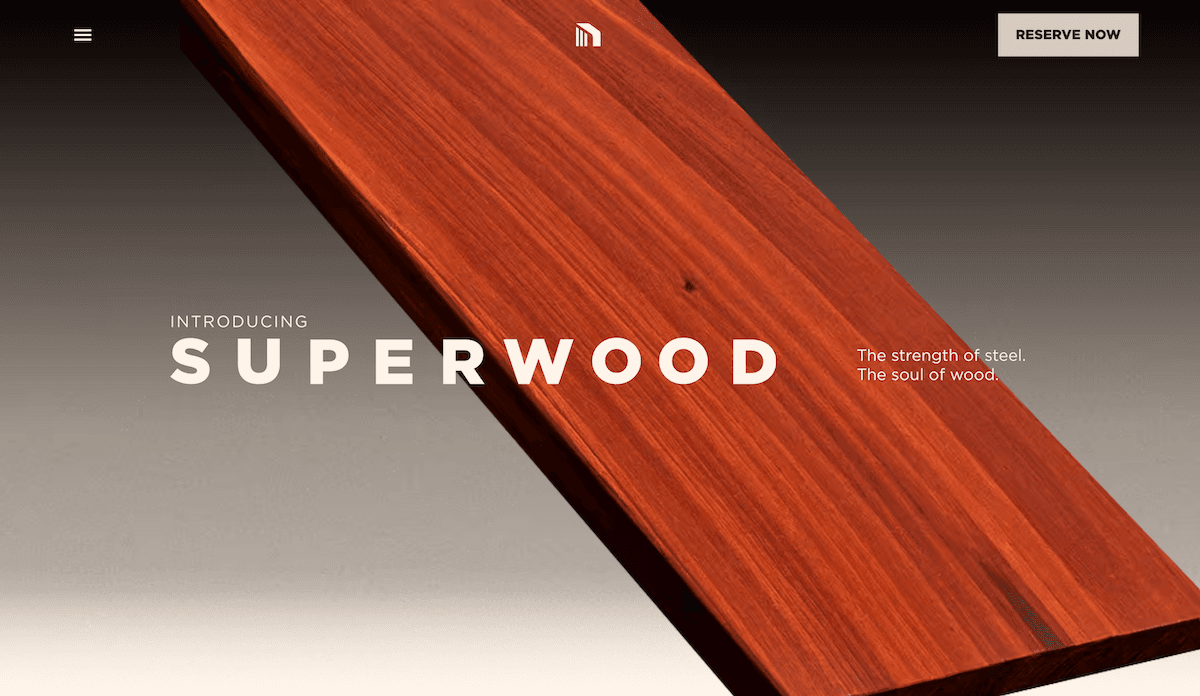
Photo credit: InventWood
InventWood develops SUPERWOOD, an advanced building material designed to give fast-growing timber the strength and durability required for applications traditionally dominated by steel and concrete.
The company was founded in 2016 by materials scientist Dr. Liangbing Hu, based on research developed in his University of Maryland laboratory. Alex Lau later joined to help commercialize the technology and turn the scientific breakthrough into a product builders could use at scale. InventWood now operates its first manufacturing facility in Frederick, Maryland, with reported annual capacity exceeding one million square feet of SUPERWOOD. Its initial products are designed for interior walls and ceilings.
According to InventWood, SUPERWOOD can achieve a strength-to-weight ratio up to 10 times greater than steel, earn a Class A fire rating, and provide greater resistance to moisture, rot, and termites than untreated wood. In April 2025, the company reported raising more than $50 million in total funding, including a $15 million first close of its Series A and a $20 million SCALEUP award from the U.S. Department of Energy received in 2022.
InventWood’s impact model is based on material substitution and long-term carbon storage. Steel and concrete are major sources of embodied emissions because producing them requires large amounts of energy. By engineering fast-growing wood to perform in more demanding building applications, InventWood aims to replace a portion of these carbon-intensive materials with a renewable alternative.
Trees absorb carbon dioxide as they grow, and wood products can retain that stored carbon for as long as they remain in use. SUPERWOOD could therefore reduce emissions in two ways: by avoiding some emissions associated with steel and concrete production and by storing biogenic carbon within buildings.
InventWood describes SUPERWOOD as carbon-negative. However, that outcome depends on factors including forestry practices, manufacturing energy, chemical inputs, transportation, product lifespan, end-of-life treatment, and the material being replaced. The reviewed public materials do not provide a complete, independently verified lifecycle assessment, so the carbon-negative designation should be treated as a company claim rather than a fully audited environmental conclusion.
The company reports that SUPERWOOD can achieve a strength-to-weight ratio up to 10 times greater than steel and meet a Class A fire rating. These figures describe production capacity and product performance rather than verified environmental outcomes. InventWood has not yet publicly disclosed metrics such as installed square footage, number of completed projects, customer adoption, embodied-carbon savings, or independently verified lifecycle emissions.
Wood, pushed further
SUPERWOOD starts as wood, then gets denser and stronger so it can compete with materials that usually dominate a building.
Made in Maryland
The first commercial plant is in Frederick, and the company says early production has already been spoken for.
Carbon stays in the building
Wood stores carbon the tree already captured. InventWood's pitch is that using more of it, and less steel and concrete, lowers a building's footprint.
Locations