Turning waste biomass into durable underground carbon removal.
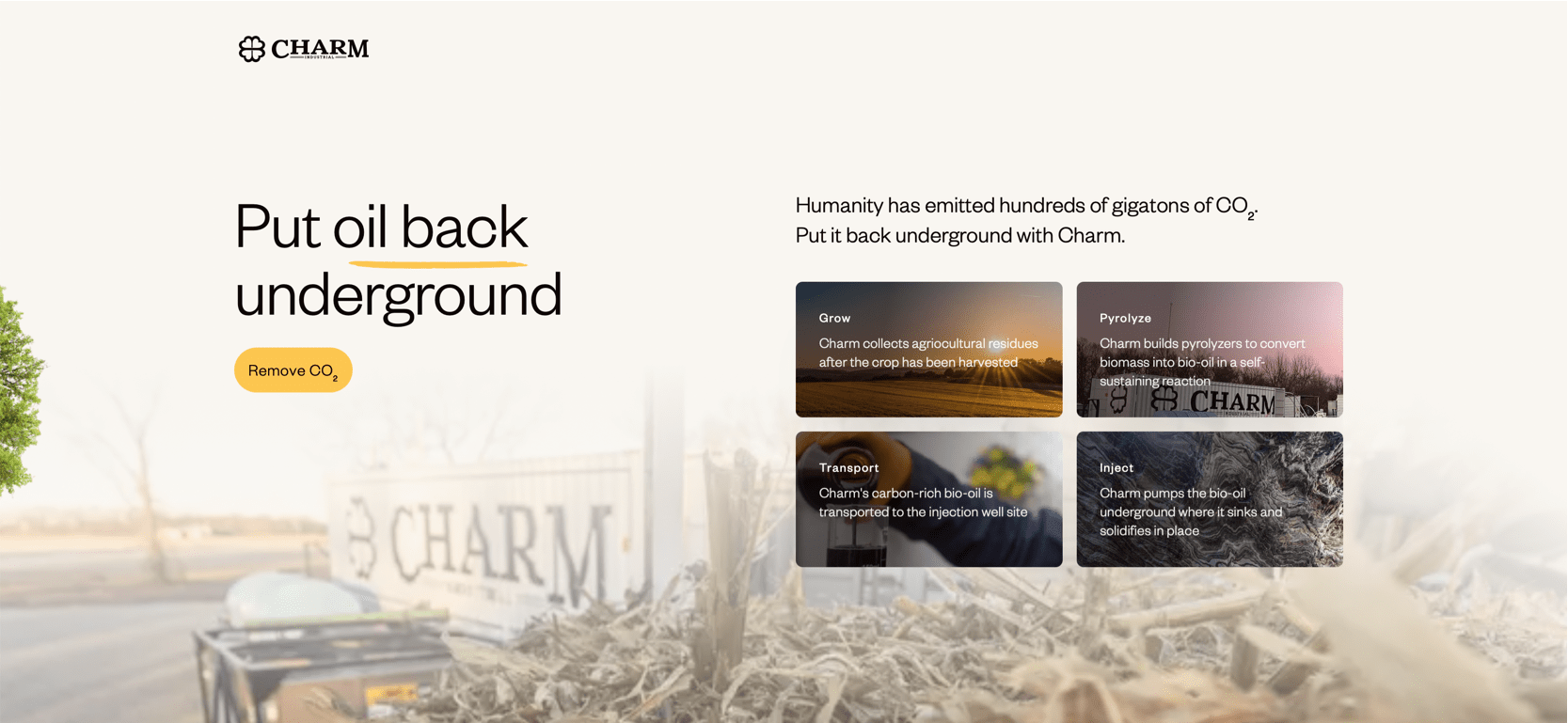
Photo credit: Charm Industrial / charmindustrial.com
Charm Industrial is a climate-technology company founded in 2018 and led by co-founder Peter Reinhardt. It developed a biomass carbon removal and storage pathway that converts agricultural and forestry residues into carbon-rich bio-oil through fast pyrolysis. Charm transports the liquid to permitted injection wells and injects it into deep geologic formations, where it is intended to sink, solidify, and retain the biomass-derived carbon for millennia.
The process separates biomass into bio-oil, syngas, and biochar. Charm uses syngas to help power pyrolysis, can return nutrient-containing biochar to fields, and accounts for feedstock, transport, processing, and injection emissions when calculating net removal. Its public Carbon Ledger reports individual removal activity, while third-party registry Isometric applies a bio-oil geological storage protocol to eligible deliveries. Registry verification and delivered tonnes are distinct from future purchases under long-term offtake contracts.
Charm also researches bio-oil as a reductant for ironmaking and operates modular pyrolysis and injection infrastructure in agricultural regions. The climate case depends on using genuine residues that would otherwise return carbon to the atmosphere, controlling supply-chain emissions, protecting soil needs, preventing leakage to other biomass uses, and maintaining safe wells and monitoring. Contract volume, production capacity, and gross carbon stored must not be described as net, delivered, or independently verified removal.
Plants remove carbon dioxide while growing, and residues retain part of that biogenic carbon. Charm aims to interrupt its return to the atmosphere by converting eligible residues into a pumpable bio-oil and placing that carbon in deep geologic storage. Modular pyrolyzers can operate closer to dispersed feedstocks, while the denser liquid is moved to injection sites. If lifecycle emissions and counterfactual biomass impacts are conservatively accounted for, the result can be durable net carbon removal.
The pathway is constrained by sustainable residue supply, alternative uses, soil-carbon and nutrient needs, wildfire and decay baselines, transport distance, pyrolyzer performance, injection-well availability, permanence evidence, and monitoring quality. Public purchases help finance scale but do not remove carbon until delivery occurs. Charm’s ledger is unusually granular, yet company-reported entries and registry-issued credits should still be distinguished, and multi-gigaton potential estimates are resource models rather than achieved impact.
Frontier’s portfolio record says Charm delivered more than 6,000 tons of removal during its first three operating years. Charm’s Carbon Ledger continued to itemize customer deliveries through March 2026, including deliveries to Shopify, Stripe, and JPMorgan Chase, but the live total is dynamic and should be read from the ledger rather than inferred from contracted volume. Charm also reported completing Shopify’s first 1,000-ton purchase ahead of schedule. These are delivered quantities; verification status is determined separately under the applicable registry and protocol.
Frontier buyers contracted for 112,003 tons for delivery from 2024 through 2030 at a total contract value of $52.9 million. Those 112,003 tons are an offtake commitment with technical, community-engagement, and monitoring milestones—not removals already delivered. DOE selected Charm for a $50,000 first-phase Carbon Dioxide Removal Purchase Pilot Prize award in 2024, with an opportunity then to compete for a purchase of up to $3 million; the larger amount was not an awarded grant in that announcement.
Charm announced a $100 million Series B in 2023. Funding and contracted revenue are financial measures, not climate outcomes. The environmental result for each batch is the net credited removal after feedstock counterfactuals and lifecycle deductions, not the gross mass of bio-oil, biomass processed, or carbon physically injected.
Durable geologic storage
Bio-oil is injected into permitted deep formations where it is designed to sink and solidify, placing biomass carbon beyond wildfire and surface-decay risks.
Residue-based feedstocks
The pathway can use agricultural and forestry residues, subject to conservative accounting for soil needs, alternative uses, collection, and transport.
Public delivery ledger
Charm publishes batch-level removal activity and customer allocations, improving the ability to separate delivered tonnes from future contracted purchases.
Modular field operations
Distributed pyrolysis can process bulky biomass nearer its source before denser bio-oil is transported to centralized injection infrastructure.
Focus areas
Locations