
Nonprofit Case Study: Give Directly
This case study gives a straightforward breakdown of GiveDirectly. It covers the mission, the problem it aims to solve, its direct cash transfer model, its financial picture, and the results it has achieved.
Photo credit: Give Directly
Key takeaways
- GiveDirectly has delivered over $900 million directly to more than 1.7 million people across 14 countries with 85-90% of donations going straight to recipients.
- A $1,000 cash transfer in Kenya generated 2.5x economic multiplier effect, with recipients increasing consumption by 23% and asset ownership by 40% three years later.
- The organization maintains 93.84% program expense ratio and 4-star Charity Navigator rating, demonstrating exceptional operational efficiency and transparency.
- Recipients showed improved food security, psychological wellbeing, and business activity with negligible spending on alcohol or tobacco, contradicting common misconceptions.
- GiveDirectly expanded to US disaster relief and COVID-19 response, distributing over $125 million to 200,000+ American families through Project 100.
GiveDirectly is a United States based nonprofit founded in 2008 by Paul Niehaus, Michael Faye, Rohit Wanchoo, and Jeremy Shapiro, a group of MIT and Harvard graduates who wanted to test a simpler approach to poverty reduction.
The organization delivers unconditional cash transfers to people living in extreme poverty.
Its mission is to send money directly to low income households so recipients can make their own financial decisions.
GiveDirectly runs programs across several African countries and has also piloted cash support in the United States for households affected by disasters or structural poverty.
The Problem
Extreme poverty limits economic mobility, nutrition, shelter, education, and long term wellbeing for hundreds of millions of people. Many traditional aid programs decide on behalf of the poor which goods or services they should receive.
This often reduces flexibility, increases program cost, and fails to address individual constraints.
The people most affected are rural households in Sub Saharan Africa, informal workers, and families with limited access to capital or formal financial services.
The Idea and Model
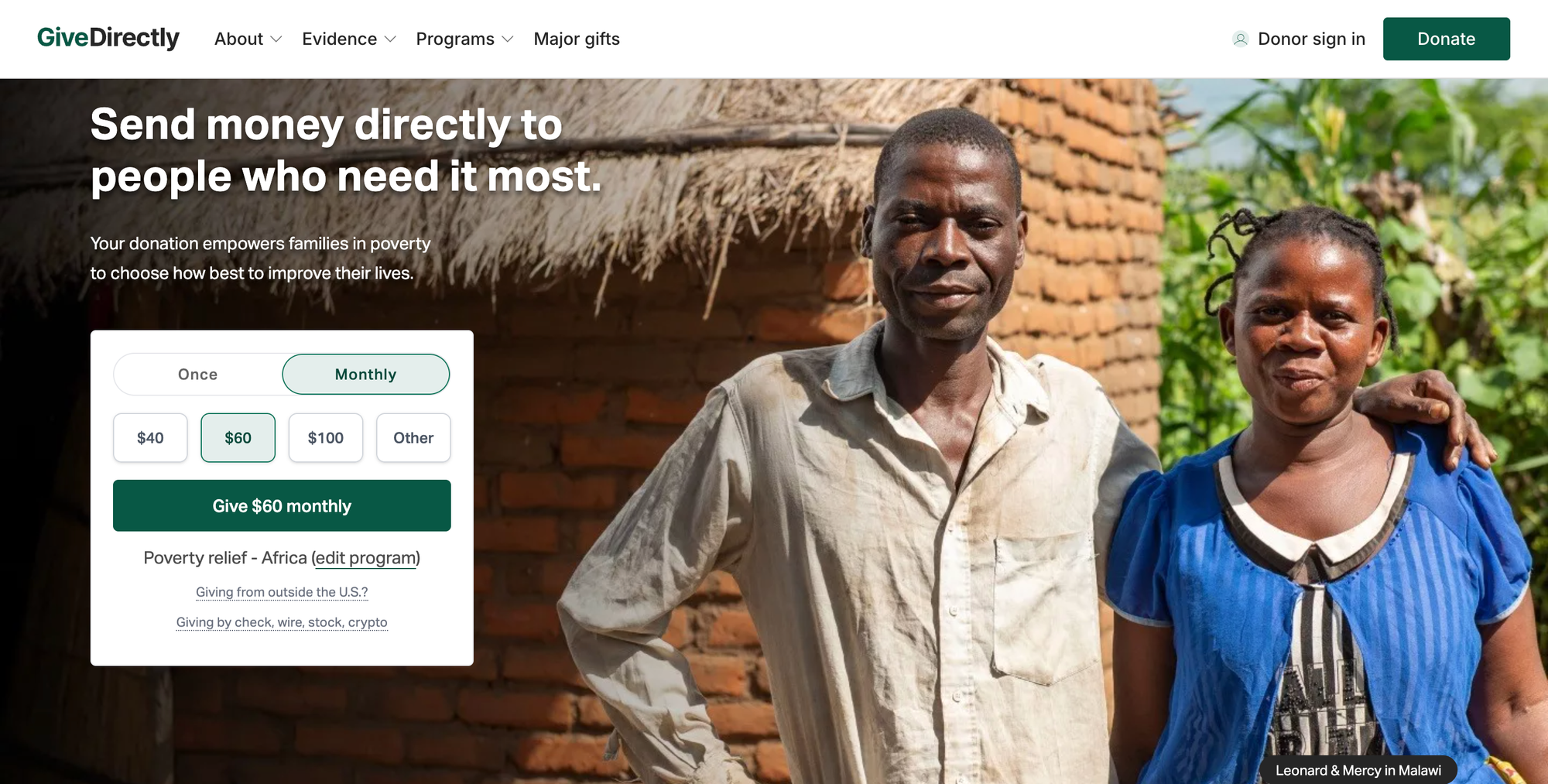
GiveDirectly’s idea is straightforward. Identify households living in severe poverty and transfer cash to them with no conditions.
The organization uses the following model.
Select target regions with high poverty rates.
Use surveys, satellite data, and on the ground verification to identify eligible households.
Transfer funds through mobile money or similar digital systems.
Confirm receipt and handle any issues.
Measure short and long term outcomes through independent research.
Programs include one time lump sums, multi month payments, basic income trials, emergency response payments, and special projects with governments.
Strategy and Operations
GiveDirectly’s strategy focuses on scale, accuracy of targeting, and rigorous evaluation.
Key operational elements include:
A mix of private donors, foundations, and institutional partners.
Country teams that manage enrollment, verification, and follow up.
Mobile money infrastructure that reduces overhead cost.
Independent academic partners such as Innovations for Poverty Action and research teams from leading universities.
Public reporting of outcomes, mistakes, and program adjustments.
Strengths include operational simplicity, strong external validation, and lower administrative layers compared to in kind programs.
Gaps include the heavy reliance on mobile networks, variation in recipient context, and the cost of accurate targeting in remote areas.
Governance and Leadership
GiveDirectly is led by a senior executive team and overseen by a board that includes economists, technology leaders, and experts in international development.
Governance influences where programs are launched, how research is designed, and how much weight is given to evidence when adjusting strategy.
The organization maintains standard nonprofit compliance processes, annual audits, and public reporting. Leadership turnover is modest, and the board has historically included founders and long standing advisors.

Targeting and Eligibility Method
Targeting is a central part of the model.
GiveDirectly identifies eligible households using:
Phone surveys and community interviews.
Satellite imagery to detect housing materials that correlate with poverty.
On site verification teams who confirm identity and eligibility.
Fraud detection systems that flag duplicate registrations or abnormal patterns.
Targeting is effective but not perfect.
False positives and false negatives occur, and the process adds cost. The organization evaluates these errors regularly but still faces challenges in fast moving or fragile environments.
Delivery Infrastructure and Verification
Cash is sent primarily through mobile money systems such as M-Pesa. This model allows fast delivery and low leakage. Verification steps include:
Confirmation messages to recipients.
Independent follow up calls.
Internal fraud checks.
Public incident reporting.
Delivery relies on stable mobile networks. In regions with weak coverage, delays or manual workarounds are common.
Impact and Evidence
GiveDirectly’s work is among the most studied interventions in global poverty. Key findings include:
A one time transfer of about one thousand dollars in Kenya increased local economic activity by roughly two and a half times the transfer amount over twenty seven months according to an independent RCT.
Recipients increased consumption by about one quarter and improved food security and asset ownership.
Studies recorded improvements in psychological wellbeing and reduced stress.
No clear improvements in some health and education metrics in certain trials.
GiveWell, a key evaluator, updated its cost effectiveness model in two thousand twenty four and now estimates the main program to be several times more cost effective than earlier estimates.
Pilots at district scale indicate minimal inflation and strong poverty reduction outcomes.
Overall the evidence is strong for short and medium term benefits.
Long term effects beyond five years are less certain due to limited data.
Reach and Impact Overview
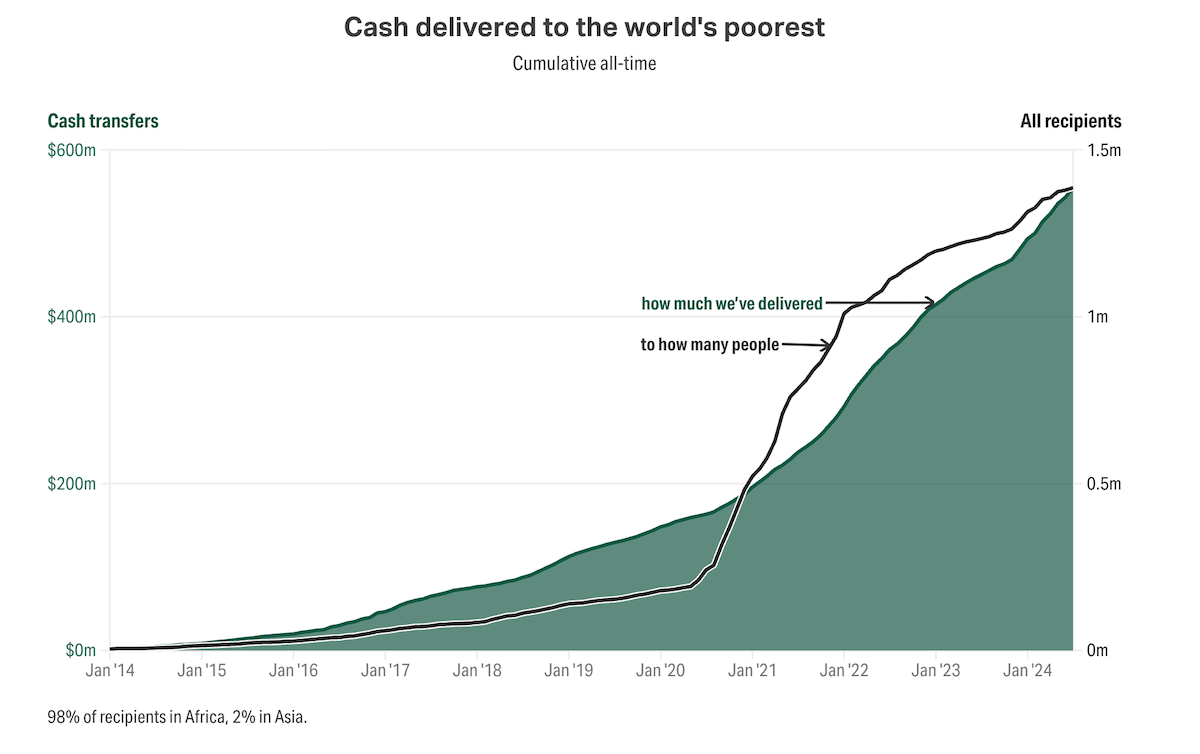
Over $900 million delivered directly to more than 1.7 million people in poverty, operating in 14 countries as of 2025.
Typically, 85–90% of donations go straight to recipients, making GiveDirectly one of the most efficient nonprofits globally.
Transfer amounts often range from $250 up to $1,000 delivered via mobile payments, with some universal basic income pilots providing recurring cash over years.
Economic Impact Facts & Figures
A one-time $1,000 cash transfer in Kenya led to a 2.5x increase in local economic activity (i.e., for every $1 transferred, $2.50 in economic growth was generated over 27 months).
Recipients of unconditional cash transfers increased monthly consumption by 23% (around $35–36 USD), improved food security, and made sizable investments in household assets, including livestock and metal roofs.
Asset ownership increased by 40% ($422 PPP per household) on average three years after receiving a transfer, with sustained improvements in psychological well-being.
Business activity and hiring surged, with one Liberia program showing 36.9% more recipients hired labor for home improvements and businesses.
Social Impact and Spillovers
Recipients invested more in children’s schooling, spent more on health, and had significant improvements in education outcomes and psychological health.
Rigorous tracking shows negligible increases in spending on temptation goods (alcohol, tobacco).
Studies report positive spillover effects for non-recipients and neighboring communities, including business growth and regional market activity.
Emergency programs sent $21.3 million to more than 30,000 refugees in Uganda, Kenya, and Rwanda, and disaster relief arrived to affected U.S. families within hours thanks to AI-and mobile-based enrollment.
Food security and income improved for more than 90% of recipients in some programs.
GiveDirectly’s impact is characterized by rapid delivery, quantifiable economic multipliers, and a consistently broad positive effect on poverty, assets, and social well-being, with ongoing evaluation expanding the evidence base.
GiveDirectly in the United States
Enjoying this? Get the next one.
We send one email each Monday with what just published on Causeartist.
Free. Unsubscribe anytime.
FAQ
How does GiveDirectly identify and target recipients for cash transfers?
GiveDirectly uses a multi-step targeting process including phone surveys, satellite imagery to detect housing materials that correlate with poverty, on-site verification teams, and fraud detection systems. They focus on regions with high poverty rates and use mobile money infrastructure like M-Pesa for delivery. While effective, the process isn't perfect and faces challenges with false positives/negatives and higher costs in remote areas.
What evidence exists for GiveDirectly's impact and effectiveness?
GiveDirectly is among the most studied poverty interventions globally. Key evidence includes a 2.5x economic multiplier from $1,000 transfers in Kenya, 23% increase in recipient consumption, 40% increase in asset ownership after three years, and improved psychological wellbeing. GiveWell updated its cost-effectiveness model in 2024, rating the program several times more effective than earlier estimates. Studies show minimal inflation and strong poverty reduction at district scale.
How efficient is GiveDirectly with donor funds compared to other nonprofits?
GiveDirectly demonstrates exceptional efficiency with 85-90% of donations going directly to recipients and a 93.84% program expense ratio. This makes it one of the most efficient nonprofits globally. The organization maintains a 4-star Charity Navigator rating and practices transparent reporting of outcomes, mistakes, and program adjustments. Their 2023 revenue was $140.34 million with $130.26 million in expenses.
What types of cash transfer programs does GiveDirectly operate?
GiveDirectly operates several program types: one-time lump sums (typically $250-$1,000), multi-month payments, universal basic income trials providing recurring cash over years, emergency response payments for disasters, and special government partnership projects. They work across 14 countries in Africa and have expanded to the US for disaster relief and COVID-19 response, including Project 100 which distributed $125 million to over 200,000 American families.
What are the main challenges and limitations of GiveDirectly's model?
Key challenges include targeting accuracy errors requiring time and money to address, reliance on mobile money systems that can face network outages, political instability affecting operations, and mixed results across different health and education metrics. The organization also faces donor funding fluctuations, operational risks in fragile environments, and potential inflation concerns with large-scale rollouts, though early evidence suggests minimal impact on local prices.
More Case Studies
Browse all
Photo credit: method, modified by causeartist


Photo credit: Who Gives A Crap, modified by Causeartist
Photo credit: New Belgium Brewing Company / modified by Causeartist
Get the Monday roundup
New companies, funders, stories, podcasts, and case studies — one email a week.
Join 25,000+ Causeartists
Free. Unsubscribe anytime.