
B Corp certification is a third-party credential issued by B Lab, a nonprofit, that verifies a company meets defined standards of social and environmental performance, accountability, and transparency.
It is not a legal structure.
It is not a tax designation.
It is a certification, similar in nature to LEED for buildings or Fair Trade for supply chains.
To earn it, a company completes the B Impact Assessment (BIA), a scored evaluation across five areas: governance, workers, community, environment, and customers.
A minimum score of 80 out of 200 is required to qualify.
The median score for companies that complete the BIA without certification intent sits around 50.
Certification also requires signing the B Lab Declaration of Interdependence, submitting to a verification review, and in most U.S. states, amending your governing documents to protect the consideration of stakeholders beyond shareholders.
As of early 2025, there are roughly 9,000 certified B Corps across 90+ countries.
The B Impact Assessment: How It Works
The BIA is free to use, publicly available, and built around questions covering how a company operates, compensates workers, impacts its community, and manages environmental footprint.
Each answer is weighted and scored. Some questions apply universally. Others depend on company size, industry, and structure.
The five categories:
- Governance (10%): Decision-making structure, mission integration, transparency, and board accountability.
- Workers (25%): Compensation, benefits, training, safety, and engagement.
- Community (25%): Local hiring, supply chain standards, civic engagement, and charitable giving.
- Environment (25%): Energy use, emissions, water, waste, and land management.
- Customers (15%): Product impact on underserved populations, data privacy, and feedback mechanisms.
You can start and save the BIA online before ever paying anything. Many founders use it purely as a benchmarking tool without pursuing certification.
What B Corp Certification Actually Costs
B Lab charges a tiered annual fee based on revenue. The following reflects B Lab's official 2026 pricing for U.S. and Canada-based companies:
| Annual Revenue | Annual Fee (USD) |
|---|---|
| $0 to $5M | $2,100 |
| $5M to $7.5M | $3,150 |
| $7.5M to $10M | $3,938 |
| $10M to $20M | escalates through mid-tier bands |
| $50M to $100M | escalates into the $10,000+ range |
| $100M to $1B | escalates into the $50,000+ range |
| Above $1B | Contact B Lab directly |
A few things worth noting here.
First, there is a single tier for all companies under $5M in revenue, meaning an early-stage startup and a $4.9M company pay the same $2,100 per year.
Second, the fee structure becomes more granular as revenue climbs, with narrower bands and steeper jumps through the mid-tiers. Third, for very large companies, annual fees can reach well beyond $50,000 before hitting the "contact us" threshold.
Always verify current pricing at bcorporation.net before budgeting. Fees have shifted upward in recent years and will likely continue to do so as B Lab expands its verification infrastructure.
These fees are assessed annually. Certification must be renewed every 3 years through a full re-verification process.
Hidden and Adjacent Costs
The certification fee is the smallest part of what you will actually spend.
Staff or consultant time for the BIA. First-time completion typically takes 20 to 40 hours for a small business, more if records are incomplete. If you hire a B Corp consultant to close the gap to 80, expect $3,000 to $10,000+ depending on scope.
Legal fees for governance amendments. Most U.S. states require companies to convert to a benefit corporation or amend their articles of incorporation to include stakeholder language. Legal costs range from $500 to $5,000+, depending on jurisdiction and complexity.
Policy and practice improvements. The BIA often reveals gaps: no formal parental leave policy, no supplier code of conduct, no environmental tracking system. Closing those gaps has real cost. For some companies it is minimal. For others it requires new HR systems, vendor audits, or operational changes.
Verification review. B Lab will request supporting evidence for your responses. Budget time to compile payroll records, benefit documentation, environmental data, and governance records.
Ongoing maintenance. Staying certified means keeping your score above 80 through business changes and growth. Some companies assign a part-time internal role to manage this across the 3-year cycle.
Realistic all-in cost for first-time certification:
- Small company (under $5M revenue): $8,000 to $25,000
- Mid-size company ($10M to $50M revenue): $20,000 to $60,000+
B Corp vs. Benefit Corporation: They Are Not the Same
This causes real confusion. Here is the distinction.
Benefit corporation is a legal structure. It is a state-level designation that legally requires directors to consider the impact of decisions on all stakeholders, not just shareholders. No third-party verification. No score. No fee to B Lab.
B Corp is the certification. A private credential issued by B Lab requiring you to meet their standards, pay their fees, and undergo their verification process.
You can be a benefit corporation without being a certified B Corp. You can be a certified B Corp without being a benefit corporation, though B Lab now strongly recommends or requires the legal structure change in most cases.
If your goal is stakeholder accountability baked into your legal DNA, the benefit corporation structure accomplishes that without B Lab involvement. If your goal is the third-party credential and its associated network signal, that is B Corp certification.
Deep dive more into this comparison.
Who B Corp Certification Actually Helps
Certification is not uniformly valuable. It depends on what you are selling, to whom, and how your growth strategy works.
It tends to pay off for:
Consumer-facing brands in competitive categories. If you are selling to conscious consumers in food, apparel, beauty, or home goods, the B Corp badge has demonstrated impact on purchase decisions.
Companies pursuing institutional partnerships or contracts. Some corporate procurement processes and impact-focused supply chains actively screen for B Corp status. This is especially true in Northern Europe, Canada, and parts of Latin America.
Founders raising from impact investors. Certification reduces due diligence friction with mission-aligned investors who use it as a baseline screen.
HR and talent acquisition at the scale-up stage. Certified companies consistently report advantages in recruiting mission-aligned talent, particularly among Millennial and Gen Z candidates.
It is harder to justify for:
Early-stage startups with limited resources. If you are pre-revenue or under $500K annually, the time and money cost is difficult to justify unless certification is central to your fundraising narrative from day one.
B2B companies in industries where buyers do not value the signal. If you are selling SaaS to logistics companies or professional services to mid-market corporations, B Corp status will likely have zero impact on sales conversations.
Companies already operating at high standards. If you publish an impact report, have strong HR policies, and manage environmental data, paying for certification primarily delivers a badge. Evaluate whether that badge has real strategic value in your specific market.
The Verification Process: What to Expect
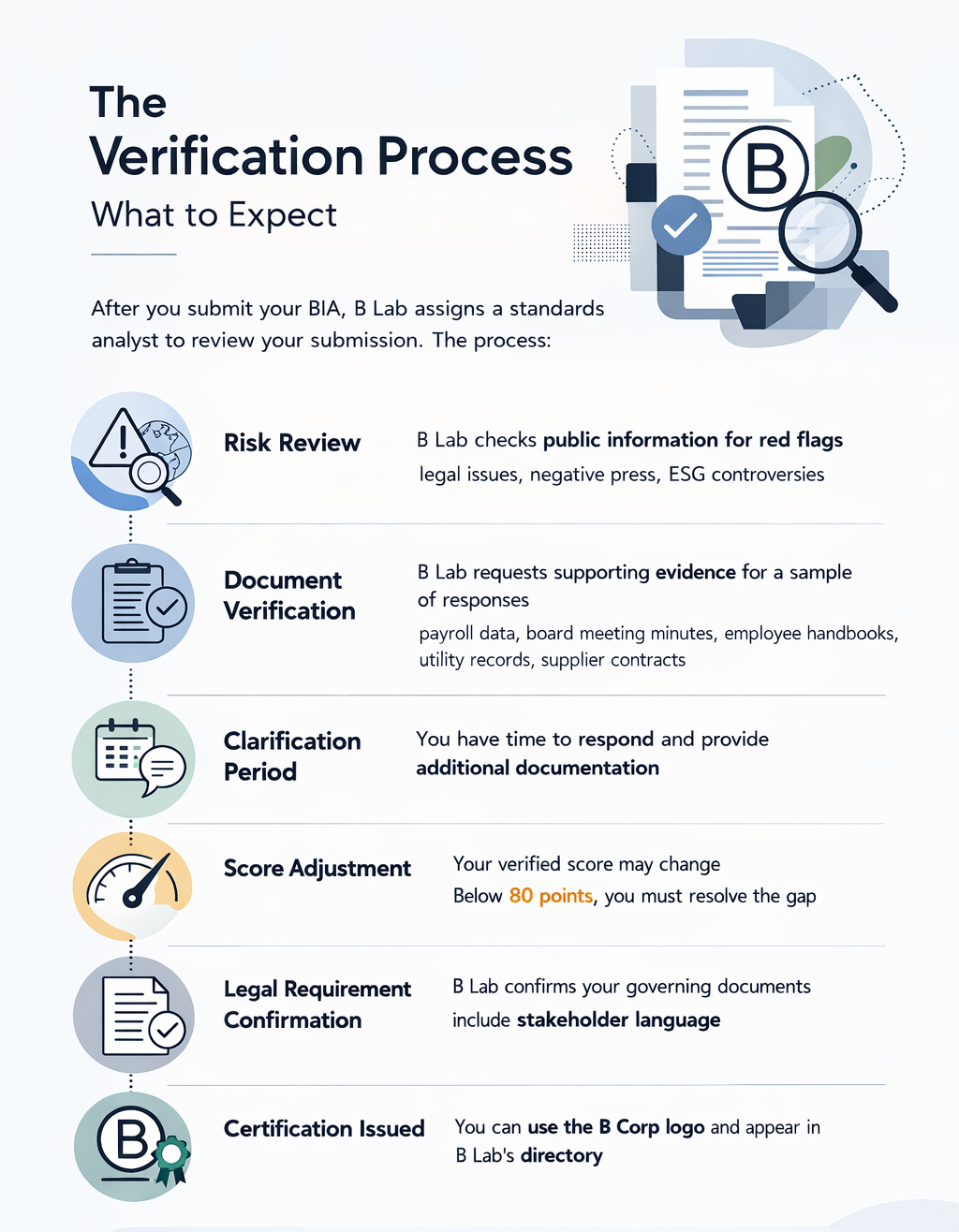
After you submit your BIA, B Lab assigns a standards analyst to review your submission. The process:
- Risk review. B Lab checks public information about your company for red flags: legal issues, negative press, ESG controversies.
- Document verification. They request supporting evidence for a sample of responses. Typical requests include payroll data, board meeting minutes, employee handbooks, utility records, and supplier contracts.
- Clarification period. You have a window to respond and provide additional documentation.
- Score adjustment. Your verified score may differ from your self-assessed score. If it drops below 80, you are not certified until you resolve the gap.
- Legal requirement confirmation. B Lab confirms your governing documents include stakeholder language.
- Certification issued. You can then use the B Corp logo and appear in B Lab's directory.
The full process typically takes 3 to 6 months from submission for a small to mid-size company.
What has Changed Since 2020
Since 2020, B Lab has been overhauling its standards, culminating in new B Lab Standards (V2) published in 2025 with phased implementation through V2.1 and beyond.
These new standards replace the old points‑based B Impact Assessment with minimum requirements across seven impact topics, stronger expectations on fair work and governance, and differentiated sub‑requirements for large and multinational companies.
Certification now involves more documentation, third‑party assurance, and multi‑year milestones, so companies certifying in this cycle generally face higher and more structured requirements than those that certified several years ago.
Starting your assessment early gives you time to understand which version and timelines apply to you and to address gaps before tighter sub‑requirements and later‑year obligations fully kick in.
Common Reasons Companies Lose or Fail to Renew
- Score drops below 80 due to growth. Scaling often dilutes impact per dollar. What worked at 10 employees is harder to maintain at 100.
- Governance changes. Acquisition or new investors can alter your benefit corporation status or stakeholder commitment language.
- Employee data shifts. Worker category scores depend on actual compensation data and benefits utilization. Fast-growing companies sometimes see these fall.
- Documentation failures. If you cannot prove the practice, the score does not count.
- Voluntary withdrawal. Some companies conclude the cost-benefit no longer makes sense at their scale.
High-profile exits from B Corp status, including Etsy, contributed to B Lab tightening its verification process.
The Honest ROI Calculation
Five questions to answer before starting:
- Do your target customers, partners, or investors recognize and value the B Corp badge?
- Are you competing in a category where certification differentiates you from alternatives?
- Can your current operations realistically score 80+ on the BIA, or would reaching that score require significant operational investment?
- Is the $5,000 to $20,000 first-year cost justifiable against the sales, fundraising, or talent outcomes you expect?
- Do you have the internal capacity to manage a 3 to 6 month process without disrupting core operations?
Yes to most: certification is worth serious consideration. No to most: use the BIA as a free benchmarking tool and revisit in 12 to 18 months.
Notable Certified B Corps Worth Studying
- Patagonia (outdoor apparel): Mission-aligned governance, one of the most cited examples in the space.
- Natura & Co (beauty, Brazil): One of the largest B Corps globally, proof that scale and certification are not mutually exclusive.
- Danone North America (food): Pursued certification across a major subsidiary as a stakeholder commitment strategy.
- Eileen Fisher (fashion): Strong worker and governance scores, long-standing certification.
- New Belgium Brewing (beverage): Employee-owned, early certifier, frequently used as a case study for operational integration.
How to Get Started
Step 1: Complete the BIA for free. Go to bcorporation.net. Do not pay anything yet. Get your baseline score.
Step 2: Identify your gap to 80. Review which categories have the most upside relative to what changes are actually feasible. Some gaps are cheap to close. Others require real investment.
Step 3: Address legal structure. Talk to a business attorney about converting to a benefit corporation or amending your governing documents. Do this before submitting for certification.
Step 4: Compile your documentation. Build a folder of supporting evidence for your highest-weighted responses before submitting. This shortens verification significantly.
Step 5: Submit and stay responsive. Verification moves faster when companies are prepared and communicative with B Lab's review team.
Step 6: Build a maintenance plan. Assign someone to track your BIA score annually, even in off-renewal years. Recertification surprises happen when companies grow without tracking the metrics.
Final Take
B Corp certification is a credible, rigorous third-party standard. It is not a marketing shortcut. It is not a guarantee of impact. And it is not free.
For the right company, it is a durable signal that opens doors with consumers, investors, and partners who want evidence, not aspiration.
For the wrong company, it is an expensive compliance exercise that produces a badge nobody in their market is looking for.
Start with the BIA. Know your score. Then decide if the gap to 80, and the annual cost of staying there, delivers real return.