In Episode 236 of the Disruptors for GOOD podcast, I sit down with Jerry Golden, Chief Policy Officer at Lyft, to talk about the fast changing world of transportation policy, Lyft’s social impact programs, thoughts on autonomous vehicles, and what it could mean for riders, drivers, and communities.
Transportation has always reflected how society functions.
In this wide ranging conversation, Golden offers a grounded look at how policy, technology, and social responsibility intersect inside one of the most influential transportation platforms in the country.
A Career Built Through Policy and Purpose
Golden described his career path as a series of “happy accidents,” rather than a straight line. Like many people who end up in public policy, he arrived in Washington with an interest in advocacy and learned by doing.
Over time, he built a reputation for understanding how policymakers think and how companies can engage productively rather than defensively.
That experience prepared him well for Lyft, a company operating at the intersection of regulation, labor, technology, and public need.
Golden joined Lyft just over a year ago, stepping into a role that touches federal legislation, state and local policy, driver advocacy, sustainability, and social impact.
The scale is significant, but so is the responsibility.
Transportation as a Social Connector
One of the most striking themes from the conversation was Lyft’s view of transportation as a remedy for social isolation.
Golden pointed to research comparing chronic isolation to serious public health risks, noting that transportation access often determines whether people remain engaged with work, healthcare, and community life.
Lyft’s mission, he explained, is not just about convenience.
It is about serving and connecting people. That mindset shapes how the company approaches policy conversations, particularly around affordability, access, and equity.
For policymakers, this means understanding that rideshare is no longer a luxury.
For many communities, it is essential infrastructure.
The Policy Reality of Rideshare
Public policy in transportation is relentless. Golden described a landscape where state and local governments often move faster than federal agencies, simply because there are more of them and each faces unique challenges.
Key issues Lyft engages on include:
- Affordability and the impact of taxes and fees on riders
- Insurance costs that directly affect ride prices and driver earnings
- Access in transportation deserts where public transit falls short
- Driver flexibility for people balancing caregiving, education, or multiple jobs
Golden emphasized that Lyft’s policy lens is rooted in real world outcomes. What matters is not intent, but impact on drivers, riders, and the communities they serve.
Autonomous Vehicles and the Long Transition Ahead
Autonomous vehicles are coming, but not overnight.
Golden was clear that the future will be hybrid for a long time.
Human drivers are not disappearing, and Lyft does not view autonomy as a replacement, but as a complement.
Lyft’s role, he explained, is not necessarily to build the vehicles themselves. It is to provide the operating layer people already trust.
The marketplace, safety systems, customer support, and demand generation that make new technology usable at scale.
Trust matters. Lyft helped establish regulatory models for rideshare over a decade ago. Golden sees the same responsibility with autonomous vehicles.
Move carefully, partner with policymakers, and bring communities along rather than forcing adoption.
Round Up and Donate, Small Change at Scale
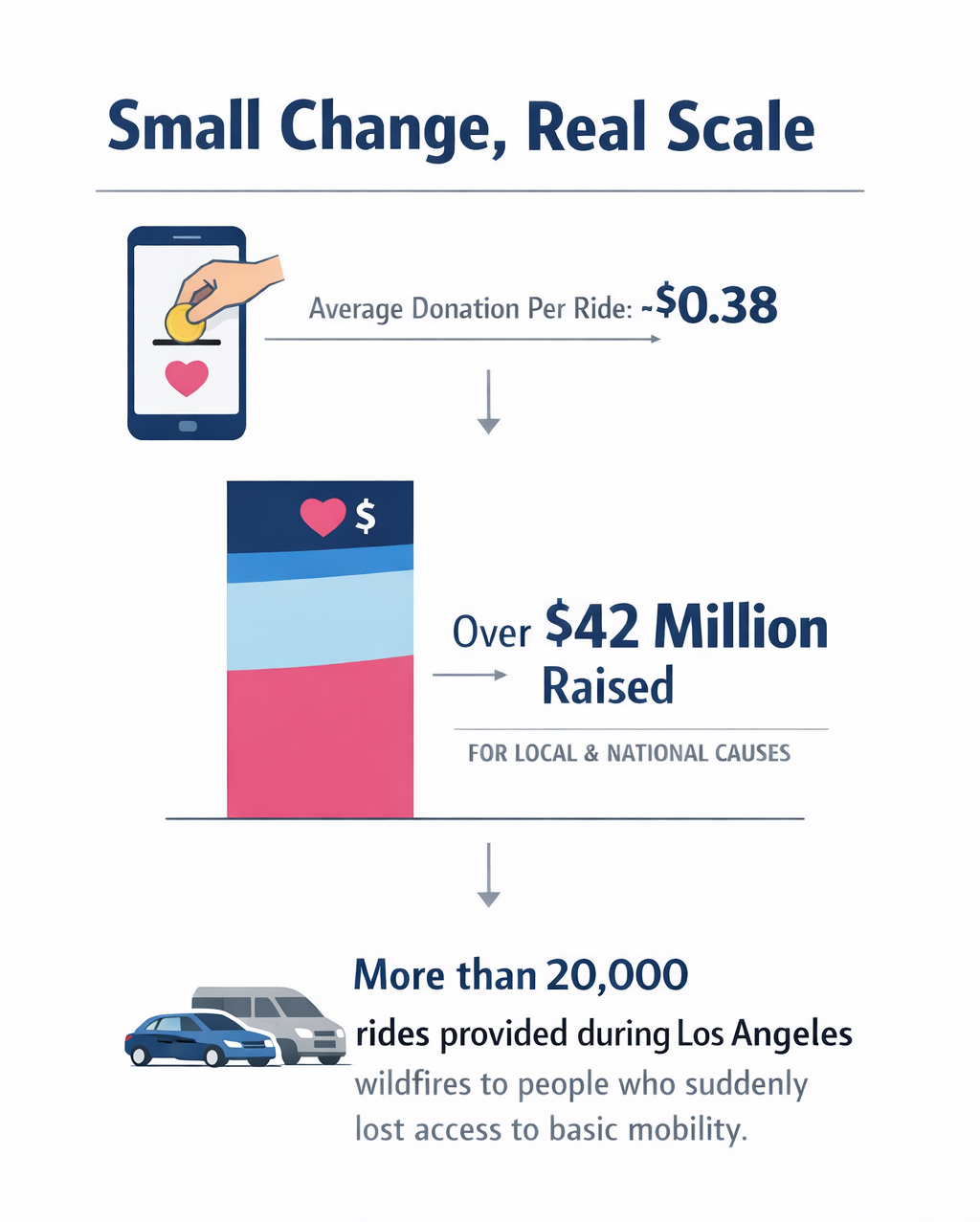
Lyft’s Round Up and Donate program is one of the most tangible examples of embedded social impact. Riders can round up each fare and donate the spare change to a curated list of nonprofits.
To date, the program has raised more than $42 million.
What makes that number notable is the average donation, roughly 38 cents per ride. It works because it is simple, voluntary, and consistent. On major moments like Giving Tuesday, Lyft has gone further, matching donations and even layering in personal matches from leadership.
Golden also shared experiments with localized giving, including pilots in Puerto Rico and Quebec, where riders support community based organizations directly connected to local needs like homelessness, healthcare, and the arts.
Disaster Response and Real World Impact
When disasters strike, transportation becomes urgent. Lyft’s disaster response program provides free and discounted rides during emergencies, from wildfires to severe weather events.
Earlier this year, Lyft activated the program during the Los Angeles wildfires, providing more than 20,000 rides to people who suddenly lost access to basic mobility.
Golden framed this work simply. Start with what you do best. Lyft moves people. In moments of crisis, that capability can mean access to shelter, medical care, food, or family.
Serving Older Adults and Vulnerable Riders
Another quiet but important innovation discussed was Lyft Silver, a product designed for older adults. Larger text, simpler interfaces, easier phone support, and family assisted payment options reflect a recognition that one size does not fit all.
Transportation access for seniors, people with disabilities, and those without smartphones is often overlooked. Golden made it clear that listening to these users has driven product changes, not marketing trends.
Looking Ahead
Golden’s goals for the coming years are pragmatic. Expand access. Grow awareness. Make sure policy keeps pace with technology without losing sight of people.
Transportation will continue to change. Automation, AI, and new mobility models will reshape cities. Lyft’s challenge, and opportunity, is to ensure those changes improve lives rather than fragment them.
Podcast Transcript Q&A
Q1: Jerry, how does someone become Chief Policy Officer at Lyft?
Jerry Golden: I did not follow a neat A to B plan. I landed in Washington, DC, knew I was interested in public policy, and started taking roles in advocacy and social impact. From there, one step led to the next. You learn how policymakers think, how to move issues forward, and you get better over time. That makes you enjoy it more, which pushes you into bigger responsibilities.
For Lyft, the timing was unexpected. I was not actively looking, but the opportunity came with a brand I already believed in. I was a Lyft rider, I understood the value proposition, and I was excited about the public good angle. I have been here about 15 months and it has been a meaningful journey so far.
Q2: What parts of Lyft fall under your policy function?
Jerry Golden: Policy can mean different things at different companies. At Lyft, you can think of it as three connected areas.
First is public policy and government affairs, how we show up with regulators and elected officials and help shape a system that works.
Second is social impact, which is not a side project here. It is tied to what Lyft believes its purpose is in communities.
Third is sustainability and the work required to keep a modern company aligned with where the world is headed.
I would also add that our policy lens is really driver advocacy and rider advocacy. We focus on the real world impact of decisions on drivers, riders, and the communities we serve. Not just good intentions.
Q3: How would you describe Lyft’s purpose in simple terms?
Jerry Golden: Lyft’s purpose is to serve and connect. A big part of that is helping people re engage with the world. We are living in a time when people can fall into isolated routines and digital bubbles. There is real value in helping people get out, show up in real life, and feel connected again.
That social connection is not a soft idea. It affects health, mental well being, and how communities function.
Q4: What are policymakers focused on right now when it comes to rideshare?
Jerry Golden: A lot of it comes back to affordability and access. Governments are under budget pressure, so you often see ideas like adding taxes or fees to rideshare. Sometimes it is treated like an extra service people do not really need.
Our job is to explain that rideshare is often basic infrastructure now. People use it to get out of transportation deserts, connect to public transit, reach work, groceries, healthcare, and even voting locations. If you price it out of reach, you are not just taxing convenience, you are limiting access to essentials.
We also spend time on unglamorous topics like insurance costs, because riders feel it in pricing and drivers feel it in demand. In a low margin business, costs show up quickly.
Q5: How does Lyft think about drivers in the policy conversation?
Jerry Golden: Drivers are often people who need flexible, supplemental income. Students, caregivers, people between jobs, people new to a city. Flexibility is not a talking point, it is the reason many drivers do this.
We spend a lot of time talking with drivers directly, hosting community events and listening to what they need. A common example is a caregiver who can drive for two hours during an appointment window, then needs to stop, but next week can work more. Our policies and advocacy work try to protect that flexibility while still improving support and stability.
Q6: Autonomous vehicles are coming. How is Lyft thinking about that shift?
Jerry Golden: I think autonomous vehicles are exciting, but the future will be hybrid for a long time. There is going to be a need for human drivers for a very long time, and that is not going away.
Our purpose stays the same, serve and connect. If AVs come onto the platform, the goal is still reliable rides, safety, and a good experience. We want to collaborate with partners and policymakers so the technology reaches its potential in a way that is safe and convenient.
There is also a trust element here. When rideshare first emerged, the idea of getting into a stranger’s car felt disorienting to many people. Lyft helped build regulatory frameworks and public trust back then. We see a similar responsibility with AVs now.
Q7: Where does Lyft fit in the AV ecosystem if it is not building the cars?
Jerry Golden: Lyft can be the partner that helps AV companies reach scale. We have built the marketplace, the in ride experience, safety layers, customer support, demand generation, and the product people already trust.
Partners look at Lyft and see millions of people using an app they know. That trust and distribution matters when you are introducing a new kind of mobility. We can help commercialize technology at scale through a familiar experience.
Q8: Lyft’s Round Up and Donate program has raised over $42 million. What makes it work?
Jerry Golden: It works because it is simple. Riders can opt in, then their fare rounds up and the change goes to a nonprofit. It is set it and forget it. People want to do good if you make it easy.
That $42.5 million is even more impressive when you consider the average round up is around 38 cents. Small amounts, repeated millions of times, add up to serious impact.
We also promoted it heavily around Giving Tuesday, and we layered in matching. Lyft matched the round ups, and our CEO David Risher matched too, which tripled the impact that day.
Q9: Can smaller, local nonprofits be included, not just the big national names?
Jerry Golden: We think about that a lot. There are a few ways we support local organizations today, especially through targeted partnerships and ride codes for specific initiatives or events. That is often city by city.
We also experimented with local nonprofit options in a couple places this year. In Puerto Rico, we launched Lyft service and offered smaller, Puerto Rico based nonprofits inside the donation experience. In Quebec, we did something similar with organizations focused on poverty and homelessness.
I cannot overpromise where it goes long term, but we are very aware that local nonprofits can see outsized benefit from these programs.
Q10: How do you split time between federal policy and state or local issues?
Jerry Golden: It varies, but often there is more state and local work simply because there are so many states and localities. Every level of government is dealing with rideshare because it has become a fundamental part of transportation in most places.
That said, there is real federal interest too, especially around safety, access, and affordability. Both levels matter, the workload just shifts depending on what is happening.
Q11: What does Lyft do in disaster response and emergency situations?
Jerry Golden: Disaster response is a point of passion for me and many on the team. We activated our disaster response program earlier this year and provided more than 20,000 free and discounted rides during the LA wildfires.
The philosophy is simple. Start where you are strong. Lyft matches people to the places they need to go. In a crisis, that can mean evacuation support, getting to shelters, getting to family, or reaching essential services when normal routines collapse.
Disasters also hit lower income communities hardest, so showing up with transportation support matters.
Q12: Beyond disasters, what other “Lift Up” social impact areas matter most?
Jerry Golden: Several categories come up often.
Jobs access, because a ride can be the difference between landing a job and losing the opportunity. We support rides to job training, interviews, and early weeks of work, often with partners like Goodwill and United Way.
Grocery access, healthcare access, and non emergency medical transportation, including partnerships that can support veterans hospitals and other systems.
Voting access, helping people get to the polls during major elections.
These are practical needs where transportation is the barrier.
Q13: You mentioned Lyft Silver. Why is that important?
Jerry Golden: Lyft Silver is designed for older adults who may have different needs. Bigger text, fewer options on screen, easier access to phone based support, and features that help adult children assist with payment or trip tracking.
We are trying to serve real people with real constraints, and when we hear consistent feedback, we build around it.
Q14: What is the hardest part of your job?
Jerry Golden: The relentless nature of it. The issues change constantly. It is rarely the exact same problem two days in a row. It might be a new twist on an old challenge, or an entirely new policy or technology issue.
You do not get to choose when the critical moment arrives. You have to be ready to show up when it matters.
That said, I also recognize the privilege. I work for a company I love, a boss I respect, and a team I learn from. Most people do not get that combination.
Q15: What are your goals for Lyft over the next few years?
Jerry Golden: Broadly, I want more people to have access to the service and understand it as an option. There are still many people who do not have the Lyft app or do not think to compare price and pickup times.
Growth matters, but so does quality. If we encourage people to use Lyft more, the experience needs to be strong, safe, reliable, and affordable.
Policy wise, the goal is alignment, making sure where the business is going matches where policy frameworks are going, and using our expertise to help policymakers get it right for riders and drivers as technology evolves.