Grove Collaborative: Business Case Study
Photo credit: Grove Collaborative
Key takeaways
- Grove Collaborative became the world's first plastic-neutral retailer in 2020, recovering over 17.2 million pounds of ocean-bound plastic by 2024.
- The company went public via SPAC merger in 2022 at a $1.5 billion valuation but faced declining revenue and operational challenges afterward.
- Grove pivoted from subscription-first to flexible purchasing in 2024, achieving first-ever positive EBITDA while maintaining 55.5% gross margins.
- Despite missing its 100% plastic-free by 2025 goal, Grove reset with a new target to avoid 15 million pounds of plastic waste by 2030.
- The company raised $498 million total from seed to public markets, demonstrating both the potential and challenges of scaling mission-driven commerce.
Grove Collaborative is one of the most ambitious experiments in mission-driven consumer commerce of the past decade. Founded in 2012, it started as a subscription delivery service for eco-friendly cleaning products and grew into a publicly traded company with a $1.5 billion peak valuation.
Along the way, it became the world's first plastic-neutral retailer, earned B Corp certification, and pioneered transparency tools no other retailer in the category had attempted.
Then it nearly fell apart.
From 2022 onward, Grove faced declining revenue, a delisting threat, an executive overhaul, and the painful acknowledgment that its flagship environmental commitment, 100% plastic free by 2025 — would not be met.
The company has spent the past two years rebuilding: operationally, financially, and strategically.
This case study covers the full arc.
The founding thesis, the growth decisions that worked, the ones that didn't, the financial turbulence after going public, and how Grove is attempting to rebuild as a leaner, more durable business without walking away from its core mission.
The Problem Grove Was Built to Solve
Walk into any conventional grocery store and the household cleaning and personal care aisle is almost entirely single-use plastic. Dish soap, hand soap, laundry detergent, paper towels, shampoo, nearly all of it packaged in virgin plastic that ends up in landfills or oceans.
The sustainable alternatives that existed in 2012 were either hard to find, more expensive, or both. The average consumer who wanted to live more sustainably had no easy path.
Natural brands were scattered across health food stores, specialty retailers, and early e-commerce sites. There was no trusted destination that did the curation work for them.
Stuart Landesberg, Chris Clark, and Jordan Savage saw that gap.
Their founding premise: build a direct-to-consumer platform that makes sustainable household products as convenient and affordable as conventional ones.
Remove the friction. Do the product vetting so customers don't have to. And make it a recurring experience, not a one-time purchase.
The founding insight was behavioral as much as environmental.
Most people don't switch to sustainable products because they don't know where to start. Solve the discovery and convenience problem, and you solve the adoption problem.
Origin Story: From ePantry to Grove Collaborative
The company launched in 2012 under the name ePantry. The initial concept focused on a subscription service delivering eco-friendly cleaning products and other household essentials. This direct-to-consumer approach was designed to make adopting sustainable habits more convenient.
The company secured initial seed funding of $675,000 in 2012. Significant funding rounds followed, including $1.4 million in April 2014 and $3.3 million in February 2015. A major rebranding to Grove Collaborative occurred in July 2016, coinciding with its launch as a Certified B Corporation and a $5 million Series A funding round.
The rebrand also introduced what would become one of Grove's most distinctive features: the Grove Guide. Each customer was assigned a personal shopper, a "Grove Guide" — who could answer questions and provide education on natural products. At its peak, nearly 50,000 customers per week were chatting, emailing, texting, and talking with Grove Guides.
This was expensive. It was also deeply differentiated.
The Growth Phase: Scaling the Mission
Between 2016 and 2021, Grove raised aggressively and grew fast.
In September 2019, Grove announced a $150 million Series D fundraise, pushing the company past a $1 billion valuation. The round was co-led by Lone Pine Capital, General Atlantic, and Glynn Capital, with participation from Greenspring Associates and existing investors including Norwest Venture Partners and Mayfield Fund. Total capital raised to that point exceeded $250 million.
In December 2020, Grove Collaborative raised $125 million at a $1.32 billion valuation.
Grove developed its own products under multiple brands, including Grove Collaborative, Seedling by Grove, Rooted Beauty, Honu, and Sustain, in addition to curating third-party natural brands.
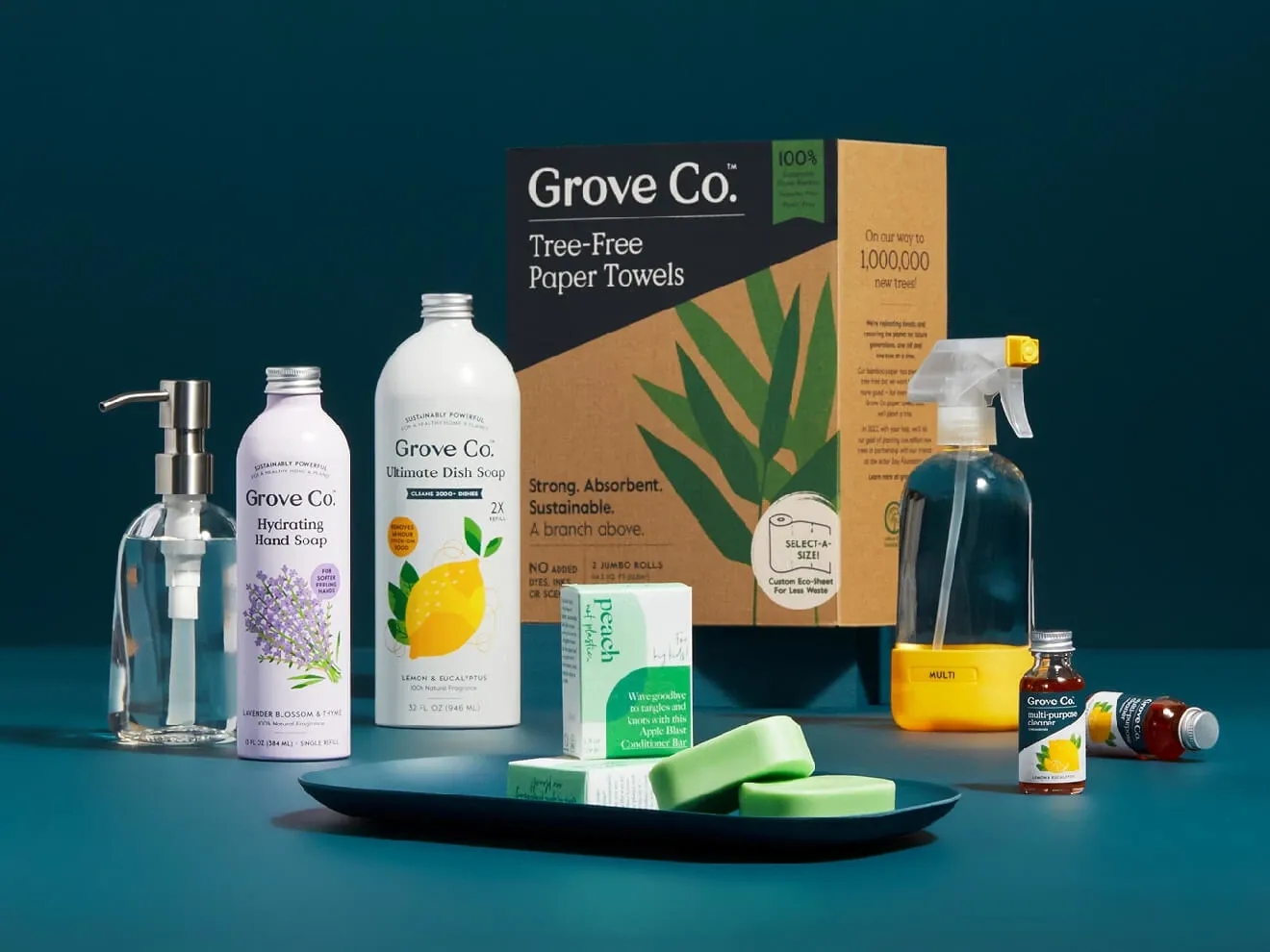
Innovations like one-ounce concentrated surface cleaners and a reusable glass laundry vessel used 70–95% less plastic than conventional alternatives. The company estimated plastic savings from these initiatives would reach nearly 1,000,000 pounds in 2019.
The subscription-first model drove strong repeat purchase metrics. Customers on recurring orders were predictable revenue. Product additions per order increased over time as customers discovered new categories.
The Target Partnership
In April 2021, Grove announced a brick-and-mortar partnership with Target. It was a significant strategic move, putting Grove Co. products on the shelves of one of the country's largest retailers gave the brand mainstream visibility it couldn't achieve through DTC alone.
In practice, it created operational complexity and, ultimately, a channel conflict Grove would later choose to exit entirely.
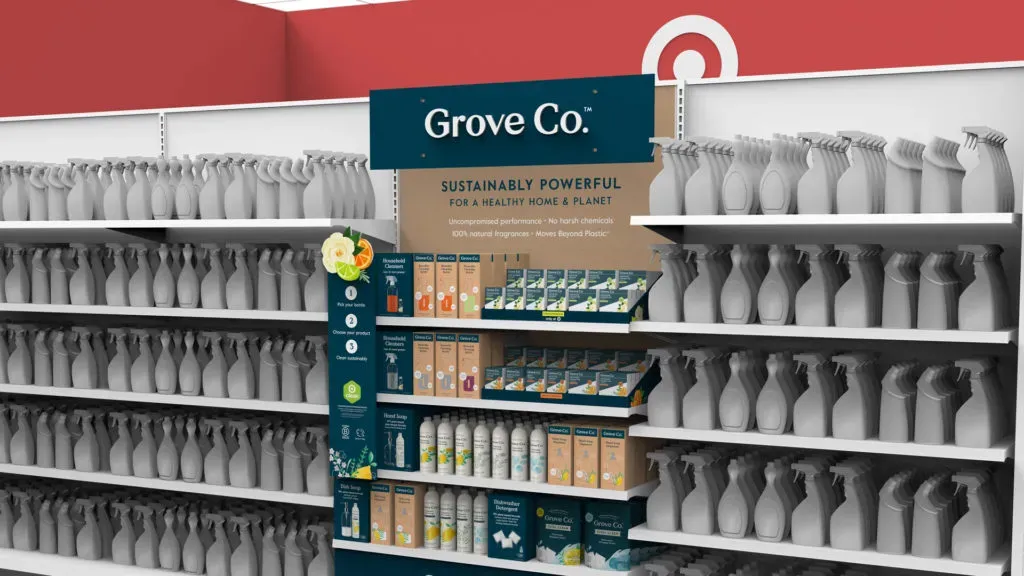
photo: AdWeek
Going Public: The SPAC Decision and What Followed
In December 2021, Grove Collaborative merged with a special-purpose acquisition company backed by Sir Richard Branson's Virgin Group. Unilever's former CEO Paul Polman was named as a partner in the venture.
At the end of 2021, Grove raised $436 million in capital through this process. The combined company listed on the New York Stock Exchange in June 2022 under the ticker GROV, with a valuation of $1.5 billion.
The company laid off 17% of its workforce soon after the Virgin SPAC merger, to cut operating costs. It was the first signal that the financial realities of a public company would force hard decisions that private investors had been willing to absorb.
The public market was not kind to Grove.
Revenue was declining as customer acquisition costs increased and the subscription model showed its ceiling. In late 2023, the company brought in Jeff Yurcisin, a former Amazon executive, as CEO.
His mandate was clear: get the company profitable before trying to grow it.
Funding History · 2012–2022
Grove Collaborative
From Seed to Public Markets
Round-by-round capital raised, cumulative funding, and SPAC IPO on NYSE
Total Raised - $498M
Peak Valuation - $1.5B
Went Public - Jun 2022
NYSE: GROV
The Business Model: How Grove Actually Works
Understanding Grove requires understanding the three layers of its business model and how those layers have shifted over time.
Layer 1: The Platform
Grove operates an e-commerce platform that serves as a one-stop online destination for sustainable everyday essentials. Everything Grove sells meets a higher standard, from ingredients to performance to packaging and environmental impact — so customers get a great value without compromising their values.
The platform now spans household cleaning, personal care, health and wellness, laundry, clean beauty, baby, and pet care products from over 240 brands.
Layer 2: Owned Brands
Owned brands represented approximately 41% of net revenue in 2024, with home care products making up 84% of that owned-brand segment.
The flagship is Grove Co., which covers cleaning, laundry, and personal care.
Acquisitions like Grab Green and 8Greens in early 2025 bolstered the eco-friendly product range and expanded Grove's focus to human health.
Owned brands carry significantly higher margins than third-party products.
They also give Grove direct control over packaging and formulation decisions, the levers that matter most for plastic reduction.
Layer 3: Fulfillment
Grove ships directly to customers from its own fulfillment centers. Since 2020, Grove measures and reports on full Scope 1-3 emissions and has carbon neutral offices, fulfillment centers, and customer shipping.
Every shipment is also plastic neutral through the company's partnership with rePurpose Global.
The Subscription Shift
As of the first quarter of 2024, Grove formally ended its subscription-first business model, making the platform more broadly appealing by offering more ways to buy and shop.
In an interview with Modern Retail, CEO Jeff Yurcisin framed the decision directly: "From my point of view, I wanted to enable subscription but I wanted to create an incentive for customers to subscribe — not to force them to subscribe."
This was a significant business model shift. It reduced the predictability of recurring revenue but broadened the top of the funnel considerably.
The Plastic Reduction Strategy: Ambition, Infrastructure, and Honest Accounting
Grove's sustainability program operates on multiple levels simultaneously and has maintained transparency, including about failures, that most public companies avoid.
Plastic Neutrality
Grove became the world's first plastic-neutral retailer in 2020, recovering over 17.2 million pounds of ocean-bound plastic by December 31, 2024, through its partnership with rePurpose Global.
By July 2024, the Grove community had avoided and recovered 24.5 million pounds of plastic, the equivalent of over 808 million standard water bottles.
This isn't a carbon offset-style accounting trick.
The recovered plastic is physically removed from environments where it would otherwise enter waterways or remain as pollution.
The Plastic Intensity Metric
Grove introduced a plastic intensity metric in their quarterly earnings reports, measuring plastic sold per $100 of revenue, an industry first.
The metric reached 1.05 pounds in 2024, down from 1.10 pounds in 2023. It tracks whether Grove is actually decoupling plastic use from business growth, not just reporting raw totals.
The Beyond Plastic Impact Tracker
In July 2024, Grove launched the Beyond Plastic Impact Tracker, an exclusive tool that discloses the personalized plastic savings in each order and over a customer's lifetime, to engage customers more directly in the fight against single-use plastic waste.
Environmental Impact · 2020–2024
Decoupling Revenue
from Plastic
Plastic intensity score, ocean-bound plastic recovered, and progress toward the 2030 avoidance goal
Plastic Neutral Since - 2020
Plastic Recovered - 17.2M lbs
2030 Avoidance Goal - 15M lbs
2024 Intensity Score - 1.05
Plastic Intensity Score
Sources: Grove Collaborative Sustainability Reports 2022–2025, quarterly earnings releases (GROV). Plastic intensity = lbs of plastic sold per $100 net revenue, reported publicly by Grove. Recovered plastic via rePurpose Global partnership. 2024 annual figures; quarterly data estimated from available disclosures. "Avoided" plastic measures orders with reduced single-use plastic vs. conventional alternatives.
The Failed 100% Plastic Free Commitment
In 2020, Grove set a public goal: 100% plastic free by 2025. In July 2024, the company acknowledged it would not meet it.
In an interview with Packaging Dive, Grove's Director of Sustainability Alexandra Bede was direct about the systemic barriers:
"The biggest barriers to us not hitting our 2025 goal was that we simply need more brands, companies, and industries to prioritize plastic reduction for plastic-free to be feasible... without government or regulatory intervention in the form of legislation, there are no incentives for companies to be more sustainable and virgin plastic will always be the cheapest available material."
Specific technical barriers included pumps for spray bottles and dispensers, where plastic-free versions exist but can be expensive; cleaning product containers where formulas interact with aluminum, necessitating a small plastic liner; and laundry and dishwasher pods, many of which are enclosed in polyvinyl alcohol (PVA).
Grove's response was to reset, not retreat.
The new commitment: avoid 15 million total pounds of single-use plastic waste — the equivalent of 495 million standard water bottles, from entering the environment between 2020 and 2030, while maintaining plastic neutrality.
By mid-2024, the company was already more than halfway to that goal.
The B Corp recertification in 2024 came with a score of 100.9 points.
The average B Corp scores around 50.
Science-Based Targets
In May 2025, the SBTi approved Grove's Science-Based Targets, committing to a 42% reduction in Scope 1 GHG emissions by 2030, aligned with the goals of the Paris Agreement.
Financial Trajectory
Enjoying this? Get the next one.
We send one email each Monday with what just published on Causeartist.
Free. Unsubscribe anytime.
Grove's financial history is a story of raising capital to build scale, then discovering that scale without profitability has limits.
According to Grove Collaborative's latest financial reports, the company's trailing twelve-month revenue is $0.18 billion as of February 2026, with 2024 revenue of $0.20 billion. CompaniesMarketCap
Financial Performance · 2020–2025
Revenue Contraction,
Margin Expansion
Peak Revenue- $384M
2024 Revenue - $200M
2024 Gross Margin - ~55%
First Positive EBITDA - 2024
Grove fully eliminated its $72 million term debt by making a $30 million prepayment in Q4 2024, leaving only $7.5 million under an asset-based loan facility. The company achieved full-year positive adjusted EBITDA for the first time in its history, marking a significant pivot towards financial stability.
Gross margin reached 55.5% in Q1 2024, improving 110 basis points sequentially and 350 basis points year-over-year.
The story is a company that was once burning capital to chase growth now posting positive operating cash flow, no meaningful long-term debt, and improving margin structure.
Revenue is smaller. The foundation is sturdier.
The Retail Exit Decision
One of Yurcisin's most consequential moves was exiting brick-and-mortar retail entirely.
After more than three years in the channel, Grove announced in Q3 2024 that it was exiting brick-and-mortar retail partnerships, with plans to sell existing inventory through early 2025.
Grove will continue expanding its flagship brand, Grove Co., as an exclusive for direct-to-consumer channels.
The aspiration Yurcisin articulated was direct:
"In the same way Chewy went after a certain segment... there are so many players out there that are carving out a niche.
We believe it's a 57 million person addressable market in the United States, customers who bought natural products, who care about human environmental health. And we're going to serve them."
In retail, Grove was one SKU among hundreds.
No customer data from the transaction, limited merchandising control, compressed margins. The DTC customer orders more frequently, buys across more categories, and has higher lifetime value.
The Tech Stack Overhaul
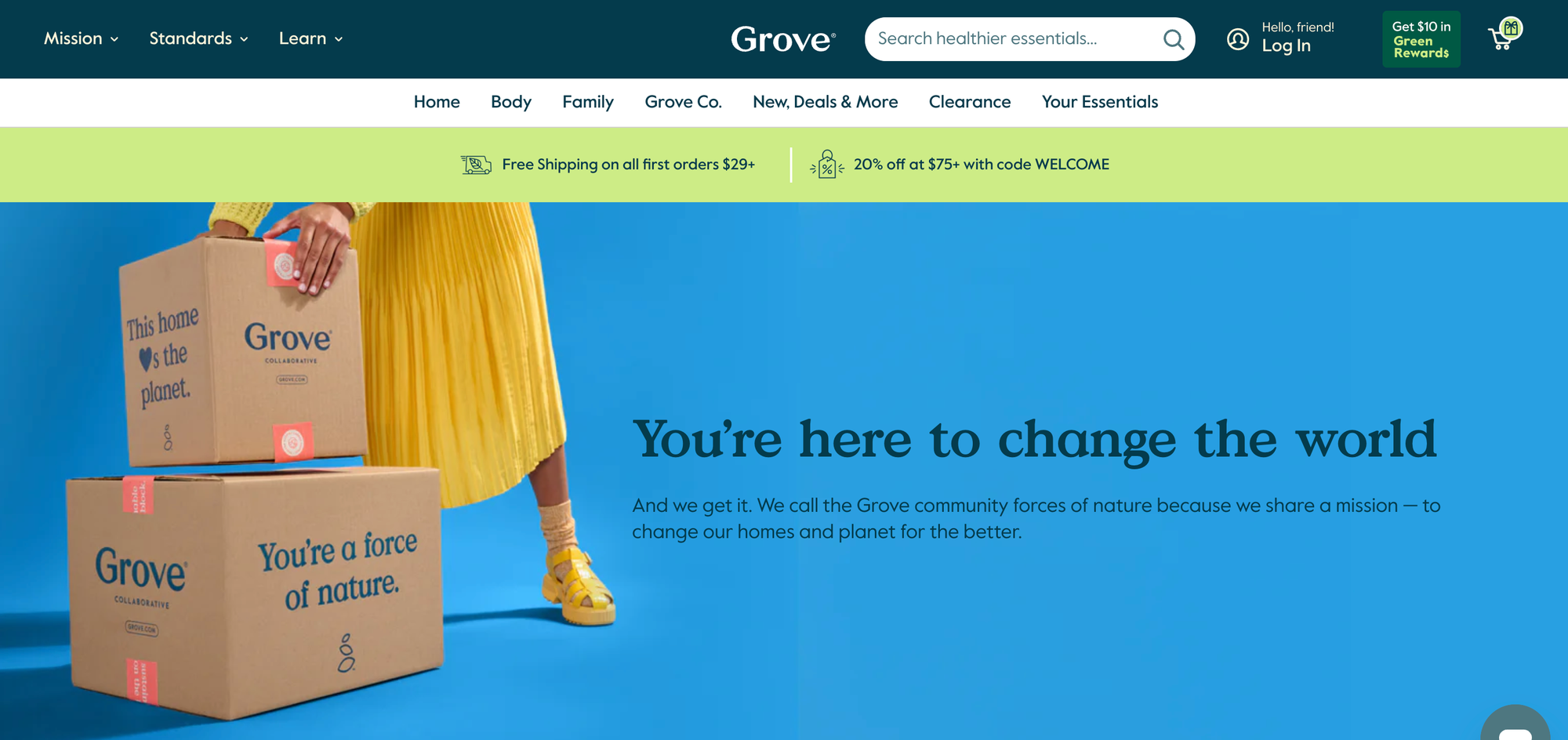
For most of its history, Grove ran on a proprietary e-commerce platform built in-house. When the company was founded, building a custom platform made sense.
But the third-party ecommerce ecosystem became much more sophisticated, with Shopify in particular focusing on enterprise and making significant progress on customization, services, and support.
The company initiated the migration to Shopify in July 2024, with the full migration completed in Q1 2025.
The move was operationally sound. Maintaining a proprietary platform at Grove's scale consumed engineering resources without adding competitive advantage.
The migration freed that capacity and gave the company access to a more mature ecosystem of integrations.
It also signals something strategic: Grove is no longer trying to be a technology company that sells sustainable products. It's a brand and curator that runs on best-available infrastructure.
Challenges and Constraints
Several things deserve honest assessment.
The subscription ceiling was real. The subscription-first model drove retention but limited the addressable market. Customers who weren't ready to commit to recurring orders had no good entry point. The fix was right, but it took years longer than it should have.
The retail channel bet underperformed. The Target partnership looked smart in 2021. It added complexity without materially improving the business. The exit was correct; the three-year detour was expensive.
The 2025 plastic-free commitment was set without verifying supplier ecosystem readiness. The goal drove innovation and industry engagement. It also made a public promise that depended on third-party transformation outside Grove's control. Ambitious goals are valuable. Promises that require coordinated industry action need more careful scoping.
The SPAC timing was poor. Merging into public markets in June 2022 during a market contraction, after ESG enthusiasm had already faded, handed Grove a $1.5 billion valuation it couldn't sustain. The immediate post-merger layoffs made the financial gap visible immediately.
Revenue is still declining. The company faces significant risks, including ongoing revenue declines, with projections for full-year 2025 indicating a mid-single-digit to low double-digit percentage decrease year-over-year.
And in August 2025, shareholder pressure led the board to agree to evaluate strategic options, including a potential sale or merger.
Competitive Positioning
Grove operates in a market with multiple forms of competition.
Amazon is the dominant threat. Amazon sells sustainable products from many of the same brands Grove carries. The difference: Amazon does not curate, vet, or stand behind environmental claims. Grove's value proposition is the curation and trust layer Amazon cannot provide at scale.
Thrive Market is the closest strategic comparison — a membership-based DTC platform for organic, natural, and sustainable products. Thrive focuses heavily on food; Grove is household and personal care. The core thesis is similar; the categories diverge enough that they aren't direct substitutes for most customers.
Conventional retailers carry sustainable product assortments but don't specialize. The customer who shops at Grove is not the same customer who picks up a Method soap at Target because it happened to be on an end cap.
Individual sustainable brands (Blueland, Branch Basics, Dropps) compete for the same customer but require managing multiple relationships. Grove's bet is that the single-destination platform is worth more than any individual brand relationship.
The 57 million conscious consumer addressable market, customers who have already demonstrated willingness to buy natural and environmentally-friendly products, is the clearest articulation of Grove's actual target: not the eco-curious general consumer, but the already-converted who want to do it better and more conveniently.
Key Lessons for Impact Entrepreneurs
Set ambitious commitments, but verify ecosystem readiness. The 100% plastic free goal drove innovation and engagement. It also promised an outcome that depended on supplier ecosystem transformation outside Grove's control. Ambitious goals are valuable. Public promises that require coordinated industry action need careful scoping upfront.
Transparency compounds. Every quarterly plastic intensity report, every honest update, every public acknowledgment of a missed goal built credibility that polished sustainability marketing could not replicate. The 100.9 B Corp score is the result of years of documented practice.
Mission alignment and margin alignment are not opposites. Grove's highest-margin revenue comes from owned brands with the lowest plastic footprint. The financial case for the mission is built into the unit economics.
The subscription ceiling is real in consumer products. Recurring revenue is valuable, but mandatory subscription as the only entry point limits the addressable market. Incentivized subscription gives Grove a larger top of funnel without abandoning the retention economics.
Proprietary infrastructure has a shelf life. Building a custom e-commerce platform made sense in 2012. By 2024, it was a drag. Invest in differentiation where it matters, product, mission, curation — and buy commodity infrastructure rather than build it.
Channel strategy matters as much as product strategy. The Target partnership looked like distribution expansion. It turned out to be a distraction from the core DTC relationship that drives actual value. Being everywhere is not the same as serving your customer well.
Conclusion
Grove Collaborative has been tested in nearly every way a company can be tested — by capital markets, by sustainability commitments, by a changing retail environment, and by its own ambitions.
It has made genuine progress on problems most consumer brands ignore. It has also made real strategic mistakes, been honest about them, and kept operating.
The current version of Grove is leaner, more financially grounded, and more focused than the $1.5 billion version that hit public markets in 2022.
Whether it becomes the sustainable household products platform it aspires to be, gets acquired, or continues to contract, that remains open.
What's not open: the company has built real infrastructure. A plastic neutrality program backed by third-party verification. A curation standard covering 3,000+ products. A decade of credibility built through public accountability. A loyal customer base that self-selects for mission alignment.
For impact investors, founders, and operators watching, Grove is a full-spectrum case study in what it actually takes to run a mission-driven consumer business at scale: not just the mission, but the margin, the model, the mistakes, and the willingness to keep rebuilding.
FAQ
What made Grove Collaborative unique in the sustainable products market?
Grove differentiated itself through three key innovations: becoming the world's first plastic-neutral retailer, offering personal Grove Guides for customer education (serving nearly 50,000 customers weekly at peak), and introducing industry-first transparency tools like plastic intensity metrics in earnings reports. The company also developed concentrated products that used 70-95% less plastic than conventional alternatives.
Why did Grove Collaborative struggle after going public?
Grove faced multiple challenges post-IPO: declining revenue as customer acquisition costs increased, the subscription model hitting its growth ceiling, operational complexity from the Target partnership, and the financial discipline required by public markets. The company laid off 17% of its workforce soon after the SPAC merger and brought in a new CEO in late 2023 to focus on profitability over growth.
How does Grove's plastic neutrality program actually work?
Grove partners with rePurpose Global to physically remove ocean-bound plastic from environments where it would otherwise enter waterways. This isn't carbon offset-style accounting - the recovered plastic is actually removed. The company also tracks plastic intensity (pounds per $100 revenue) and provides customers with personalized plastic savings data through their Beyond Plastic Impact Tracker.
What was Grove's business model transformation in 2024?
Grove ended its subscription-first model in Q1 2024, shifting to flexible purchasing options to broaden customer appeal. CEO Jeff Yurcisin explained they wanted to 'enable subscription but create an incentive for customers to subscribe—not force them.' This reduced recurring revenue predictability but expanded the customer funnel and helped achieve the company's first positive EBITDA.
Why did Grove fail to meet its 100% plastic-free goal?
Grove's sustainability director cited systemic barriers: lack of industry-wide prioritization of plastic reduction, absence of regulatory incentives making virgin plastic always the cheapest option, and technical challenges like spray bottle pumps, formula-aluminum interactions requiring plastic liners, and laundry pods using polyvinyl alcohol. The company reset with a new 2030 goal to avoid 15 million pounds of plastic waste.
More Case Studies
Browse all
Photo credit: Who Gives A Crap, modified by Causeartist
Photo credit: Oatly, modified by Causeartist

Photo credit: Blueland, modified by Causeartist

Get the Monday roundup
New companies, funders, stories, podcasts, and case studies — one email a week.
Join 25,000+ Causeartists
Free. Unsubscribe anytime.